
Urban sociologist and geopolitical commentator
Japan-Türkiye Hedging Tests India’s Indo-Pacific Bet, Greece Anchors Stability
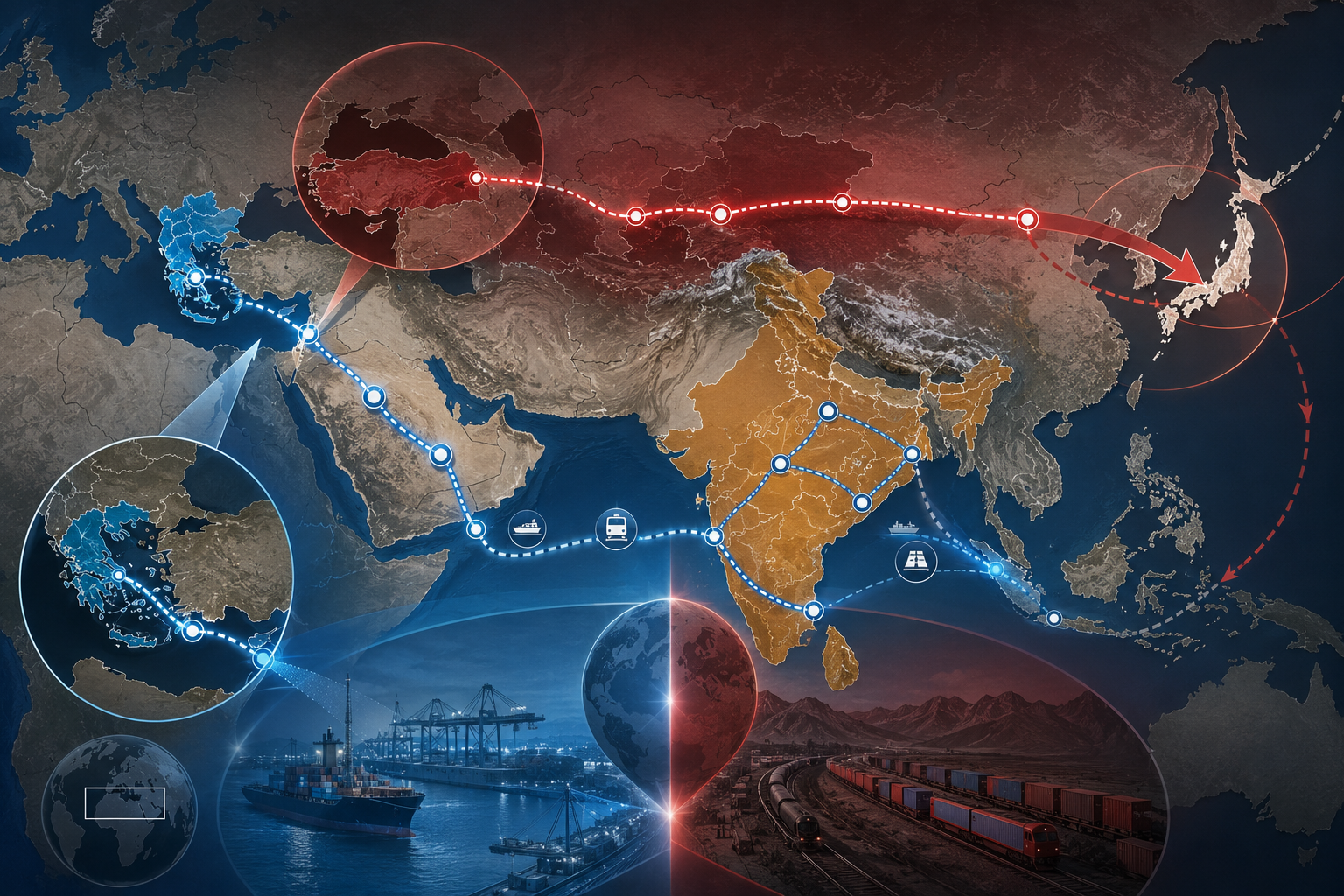
Japan-Türkiye Hedging Tests India’s Indo-Pacific Bet. An AI Illustration.
A recent article suggested that Japan may cultivate Türkiye as a “secondary strategic pillar”, raising the more important question of whether such “hedging” is compatible with the long-term partnership India expects from Japan. The key issue is whether such a relationship reflects interest-based hedging, revisable, low-commitment, and functionally bounded, or identity-congruent alignment, which is more durable, harder to reverse, and carries obligations that outlast the interests that first created it.
A theoretical scaffold
Three bodies of work are useful here.
Hedging theory. Kuik Cheng-Chwee’s (2025) distinguishes hedging from balancing and bandwagoning by its deliberate ambiguity. Kuik Cheng-Chwee and, separately, Jürgen Haacke & John D. Ciorciari (2019; 2022), further note that hedging sits on a spectrum from “risk-contingency” behaviour (insurance against a low-probability but high-cost scenario) to “return-maximizing” behaviour (opportunistic diversification for gain). Japan courting Türkiye, on the continental-connectivity logic the Hudson piece describes, reads as return-maximizing hedging: a bet on Eurasian corridor economics, not a hedge against U.S. abandonment.
The alliance security dilemma. Glenn H. Snyder’s (1984) holds that allies face a permanent trade-off between fear of abandonment and fear of entrapment. Applied here, the risk to India is not that Japan abandons its own alliance commitments; it is that India could be exposed to entrapment by proxy. If Japan’s connectivity partnership with Türkiye deepens, and Türkiye’s own commitments, to Pakistan on defense sales, to the OIC bloc’s position on Kashmir, remain active, India absorbs a diplomatic externality it did not generate and cannot easily price out, simply by virtue of sitting adjacent to a partner (Japan) that is now transacting with a partner of a rival (Pakistan). This is not entrapment in Snyder’s original sense of being pulled into war; it is a softer, but real, version: reputational and diplomatic drag transmitted through a third party.
Lattice versus hub-and-spokes. Michael Green and Daniel Twining’s (2008) and Matteo Dian’s (2019) studies on the evolving architecture of Asian security describes a shift from the old American “hub-and-spokes” model (Washington bilaterally linked to each ally, allies weakly linked to each other) toward a “lattice” of overlapping minilateral and bilateral ties. A networked (or lattice-like) alliance architecture is generally considered more resilient than a traditional hub-and-spokes system because redundancy and multiple pathways for cooperation reduce dependence on a single central node (Wilkins 2022; Sambasivam et al. 2024). But a lattice only delivers that resilience if its individual strands are functionally compatible: if the partners a given node adds do not actively work against the interests of its other nodes. This logic is consistent with Snyder (1997) and Victor Cha (2016), who both emphasize compatibility of interests as fundamental to alliance networking. A Japan-Türkiye strand and an India-Japan strand can coexist inside a lattice only if Türkiye’s other commitments do not corrode the trust the India-Japan strand depends on.
Why Japan’s transactionalism is not the problem
Eric Heginbotham and Richard Samuels’ (1998) concept of Japanese mercantile realism explains why a Japan-Türkiye relationship is less risky than it may appear. Japan’s post-war strategy has consistently prioritized economic statecraft and technological leverage over ideological alignment, making a Türkiye partnership based on Eurasian connectivity and chokepoint economics a functionally bounded and revisable commitment. This logic underpins Japan’s simultaneous engagement with Gulf states, China, and India without requiring exclusivity. Precisely because such commitments are transactional and shallow, they can be recalibrated if they begin to generate friction with higher-priority partners such as India.
Why Türkiye’s non-transactionalism is the actual variable
The source of friction is not that Japan hedges, but that it may hedge toward a partner whose foreign policy is less transactional. Türkiye’s foreign policy under the AKP has been interpreted by Ibrahim Kalin (2012) and scholars such as M. Hakan Yavuz (2022) through the lenses of neo-Ottomanism and strategic autonomy, emphasizing civilizational identity, leadership within the Islamic world, and independent great-power aspirations. Consequently, Türkiye’s ties with Pakistan, expressed through OIC solidarity, support on Kashmir, and broader Islamic identity politics, are embedded in a normative framework that is costlier to revise than purely commercial relationships.
In hedging-theory terms, Türkiye is a less suitable hedging partner because its external commitments are shaped more by identity and values than by revisable, return-maximizing calculations. Consequently, Japan’s typically transactional and elastic approach contrasts with Türkiye’s comparatively inelastic commitments. A partnership between the two can, therefore, transmit Türkiye’s strategic rigidities across Japan’s wider network, including to India.
Implications for Indo-Pacific architecture
If Japan deepens continental ties with Türkiye, the key consequence is unlikely to be any rupture in the U.S.-Japan alliance but rather a geographic bifurcation of Japan’s strategic focus between a maritime Indo-Pacific pillar anchored in the Quad and a continental Eurasian-connectivity pillar spanning Central Asia, the Caucasus, and Türkiye. While these tracks are compatible, they compete for Japan’s finite diplomatic, defense-industrial, and financial resources, reducing the incentive to close the asymmetry in the India-Japan relationship by elevating India from a developmental and manufacturing partner to a truly co-equal strategic one.
India-Greece as the assured tier: an ontological-security argument
Rather than contesting Japan’s choices, India should strengthen partnerships that are less vulnerable to transmitted strategic risk. Here, the constructivist concept of ontological security, developed by Jennifer Mitzen (2006) and Brent J. Steele (2008), is more useful than pure interest calculation. Ontological security concerns a state’s need for a stable sense of identity and role; partnerships grounded in mutual recognition are therefore more durable than those based solely on shifting interests.
India and Greece exemplify this on three counts. First, threat-perception symmetry: Greece’s concerns over Turkish revisionism and India’s concerns over Pakistani revisionism, reinforced by Turkish support, are structurally parallel, creating durable strategic empathy. Second, institutional embeddedness: Greece’s position within the EU’s Common Security and Defence Policy and NATO provides India indirect access to the emerging European strategic-autonomy framework. Third, low normative overhead: unlike India-Japan ties, which retain developmental asymmetries, or India-Türkiye ties, burdened by Pakistan and Kashmir, India-Greece cooperation begins from a comparatively clean slate.
In hedging terms, this is not risk-contingency hedging against Türkiye but identity-congruent alignment, a stable foundation within India’s diversification portfolio amid the more elastic, transactional relationships that partners such as Japan will continue to pursue.
An asymmetric hedging thesis
The argument is not that Japan is drifting from India or that Türkiye is inherently problematic, but that transactional hedges can transmit risk when linked to partners with identity-anchored commitments. India should therefore interpret Japan’s engagement with Türkiye through the same multi-alignment lens it expects for itself, while treating the India-Greece partnership as the stable anchor of its diversification strategy, grounded in ontological security and institutional embeddedness rather than relationships that may shift with changing strategic priorities.
Related Topics