
And yet, it moves.
Jerusalem, and One Strip of Bacon
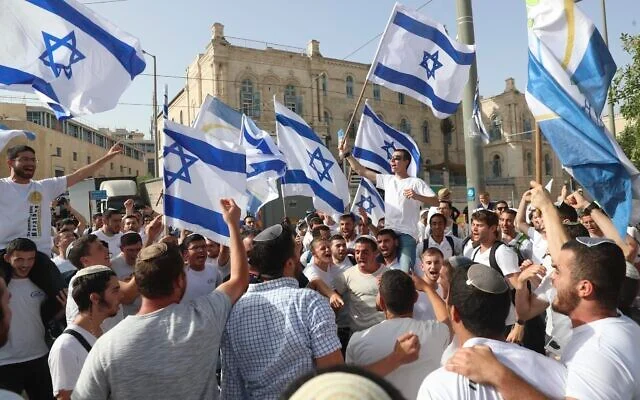
A scene from a previous flag march in 2021. (AP Photo/Ariel Schalit)
Twelve trashy bars and three shuls around the corner from one another. Folk dances at Safra at 1 a.m. on Yom HaAtzma’ut, with folks who dance 30 years younger than they walk. Aricha Sabich on a Friday, or a Tuesday, or whenever. A bar which sells most of its chametz on Pesach, but not all, so that folks who still need their prohibited libation can find it. Jerusalem is many things, and it is no less any of them than it is all of them.
Jerusalem is Jerusalem because it holds all of these experiences, languages, religions, political diversity, and of course, people at the same time, in a city that has been born and reborn over the last 3,000 years. That charm holds a lot of weight as well. It’s why I’ve never seriously considered moving in the 12 years I’ve called Israel home; no city feels like Jerusalem. And that charm is cause for celebration.
But what kind of celebration?
When I was in yeshiva, we attended the flag march on Jerusalem day without any hesitation or reservation. As fun as it was, even then, I was uncomfortable with the distribution of stickers and shouting of slogans which, in my mind, stood in opposition to menschlichkeit, human decency. I hadn’t yet seen the vandalism or violence which comes up, on an annual basis, as part of the march.
When the next year I wrote about how I saw the march as a vehicle for chilul Hashem, desecration of the Name of God, I was met with opposition and hateful comments. But many who weren’t showing hate presented another side: the accusation was unwarranted, because the vast majority of folks do not commit vandalism or act violently during the march. A small portion should not affect our view of a full picture.
As a person who wants deeply to celebrate Jerusalem, this logic seems somewhat convincing. But as a religious Jew who knows a bit of Halakha, I know it can’t be. When we have a mixture of something prohibited and something permitted, most people know that the majority determines permissibility, as long as the prohibited item is a significant, negligible minority of the mixture, which sounds like our case.
But mixtures are only permitted if they happen in an unpredictable way; one cannot intentionally mix a few ounces of bacon into a pot, despite it being negligible. And even when unintentional, if the prohibited item can be tasted, and has influenced the flavor in a way one can notice, or if the item retains its character, the mixture is invalid. One strip of bacon, then, is reason to consider a whole pot invalid.
If we are to have marches and parades and celebrations, they must be without the prohibited behaviors that, besides being a stain on our religious and Zionist communities, at their most basic, harm human beings created in the Image of God. The behavior of a few, while it does not say much about the behavior of the mass, is reason enough to consider how we go about our celebrations, if year after year the same prohibited mixture occurs. We cannot say it is unpredictable; we cannot say it is not noticeable; we cannot say it gets lost in the crowd.
At the very least, it behooves our community to ask the question of how to better celebrate the miracle and the wonder that is Jerusalem, and what action can be taken to ensure that our celebrations do not come at the expense of others. We would not accept this kind of mixture in our kitchens, we should not accept it in our streets.
If you’re interested in joining religious Zionist conversations on how to hold our community to higher standards, and how we can meet issues like this one, please consider subscribing to “State of the Movement,” a new podcast confronting ideology, education, history and politics within the National Religious Zionist Movement in Israel, and the hard questions facing it in this current moment. Our first episode with Rabbanit Nechama Goldman Barash launched this week, and touches on our experiences of the celebrations of Yom Yerushalayim, and thinking about how to celebrate in a manner which is more considerate of others. We look forward to sharing more conversations and reflections.
Yom Yerushalayim Sameach, to all who love Jerusalem enough to preserve the love which others have for it.
Related Topics
Related Posts