Jerusalem: Between the Bible and the Bulldozer
In this blog post, I attempt to unravel my complex relationship with the world’s most misunderstood city. It took several rewrites, and yet, so much remains unsaid.
Seeing is believing, but living here is a different voyage altogether.
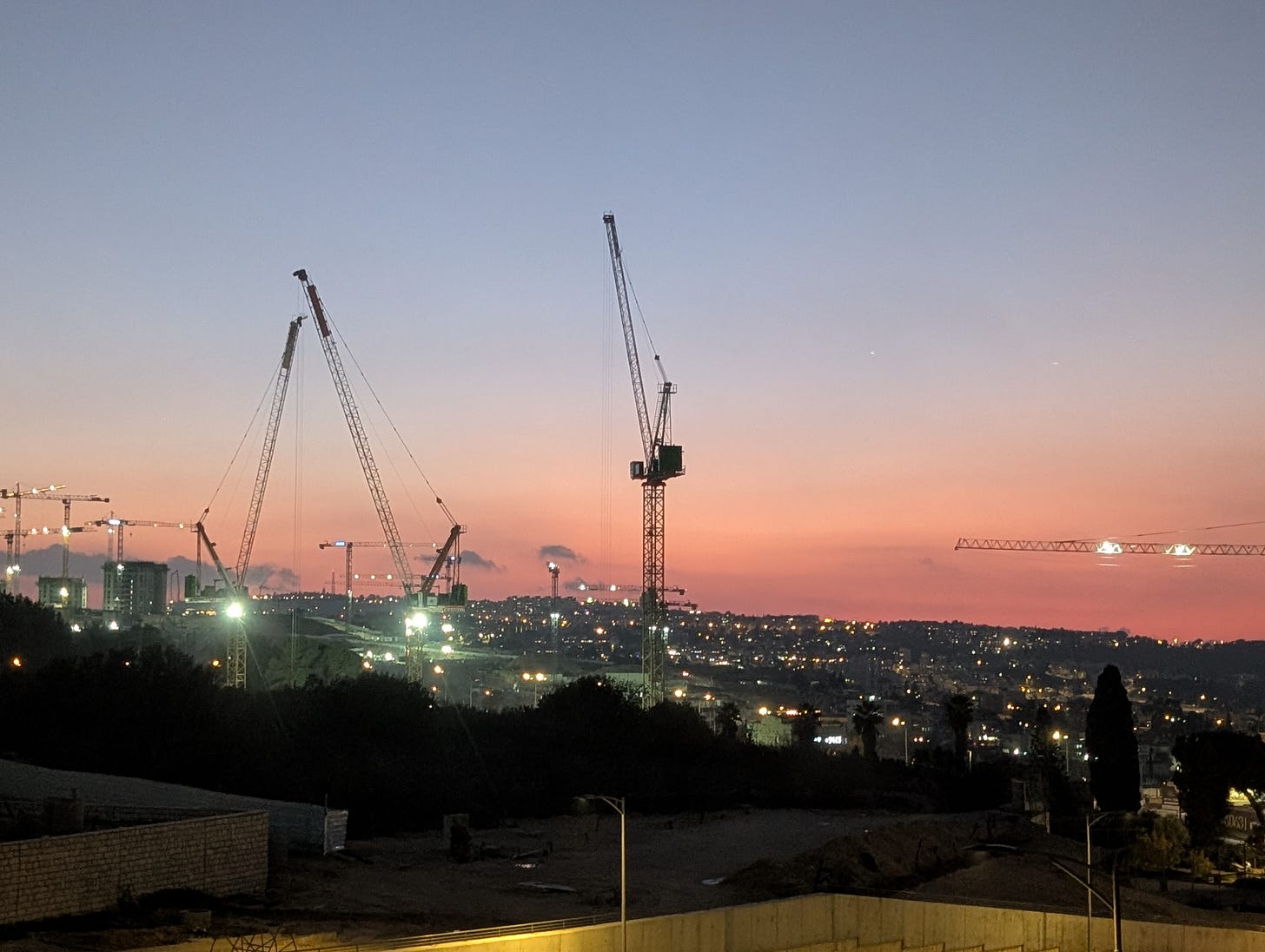
Despite the constant reminders, I sometimes forget that I live in an ancient biblical city. I guess it’s the cranes. There are masses of them. Wherever I go, there they are—practically blocking the skyline.
It’s contradictions like these that make my mind swirl. This place maddens me—but we are strangely inseparable. For newcomers, there is no ‘welcome’ mat anywhere to be seen. It makes no difference if you have lived elsewhere in the country; anyone starting out here will bear the same telltale deer-in-the-headlights look. It might not ever leave them. My parents, who have recently moved to Jerusalem after over a decade in the center of the country, describe it as “another planet.”
The first year I lived in the city, it was the mid-nineties. I was pregnant with my firstborn son. I would ride the bus to learn Hebrew at ulpan. I always got a seat—that was about the only plus of my commute. As the bus lurched from one neighborhood to the next, I observed the passengers who yelled and gesticulated at each other (and sometimes even at me), apparently stuck in one never-ending heated argument. I couldn’t have told you what about. I could barely read Hebrew at the time, so how could I track the trajectory of a row?
Back then, each day I asked myself the same question: what the hell was I doing in this city? Surely there was somewhere quieter and calmer to raise a family, somewhere that didn’t sap all my energy just to keep my feet on the ground.
In my life, I have seen a lot of cities. Some of them are so streamlined and elegant I want to go mad. Why can’t I live in a city like that, I ask myself. They proudly show off carefully preserved architectural delights, meticulous planning, vision, and foresight—a timeline that’s easier to follow than this one, which heaves backwards and forwards like a mad seesaw.
Yes, my city is paved with history. Jerusalem tells its stories in ancient scrolls hidden in hillsides. It’s a whirlwind of conquerors and conquests, battles, sieges, massacres, occupations, crosses, crescents, and, of course, walls. The fault lines and borders are invisible to tourists but all too apparent to its inhabitants. It has neighborhoods and ghettos, villages swallowed by suburbs swallowed by commercial centers. Stores open and close in quick succession, as do roads. You will wake up one morning and find your U-turn sign replaced with one for a one-way street. Things move so fast you barely have time to catch your breath. No, there is no constant in this ancient place other than change—and stone, lots of it.
Backwards and Forwards
I live in a city that barrels forward but somehow never loses track of its past. During my on-off thirty-two years here, approximately 140,000 housing units have appeared. Small enclaves have morphed into giant neighborhoods, and bare hilltops have been savagely razed and colonized by apartment buildings, community centers, shopping districts, and parks. After a car accident, my total-loss Toyota came to rest in a salvage yard on Givat Hamatos (literally “Aeroplane Hill,” apparently named after a KLM cargo flight that crashed there in 1951). That area is now under massive construction for a new neighborhood. I wonder where my car went.
New roads tunnel their way through every corner of the city. But before any building starts, there’s a compulsory inspection for archaeological remains, of course. When you see the canopy of an archaeological dig on an empty lot, you can safely assume that building work will begin within a year or two. In both instances, we’re making history.
And babies are born. Lots of them. Jerusalem houses several large hospitals, each with spacious maternity wards. Despite soaring costs, apartments are purchased and rented. You have to believe in miracles to live here.
Old and new sit side by side. The lower the building, the older it is; the taller, the newer. Municipal planning policies once pushed buildings to stick to a modest height. The one I live in (fifteen stories—God help me) used to be considered among the tallest in the city. Demographics have since dictated otherwise. New twenty-story towers spring up like mushrooms. Visitors who haven’t been here for a year or two drive around mystified, unable to recognize anything or choose the right exit at a new traffic circle.
Stone Is Subtle
But one thing that unites all of this is stone.
During the period of the British Mandate, a law was introduced to preserve the ancient character of the city: all buildings had to be faced with local stone. Towers, office buildings, municipal projects, and luxurious hotels now blend seamlessly with ancient landmarks. My God—even the Montefiore windmill is built with the stuff. Strip away the thin veneer and it’s all brick, glass, and steel underneath. But the stone cladding works flawlessly, like an application of foundation to disguise wrinkles and ugly red marks.
There is something about stone that reassures. It doesn’t chip, discolor, or age. It allows Arabs, Jews, and Christians alike to share something we know won’t be changing any time soon. For a brief moment, the Mamila Shopping Mall, the Old City Arab Bazaar, and the Via Dolorosa all meld into one.
Jerusalemites are reminded of ancient times, when giant blocks of stone, several feet high, were dragged into the city from nearby quarries to build the First and Second Temples.
When the Friday afternoon sun makes its slow descent and Shabbat settles over the city, the roads start to empty. Worshippers make their way to synagogue clutching prayer books and small children. The stone bears an otherworldly glow. Crows peck at scraps of bread. Cats stretch luxuriantly on walls, tails curled, and for a brief second I feel the stony silence of the city.
I returned to Jerusalem after twelve years in a tight-knit religious town thirty kilometers away. I was newly divorced, fleeing the looks and the judgment, and I was scared. I was afraid of losing myself in a big city. I needn’t have been. Between these walls, there is a crevice for everyone.
People are friendly and open. You won’t get lost easily. A child won’t wander far before a caring passer-by faithfully deposits the mite back in the arms of frantic parents. I have wandered these streets at some pretty ungodly hours and never felt afraid.
Check out any time you like, but…
And yet I still run away from time to time, determined to seek refuge somewhere—anywhere. The chaos chews away at me and I need a breather. But I always return. As I head home, I see “Welcome to Jerusalem” etched in blooming flowers on the hillside at the city’s main entrance. I glimpse sand-colored buildings dotting the hillsides, shaded by olive, cypress, and oak. The rolling hills stretch into the distance, reaching from the Jerusalem forest and dipping toward the Judean desert. I catch my breath.
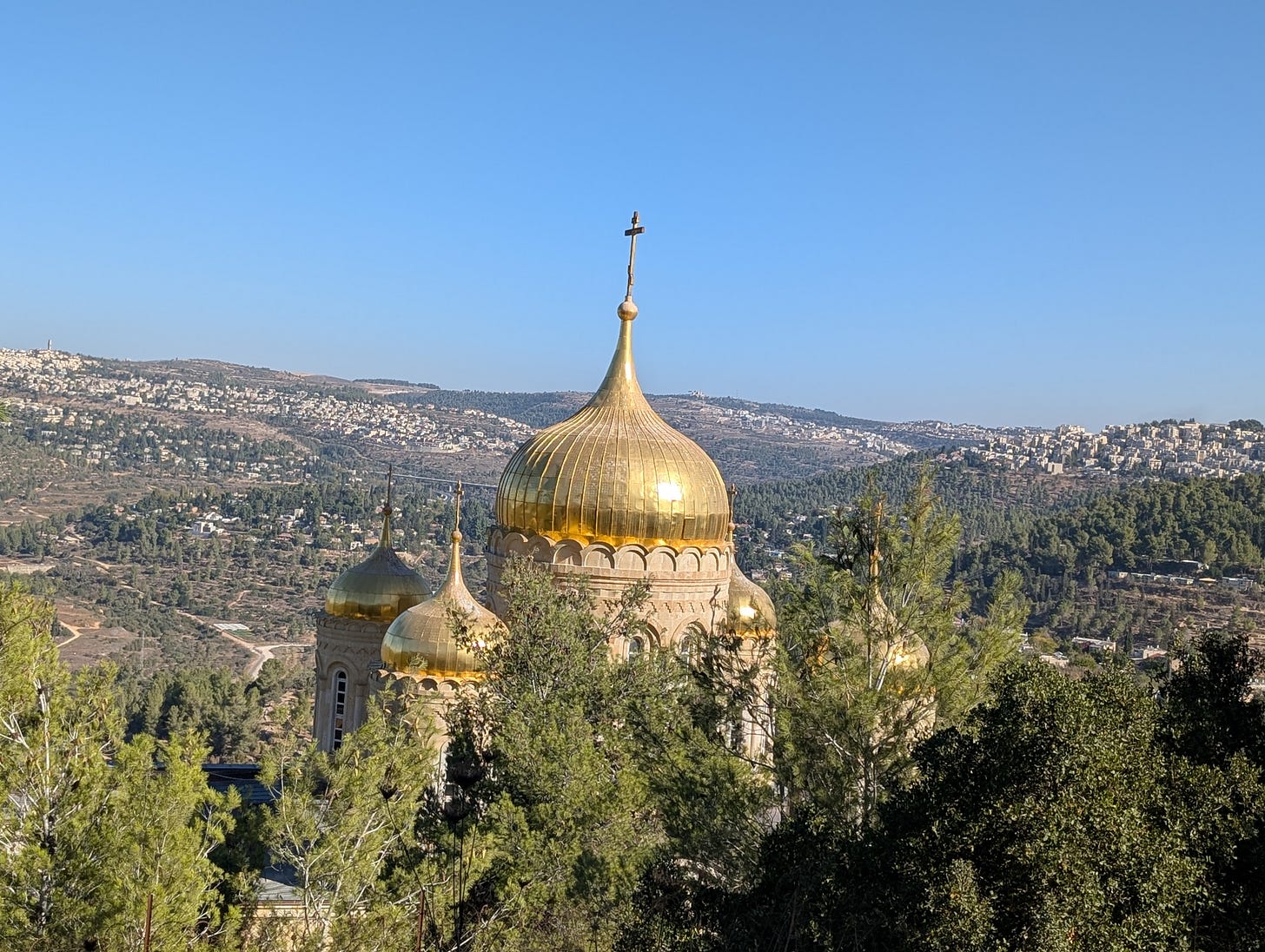
Jerusalem folds me back into her cool embrace. I am infused with the bone-deep sensation of home.
And yet we Jerusalemites could hardly be called one big happy family. Deep swaths of Palestinian East Jerusalem are largely a no-go zone for Jews. The ultra-Orthodox neighborhoods of Geula and Meah Shearim will welcome Jews only if they are dressed according to strict standards. If not, enter at your peril. Mistakenly drive your car through certain neighborhoods on Shabbat and you may be spat at, stoned, or blocked altogether. Demonstrations that paralyze the city are common events.
Everything goes deeper—deeper than the stones, deeper than the lowest foundations, deeper than the water cisterns and ancient quarries.
Take a Walk to the Wall(s)
I invite you to come and see for yourself. We’d be happy to host you. Avi’s sourdough bread cannot be beat.
Come for Shabbat. Enjoy the quiet. No visit to Jerusalem would be complete without a walk to the Western Wall. It’s only an hour’s walk from us.
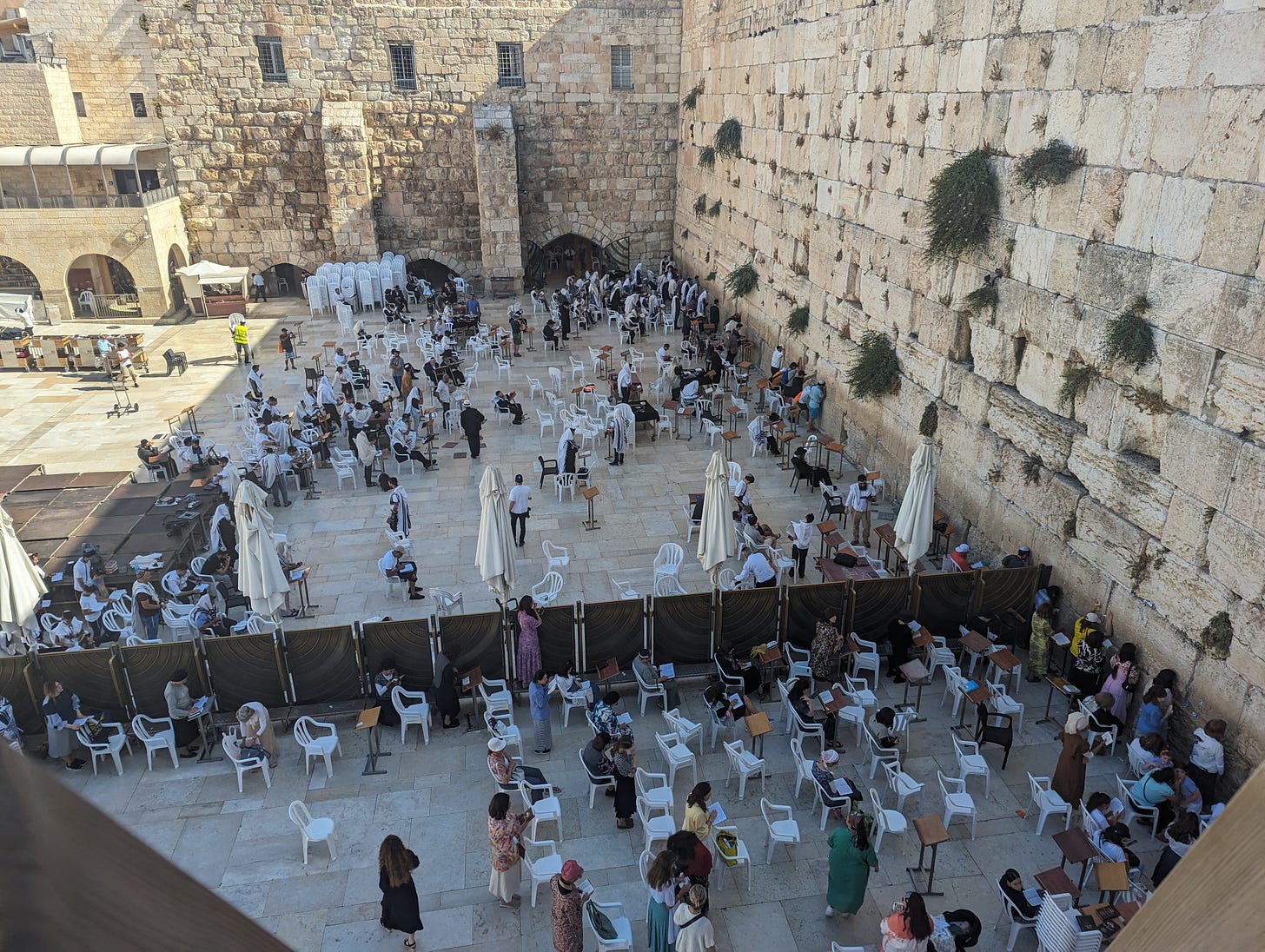
Leave my house and head north. No need for Google Maps—just ask the friendly passers-by and they will direct you, waving reverently, pointing, smiling. Once you see the walls of the Old City, head up the cobblestoned lanes, dodge the traffic and hawkers, pass through a security check, and nod at the soldiers who look as though they are still in high school. You will enter a vast enclosed square: stones underfoot, to the left, to the right, and straight ahead, walls snaking as far as the eye can see. You’ll glimpse the gold dome of the Dome of the Rock in the distance, and the ancient gravestones of the Mount of Olives cemetery beyond. Hundreds of men and women in prayer will pass you by. Families emerge with plates of cookies and cakes as multiple bar mitzvah celebrations take place. Young and old, religious and secular, converge, all moving toward the stones—the towering wall, our last standing remnant of the Second Temple. They slip tightly folded prayers between the stones, or open prayer books and bob silently. You may feel yourself bob a little too. How do you digest a city like this?
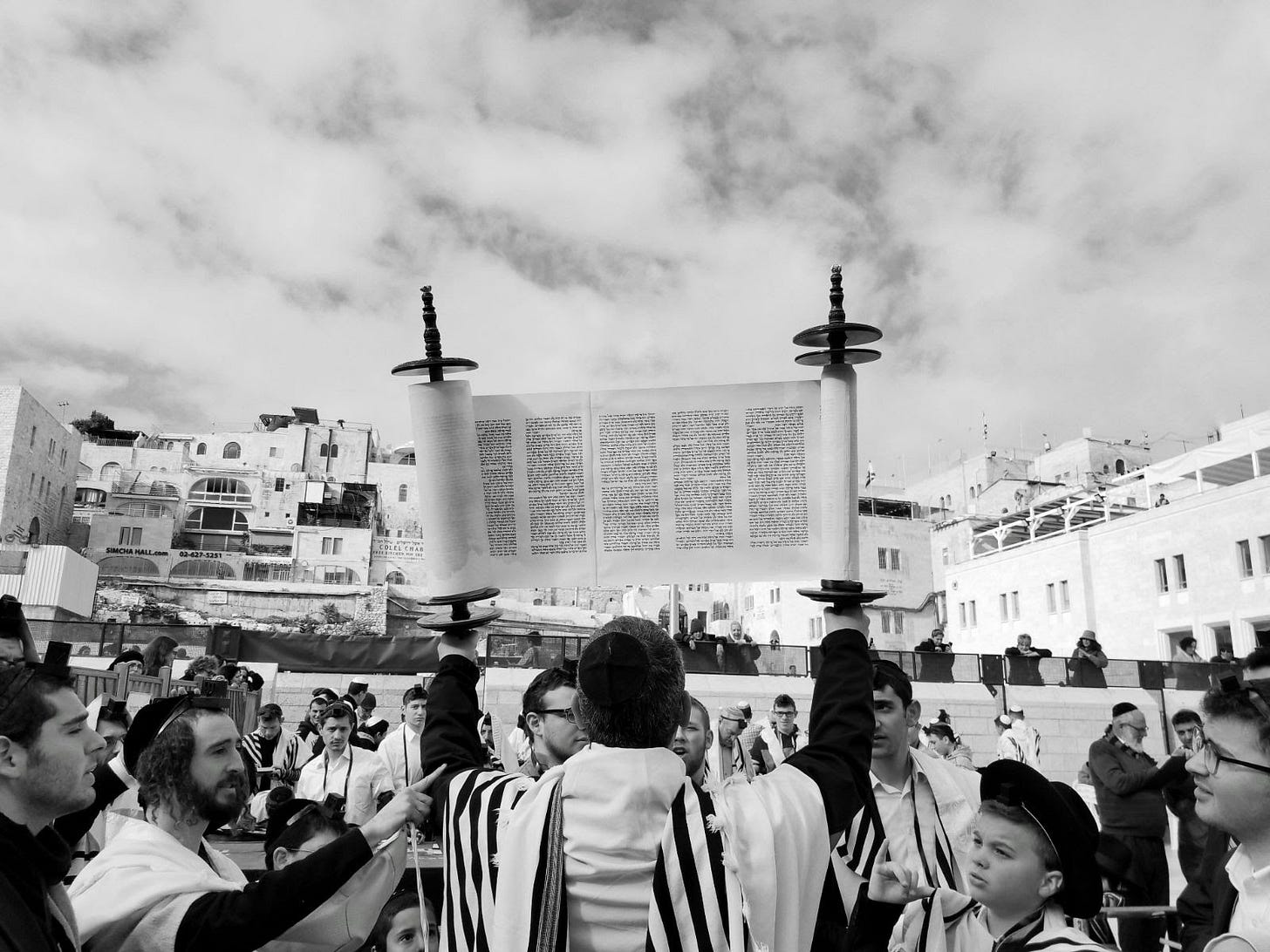
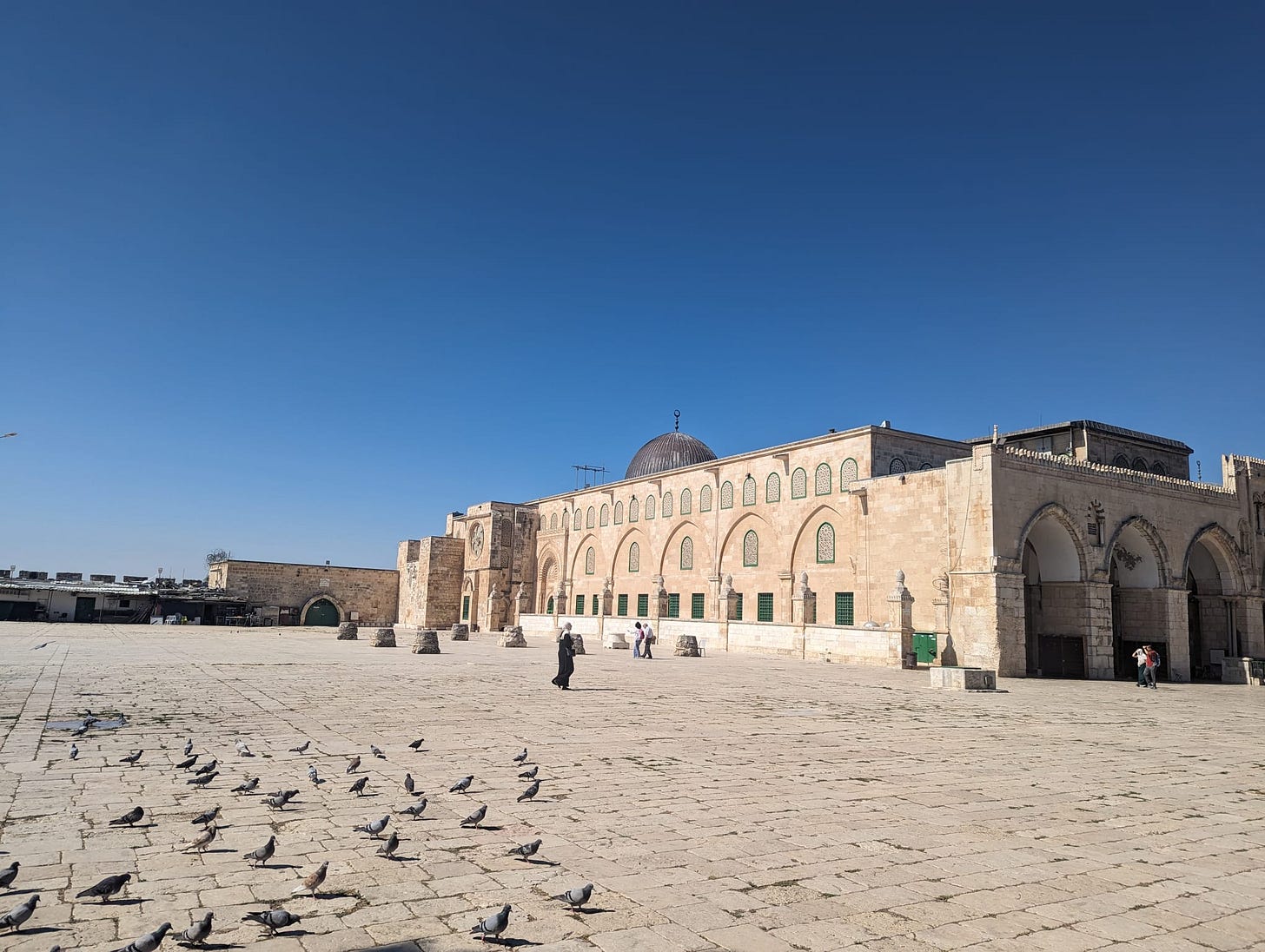
Climb the large wooden staircase to the right of the Wall—you can’t miss it. Pass through security again. Stop and take a long sip of water, because it is quite a climb. Then you’ll find yourself where it all began: Har HaBayit. Temple Mount. Mount Moriah. Al-Aqsa. What you call it reveals what you believe.