
CEO of Time to Stand Up for Israel
Jerusalem Is Not Just a City — It Is Something I Feel
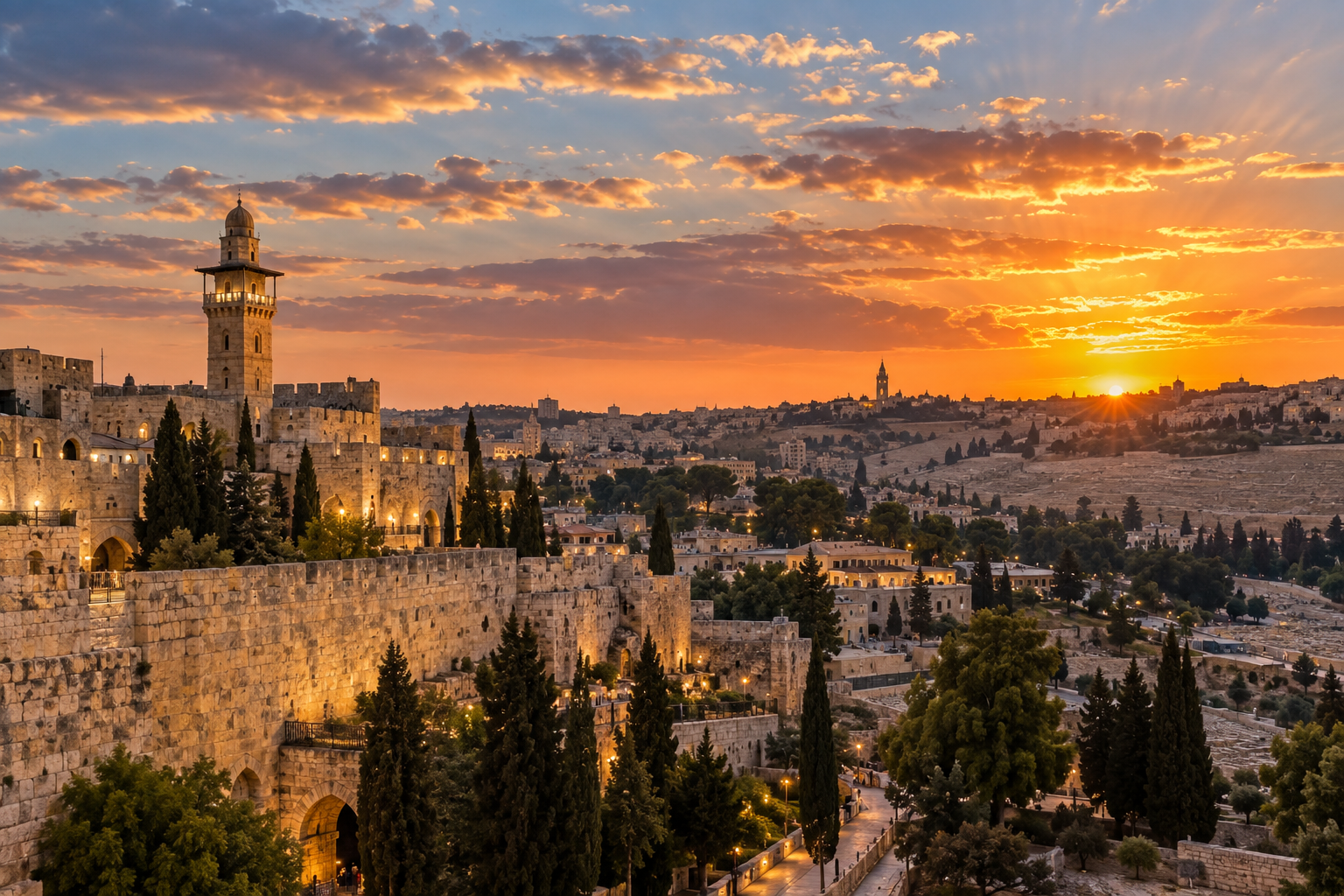
Photo Credits: Sabine Sterk ( AI)
There are cities I have seen, cities I have admired, and cities whose beauty I can appreciate from a distance.
Jerusalem is different.
For me, Jerusalem is not simply a destination on a map. It is not just ancient walls, holy places, archaeological discoveries or another subject in the endless political discussion surrounding Israel.
Jerusalem touches something much deeper in me. And I know I am not alone. There is even a rare psychiatric phenomenon commonly called Jerusalem Syndrome, in which some visitors to Jerusalem experience intense religious preoccupations, delusions or unusual behavior. It is important not to romanticize this condition. Genuine psychiatric symptoms deserve proper medical care, and many documented cases involve people who already had psychological vulnerabilities.
But beyond that rare clinical phenomenon lies a much bigger and more fascinating question:
Why does Jerusalem affect so many people so deeply? Why can someone arrive in Jerusalem and suddenly become emotional?
Why can a wall, a stone, a prayer or the sound of Hebrew in the streets create feelings that are difficult to explain? I think I understand at least part of the answer. Because when I think about Jerusalem, I don’t just see a city.
I see survival.
I see generations of Jewish people who were separated from their ancestral homeland but refused to forget Jerusalem.
I think about Jews scattered across Europe, North Africa, the Middle East and eventually almost every corner of the world. Different languages. Different countries. Different circumstances. Yet Jerusalem remained with them. They prayed toward Jerusalem. They spoke about Jerusalem. They mourned Jerusalem.
At Jewish weddings, even at the height of happiness, Jerusalem was remembered. At Passover, generation after generation expressed the hope of returning to Jerusalem. Think about what that means. Empires appeared and disappeared. Borders changed.
Jewish communities were expelled from one country and forced to rebuild their lives in another. There were persecutions, pogroms and ultimately the Holocaust. Yet the connection was never erased.
That affects me personally because supporting Israel, for me, is not simply taking a position on today’s politics. It is recognizing an extraordinary story of a people who refused to disappear.
When I see Jerusalem, I see the physical evidence that Jewish history did not begin in 1948. That history is beneath your feet.It is in ancient texts. It is in archaeological remains. It is embedded in Jewish prayer and tradition. And it is alive again in the streets.
That is what makes Jerusalem so powerful to me. Imagine ancestors praying for generations toward a city many of them believed they might never see, and then imagine walking through that city today and hearing children speaking Hebrew.
There is something almost impossible to describe about that. History suddenly stops being history. It becomes present tense.
Of course, Jerusalem is sacred to others too. Christians throughout the world have a profound connection to the city because of the life and crucifixion of Jesus. Muslims regard Jerusalem as one of Islam’s holy cities.
That is part of Jerusalem’s extraordinary character.
Billions of human beings know its name.
People can carry an image of Jerusalem inside themselves for decades before ever physically arriving there.
Perhaps that helps explain why Jerusalem can sometimes overwhelm people. But my own connection comes back to Israel. I watch the way Israel is discussed internationally and sometimes feel that the actual human story disappears.
Israel becomes a headline. Israel becomes a controversy. Israel becomes a UN resolution. Israel becomes a battlefield on social media.
And Jerusalem becomes something people thousands of kilometers away casually argue about.
But when I think about Jerusalem, I cannot reduce it to politics.
I think about people.
I think about Jewish families.
I think about generations who dreamed about returning.
I think about Israelis living ordinary lives in a place carrying extraordinary history.
Walk through Jerusalem today and you experience something remarkable.
Ancient stones and modern cafés.
Synagogues and markets.
Archaeological sites and technology.
Prayer and traffic.
Soldiers and schoolchildren.
History and everyday life occupying exactly the same space.
That contrast moves me.
Because Israel itself represents that same combination.
Ancient roots.
Modern life.
An old people building a young country.
And perhaps this is why I feel such a strong need to stand up for Israel.
Not because Israel is perfect. No country is.
Not because every decision of every Israeli government must be defended. It shouldn’t.
But because I refuse to accept the idea that Jewish history can simply be erased when it becomes politically inconvenient.
I refuse to pretend that the Jewish connection to Jerusalem appeared yesterday.
And I refuse to watch thousands of years of history reduced to slogans.
Jerusalem reminds me that identity can survive exile.
That memory can survive persecution.
That a language can return to everyday life.
That a people scattered across the world can come home.
Perhaps that is the deeper Jerusalem effect.
Jerusalem Syndrome describes something rare and clinical.
But there is another Jerusalem phenomenon that is much more common.
You arrive expecting to see history.
And suddenly you feel history.
You realize that the stones beneath your feet witnessed generations who came before us.
You realize that the prayers once whispered from thousands of kilometers away are now being spoken again in Jerusalem itself.
And something changes.
That is my connection to Jerusalem.
It isn’t only intellectual.
It isn’t only political.
It is emotional.
When I see Jerusalem, I see what happens when a people refuses to forget who they are.
I see resilience.
I see continuity.
I see life.
And I see Israel.
For centuries, Jerusalem lived in the hearts of Jews who could not reach it.
Today, Jerusalem lives again as the capital of the State of Israel.
That is not merely a political fact to me.
It is one of the most powerful stories of survival in human history.
Jerusalem is more than a city I stand up for.
It represents the reason I stand up for Israel.
Related Topics
Related Posts