
Founder & Principal, Line of State
Jerusalem’s Decision to Refrain from the Sharm El-Sheikh Peace Summit
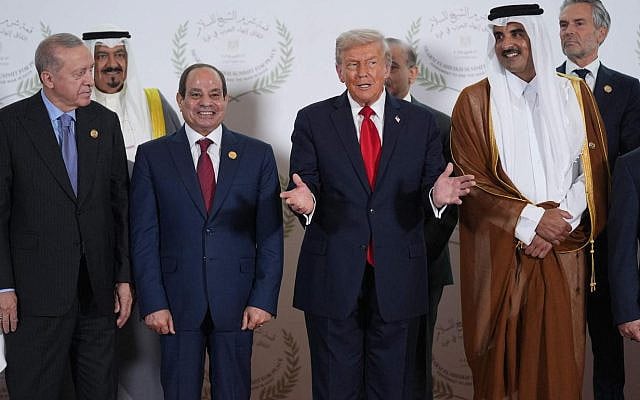
(Front L-R) Turkish President Recep Tayyip Erdogan, Egyptian President Abdel Fattah al-Sisi, US President Donald Trump, and Emir of Qatar Sheikh Tamim ben Hamad al-Thani and other leaders pose for a family picture at the Gaza summit in Sharm El-Sheikh on October 13, 2025. EVAN VUCCI / AFP.
This week, Sharm El-Sheikh became an international stage.
US President Donald Trump, Egyptian President Abdel Fattah el-Sisi, Turkish President Recep Tayyip Erdoğan, and Qatari Emir Sheikh Tamim bin Hamad Al-Thani signed the “Trump Declaration for Lasting Peace and Prosperity”.
Israel was not there – not because the summit coincided with Simchat Torah, nor merely due to Erdoğan’s opposition (though he was quick to claim credit for Israel’s exclusion) – but because it chose to abstain. Its absence was not diplomatic neglect but strategic presence.
Jerusalem preserved its sovereign freedom, refusing to exchange its operational, legal, and intelligence flexibility for diplomatic spectacle. Even symbolic participation or a signature would have risked transforming every defensive move into international liability.
In the Middle East, those who pose for photographs beside the makers of the problem lose the ability to resolve it. The summit looked like a moment of peace, but it was in fact a mirror reflecting the sharp dissonance between declarations and reality.
The promises of “combating extremism”, “mutual prosperity”, and “conflict resolution via diplomacy” sounded noble – yet the flags of Turkey and Qatar, the only ones raised alongside those of the United States and Egypt, revealed how far image and substance can diverge.
Qatar continues to host Hamas’s political leadership in Doha, shielding and funding them under the veneer of “humanitarian mediation”. Turkey, meanwhile, has institutionalized October 7 as “Palestine Awareness Day”, teaching its children that the massacre in Israel was “liberation”. Both nations build diplomatic capital on the ruins of accountability: Ankara distributing passports to Hamas operatives, Doha granting them immunity and funds.
This is diplomacy dressed in disguise – soft language that whitewashes direct intervention.
But the political gap is as deep as the moral one. The Sharm El-Sheikh agreement leaves critical questions unanswered: Who governs Gaza? How will the ceasefire be enforced? Is this merely a pause, or a step toward a de facto Palestinian state?
Any decision on Gaza made without Jerusalem’s consent will lack legitimacy, stability, and sustainability.
Trump opted for deliberate ambiguity – a flexible framework that allows maneuvering yet reserves decisive power for Israel. He spoke of reconstruction, not sovereignty, recognizing that no political reality can be imposed on Israel unless it emerges via its own strength. Yet in a world eager to fill voids, that ambiguity quickly became a playground for others – states, organizations, and powers that prefer to speak of peace without taking responsibility for making it real.
Jerusalem, by contrast, does not wait for history to write itself. It defines the boundaries of settlement, safeguards its freedom of action, and insists that its security be assessed not by declarations, but by deeds.
Meanwhile, Egypt bears alone the burden of stability. It fights the Muslim Brotherhood and its branches in Sinai – financed by Turkey and Qatar – and understands that Hamas is their Palestinian arm. Security cooperation with Jerusalem – intelligent, discreet, and effective – remains the only deterrence that works. A cold peace? Perhaps. But a warm security partnership – absolutely. Precisely for that reason, the composition chosen for the Sharm summit did not reinforce Cairo’s message of stability; it only exposed how fragile the regional balance of interests truly is. Deterrence endures because it is discreet and flexible – not formal and declared.
Israel does not need ceremonial gestures, but rather the preservation of a decision-making space free of self-interested mediators. It is not bound by agreements signed without its consent – certainly not ones that allow its adversaries to reenter through the diplomatic back door.
On the day other states rushed to pose for pictures before they understood what they had signed, Israel kept what others lost: judgment. It neither boycotts nor flatters; it simply acts – with composure, responsibility, and a clarity that turns practice into principle. The past two years have proven it beyond doubt.
—
First published in Hebrew in Maariv, this article now appears in English in a revised version prepared by the author.
Related Topics
Related Posts