
Jewish Resistance: It Began with the Children
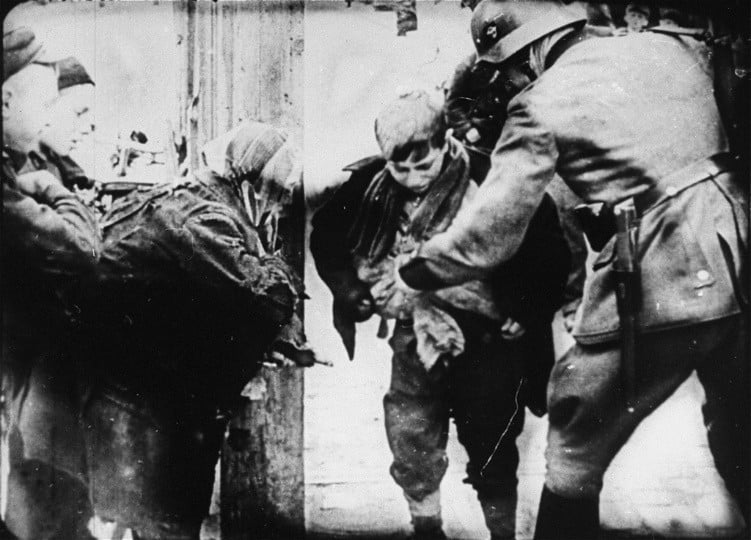
The first line of Jewish resistance in Warsaw was not a rifle.
It was a seven-year-old slipping through a gap in the wall.
She was seven the first time she went through.
Not over it. Over it was for the desperate and the doomed, the ones who tried ladders in daylight and were shot off the brick like birds. Edna went through. There was a gap at the base where the mortar had failed, a seam between two worlds no wider than a loaf of bread, and a seven-year-old body is a small and miraculous machine.
She folded herself into it.
On one side: the sealed quarter where her family was slowly starving by design. On the other: Warsaw, still moving through its ordinary business — shops, streets, bread.
This is not the image most people summon when they think of Jewish resistance in Warsaw. They picture the rifle. They picture April 1943, burning rooftops, homemade grenades, young fighters of the Jewish Fighting Organization holding off the German army far longer than anyone thought possible.
That came later. It was extraordinary. It deserves every monument it has.
But resistance did not begin with the gun.
It began with the potato.
The arithmetic of starvation
Here is what the Germans had decided, written down, and administered: Jews in occupied Poland were assigned starvation rations. In the Warsaw Ghetto, the official daily allotment was roughly 180 to 200 calories. Germans received many times that amount. Poles received more than Jews, but still far below adequacy.
The policy was not neglect.
The policy was death, calculated to the calorie and distributed by ration card.
By that arithmetic, the people trapped behind the ghetto wall should have been gone within months. They were not. One reason was smuggling. Historians estimate that a staggering share of the food eaten in the Warsaw Ghetto came not through official channels, but through illegal ones: over the wall, under the wall, through the sewers, through bribery, barter, courage, desperation — and through children.
Children were small enough for openings adults could not enter. Children drew a fraction less suspicion. A child could vanish into a crowd, could run, could look for one fatal and useful moment like nobody’s problem.
So the smallest people in the ghetto were handed the largest job there was:
Keep everyone else alive.
What Edna carried
Picture the return trip, because the return was the dangerous one.
Going out, she was empty.
Coming back, she was worth shooting.
She had bread against her ribs, hidden under her coat. Maybe an egg, wrapped carefully so it would not break, because a broken egg meant a wasted run and a wasted run meant a hungry night. Maybe a few potatoes, heavy as stones, the difference between her mother eating and her mother not.
She had to move slowly enough not to look like she was fleeing and quickly enough to be home before dark. She had to keep her face arranged into the face of a girl carrying nothing at all.
She was seven.
She did not learn the wall by herself. Her older brother Jakov taught her — Jakov, who had started the family down this road, who knew which guards might be bribed and which seam in the mortar had crumbled wide enough for a small body to pass.
Her sister Miriam taught her too. Six years older, Miriam had become something like a second mother: how long to wait in shadow before moving, which hours were safest, how to walk home without giving the body away.
Someone always taught the next one. That was how the lifeline held — hand to smaller hand, route to route, fear turned into instruction.
By the time Edna went through the wall on her own, she was already carrying everything her brother and sister had given her.
And, if the run went well, bread besides.
There was a guard at one stretch of the wall who liked to make the children run before deciding whether to fire. The ones who survived knew this. They went anyway the next day, and the day after that.
Not out of bravado.
Out of arithmetic.
The family did not eat if the child did not go.
A wider definition of resistance
We have a name for the men and women who picked up weapons in 1943. We call them fighters, and we are right to.
But Jewish historians also use another word: amidah — standing firm. Resistance did not always mean defeating the machine. Sometimes it meant refusing to let the machine define the whole of life.
By that measure, one of the first acts of Jewish resistance in Warsaw was not a shot fired from a rooftop. It was a child going through a wall with food under her coat.
The Germans set the number at 180 calories and meant it as a sentence.
Edna, and thousands like her, smuggled that sentence full of holes.
The first line of defense was the smallest
It is tempting to make her a symbol and leave her there: the brave little smuggler, a poster, a poem.
There was a poem, in fact.
“The Little Smuggler” was written inside the ghetto by Henryka Łazowertówna, a Polish-Jewish poet who worked with CENTOS, the children’s relief organization. Her poem gives voice to a child who risks death at the wall not for glory, not for politics, not even for himself — but because his mother is hungry.
That is the detail that should stop us cold.
The child is not most afraid of his own death.
He is afraid of hers.
Łazowertówna’s own death echoes that fear. During the great deportation to Treblinka in the summer of 1942, she was reportedly offered a chance to be pulled from the transport at the Umschlagplatz. She refused to leave without her mother, Bluma. They were murdered together at Treblinka.
The woman who gave the little smuggler his voice would not abandon her mother any more than the child in her poem would abandon his.
But Edna was not a symbol while she was doing it.
She was a child with cold hands, a wall in front of her, and people behind her who would go hungry if she lost her nerve.
That is what the rifle version of resistance can obscure. Long before anyone could fight the machine openly, someone had to keep a family alive long enough to see another morning.
That refusal did not always look heroic.
Sometimes it looked like a small girl walking home with bread under her coat, trying not to be noticed.
She was seven.
And she went back through the wall again tomorrow.
Janet Bond Brill, PhD, is the author of Little Edna’s War, based on her mother-in-law’s Holocaust testimony, published on January 27, 2026, on International Holocaust Remembrance Day.