
Jews Were Murdered Again, And This Is Why No One Can Claim Surprise
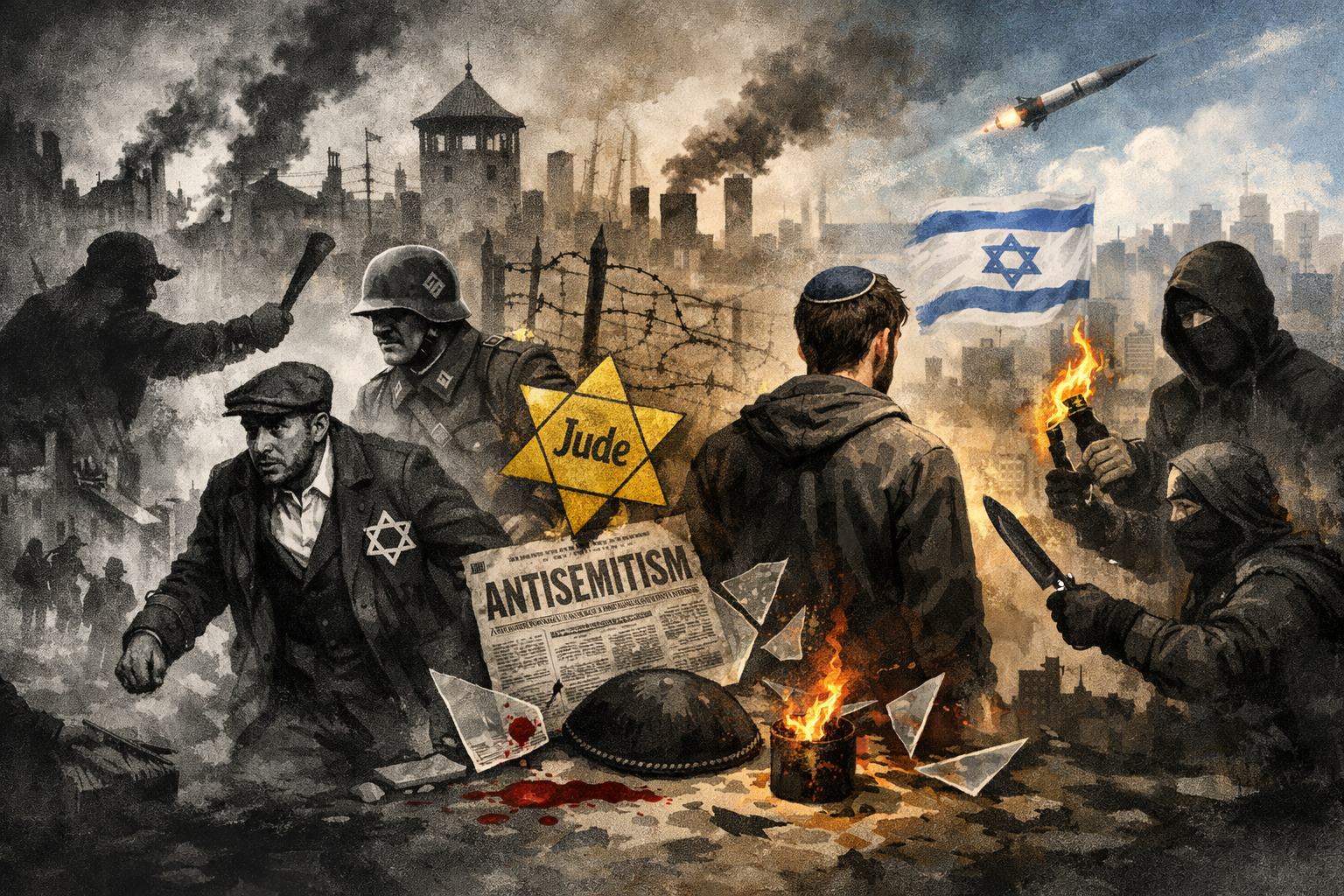
Jews were murdered again.
Not because antisemitism suddenly returned, and not because the warning signs were unclear, but because years of violence were minimized, contextualized, or treated as isolated events until the consequences became impossible to ignore.
The most dishonest response to antisemitic murder is to ask how this could have happened.
It happened because it had been happening all along.
For decades, attacks on Jews were framed as singular incidents, local failures, or the actions of lone extremists. The pattern was visible, but it was rarely acknowledged as such. Each time, the response was caution against overreaction. Each time, the violence was absorbed into broader narratives that diluted its meaning.
What occurred recently did not mark the return of antisemitic violence. It marked the cost of refusing to recognize that it never left.
A Long Record, Repeatedly Ignored
Antisemitic violence did not emerge suddenly, nor did it begin with any single country or conflict. It unfolded across decades and borders, repeatedly failing to trigger sustained alarm or institutional reckoning.
In August 1982, six Jews were murdered at Jo Goldenberg’s Jewish restaurant in Paris. In January 2015, four Jewish shoppers were killed at the Hypercacher kosher supermarket, targeted explicitly because they were buying kosher food. These were not ambiguous attacks. They were acts of antisemitic terror in civilian spaces.
In October 2018, eleven Jews were murdered during Shabbat services at the Tree of Life synagogue in Pittsburgh. There was no geopolitical pretext, no plausible reinterpretation, and no contextual explanation available. Jews were murdered while praying.
That attack should have ended denial. It did not.
What followed, the synagogue shooting in Poway, the kosher market attack in Jersey City, and the Hanukkah machete attack in Monsey, were treated as episodic. Each was framed as an aberration. The connective tissue was rarely examined.
Violence Without Reckoning
Jews were attacked at prayer, in their homes, at kosher businesses, on religious holidays, and in public spaces. The locations changed. The pattern did not.
Even when violence escalated, recognition lagged behind. Attacks were mourned, but their continuity was obscured. The result was normalization, not surprise.
In March 2018, Mireille Knoll, an 85-year-old Holocaust survivor, was murdered in her Paris apartment in an antisemitic hate crime. She was stabbed repeatedly and set on fire. The killing shocked France briefly. It did not alter the trajectory.
Distance played a role. Violence against Jews in Israel was long treated as endemic to a distant conflict, something tragic but tolerable. Israeli civilians lived under thousands of indiscriminate rocket attacks for years, a reality no other democratic society would be expected to normalize.
That expectation did not remain geographically contained.
When Jewish vulnerability is treated as manageable “over there,” it becomes easier to minimize it “over here.”
October 7 and the Collapse of Denial
On October 7, 2023, Hamas carried out the largest mass killing of Jews since the Holocaust, slaughtering civilians in their homes, at a music festival, and in public spaces across southern Israel.
The scale, brutality, and explicit targeting should have shattered any remaining pretense that antisemitic violence was episodic or containable.
Instead, even this massacre was quickly reframed. Within days, it was contextualized, rationalized, or relativized in public discourse, often before the dead were buried.
October 7 did not introduce something new. It exposed what had already been tolerated.
When Violence Entered Open Society
In November 2024, antisemitic violence in Amsterdam crossed another threshold. After a football match, assailants actively searched for Jewish and Israeli civilians in the streets, assaulting them and sending victims to hospitals.
This was not an attack on an institution. It was public, coordinated, and social.
That distinction matters.
Violence that moves from confined spaces into open civic life signals more than hatred. It signals permission.
The Question That Remains
How many attacks were required before a pattern could be acknowledged as a pattern?
From Paris to Pittsburgh, from Amsterdam to Manchester, the road was long, and it was marked repeatedly. What failed was not warning, but recognition.
Antisemitic violence did not arrive without notice.
It arrived after decades of warnings were ignored, after each attack was treated as isolated, and after Jews were buried again and again.
A society that treats hatred as context and murder as aberration is not surprised by violence. It is preparing for it.
Jews were murdered again.
Not because no one could have known, but because too many chose not to listen.