
Journalism: The Clock Is Still Ticking
How 60 Minutes taught journalism to compete for attention—and what happened when the algorithm took over
The fall of American journalism did not begin with TikTok, Instagram, YouTube, Twitter, or the algorithm. By the time millions of Americans began getting news from influencers, podcast hosts, and tech bros speaking into phones from their cars, the groundwork had already been laid.
Long before the infinite scroll, journalists had learned that information must compete for attention. The inverted pyramid taught newspaper reporters to place the most important facts first. Broadcast news added another demand: complicated events needed simple narratives, recognizable characters, adversaries, and resolution. Social media did not invent those rules. It inherited them.
To understand how journalism became a stream of emotionally irresistible fragments, we should look not to America’s least trustworthy news source, but perhaps its most trusted television news program.
We should look to 60 Minutes.
The accusation sounds absurd. For more than half a century, 60 Minutes exposed criminals, confronted executives, challenged presidents, and held powerful people to account. This was magnificent journalism. It was also journalism with characters, conflict, suspense, and emotional payoff, packaged into 10-15 minute segments capable of holding a mass audience.
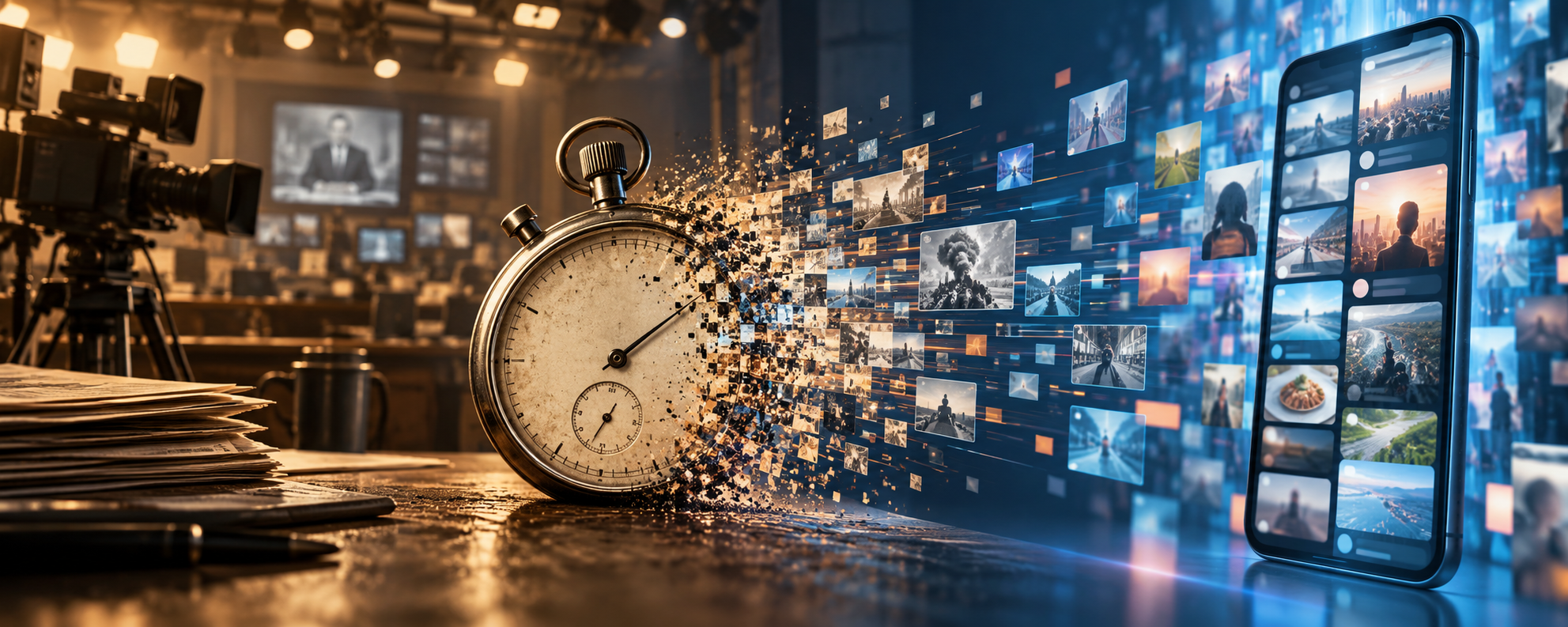
It was a feed before there were feeds, and its most recognizable symbol made the bargain visible: a stopwatch reminding viewers that attention was always running out.
The program was not killing journalism. Not yet. It was teaching journalism to make a bargain with attention—a bargain the algorithm would eventually inherit, perfect, and enforce.
Nearly six decades after the program’s debut, the technology has changed, but the bargain has not. Last month, the Bari Weiss era of 60 Minutes officially began. After months of turmoil and promises of reinvention, the program returned for its 59th season with new faces, glossier graphics, and a refreshed version of its most recognizable image: the ticking stopwatch. The open-book graphics behind its correspondents were replaced by sleek digital screens. A program conceived as a television version of Life magazine had traded the book for the screen. But it kept the iconic clock.
At its best, 60 Minutes followed a simple hierarchy: a story should not be important because it is interesting; it should be made interesting because it is important. The program used attention in the service of journalism. The platforms that inherited its techniques increasingly use journalism in the service of attention.
When 60 Minutes debuted in 1968, television news was still treated as something close to a public obligation. Networks maintained news divisions for prestige and because broadcasting over public airwaves carried at least the suggestion of civic responsibility. News was something they were expected to provide, not something expected to turn a profit.
Don Hewitt, the veteran CBS producer who created 60 Minutes and ran it for more than three decades, saw another possibility. He understood that important journalism and watchable television were not natural companions: the public might need to know something without especially wanting to watch it. Borrowing from Life magazine, he placed war, politics, celebrity, crime, and human-interest stories inside the same package. Instead of devoting an hour to a single documentary, 60 Minutes offered several shorter stories. The subjects changed, but the package—and the faces—remained familiar.
Mike Wallace, one of the program’s original correspondents and eventually its most famous, was not simply a reporter delivering information. He was a character in the drama: relentless, skeptical, faintly menacing. When Wallace leaned forward and asked a question for which someone had clearly failed to prepare, the interview became a confrontation, the correspondent a protagonist, and the revelation a climax. Viewers experienced the satisfaction of watching someone powerful forced to answer.
This was the program’s genius. 60 Minutes did not make journalism less serious. It made seriousness entertaining. Months of reporting were shaped into stories with opening hooks, recognizable characters, rising tension, and some form of resolution. Reality rarely arrives in that condition. Television had to produce it that way.
After CBS moved the program to Sunday evening in 1975, 60 Minutes became one of America’s highest-rated programs of any kind. That changed everything. The networks had always known entertainment could make money. 60 Minutes demonstrated that journalism could make money too, turning the news division from a civic expense into a profit center. Its success financed researchers, foreign reporting, camera crews, and expensive investigations. It also changed the terms of the public mission.
Once journalism proved it could produce ratings, ratings stopped being a welcome consequence of excellent reporting and became an expectation. The governing question began to shift from “What does the public need to know?” to “Will the public keep watching?”
60 Minutes could often answer both questions with the same story. That was its brilliance. The industry that followed discovered that it did not always have to.
Even Hewitt eventually understood what he had unleashed. “We ruined television,” he once said, “because we made it profitable to do this kind of thing.” He was referring to the imitators. He could not yet envision the feed.
By the 1990s, prime time was filled with 60 Minutes descendants. But most were cheaper replicas of the original. The ambush interview survived without the investigation behind it. Cable news made confrontation continuous, digital media optimized the headline for the click, and social media placed personality, conflict, and emotional payoff inside an endless personalized stream.
60 Minutes broke the hour into stories. Cable news broke the story into confrontations. Digital media broke the confrontation into clips. Social media broke the clip into moments. The algorithm reduced the moment to whatever could stop a thumb.
Today, even 60 Minutes lives inside the system it foreshadowed. During its most recent season, it averaged 9.1 million television viewers per episode and accumulated 2.5 billion video views on social media. The viewer had become a view.
A fifteen-minute 60 Minutes investigation was not a fifteen-second TikTok. Its reporting could take months, and its best stories compressed complicated subjects without destroying them. But the algorithm inherited the pressure built into the format—hooks, conflict, emotional payoff—and automated it. The producer asked how to hold an audience. The algorithm asks how to hold you.
That transformation is especially visible in the widening generational divide over where Americans get political news. In a September 2024 Pew survey, 63 percent of Americans 65 and older said television was their most common source of political and election news. Among adults under 30, only 10 percent said the same. Nearly half of those younger adults—46 percent—named social media as their primary source, compared with just 3 percent of Americans 65 and older. Pew Research Center
These are not merely different delivery systems. The older viewer turned on a news program shared with millions. The younger viewer often encounters news inside a feed opened for comedy, music, friends, recipes, sports, gossip, politics, and war. One generation chose a news source. For the other, a distribution system increasingly chooses the news.
We usually describe the danger as misinformation: fabricated images, invented quotations, conspiracy theories, and lies. But the more pervasive distortion need not be false. A video can be authentic, the suffering genuine, and every word in its caption accurate. What happened before the camera arrived, what happened after it left, what contradicts the image, and whether the event is typical may never appear. The viewer receives a true fragment and mistakes it for the whole. The fragment does not need to lie. It merely needs to arrive alone.
Traditional journalism was never free of this problem. Every story excluded facts, every broadcast imposed a frame, and a small number of institutions held enormous power over the national conversation.
But the broadcast system provided something the personalized feed cannot: a common object of attention. Millions watched the same program in the same order at the same time. They could disagree about what they had seen, but at least they had seen it together.
The feed does not merely show different people different opinions about the same event. It shows them different events, images, villains, victims, and realities. Each feed may contain authentic information yet leave its owner bewildered that anyone exposed to “the facts” could reach another conclusion.
60 Minutes learned how to package information so a mass audience would keep watching. The feed learned how to package a different world for every viewer.
Artificial intelligence may represent the next turn of the screw. The feed decides which fragment of journalism to show us. AI can assemble the story itself, summarizing and recombining the work of reporters into a personalized answer that may never send the reader to the original source. The algorithm learned which story would hold our attention. AI may increasingly determine how that story is told.
Journalism cannot simply reject the attention economy. Reporting that nobody reads or watches cannot fulfill its public mission. Good journalism should be vivid, beautifully written, and compelling. 60 Minutes was right about that. But journalism must retain the freedom to be complicated and inconclusive.
One of my twenty-something nephews once made the point for me. After I shared an essay I thought was worth reading on a family text chain, he offered his review: “I give this article a solid yawn.” It was funny, honest, and in its own way revealing. Some things are worth reading even when they fail to entertain. Journalism sometimes has to risk the yawn. It must tell people what they need to know even when they would rather swipe past it. A story should not be important because it is interesting. It should be made interesting because it is important.
There will be no return to the age of three television networks, nor should there be. The old gatekeepers cannot be restored, the common audience cannot be reassembled, and Walter Cronkite will not descend from the heavens to tell us the way it is. The challenge is not to recreate the media system of 1968. It is to recover a principle that system imperfectly preserved: attention is necessary to journalism, but it cannot be journalism’s highest value.
The stopwatch on 60 Minutes told us that the program had an ending. It was visible, finite, and the same for everyone. The feed has no ending. Its clock is invisible, its programming is different for each of us, and it is designed to discover what will prevent us from looking away.
60 Minutes learned how to make us pay attention to the news. The attention economy learned how to turn the news into whatever we will pay attention to.
The clock is still ticking, but it is no longer measuring the program.
It is measuring us.