A Jew from Texas, who knew?
Judaism Dawn to Dusk in Hidalgo County, Texas
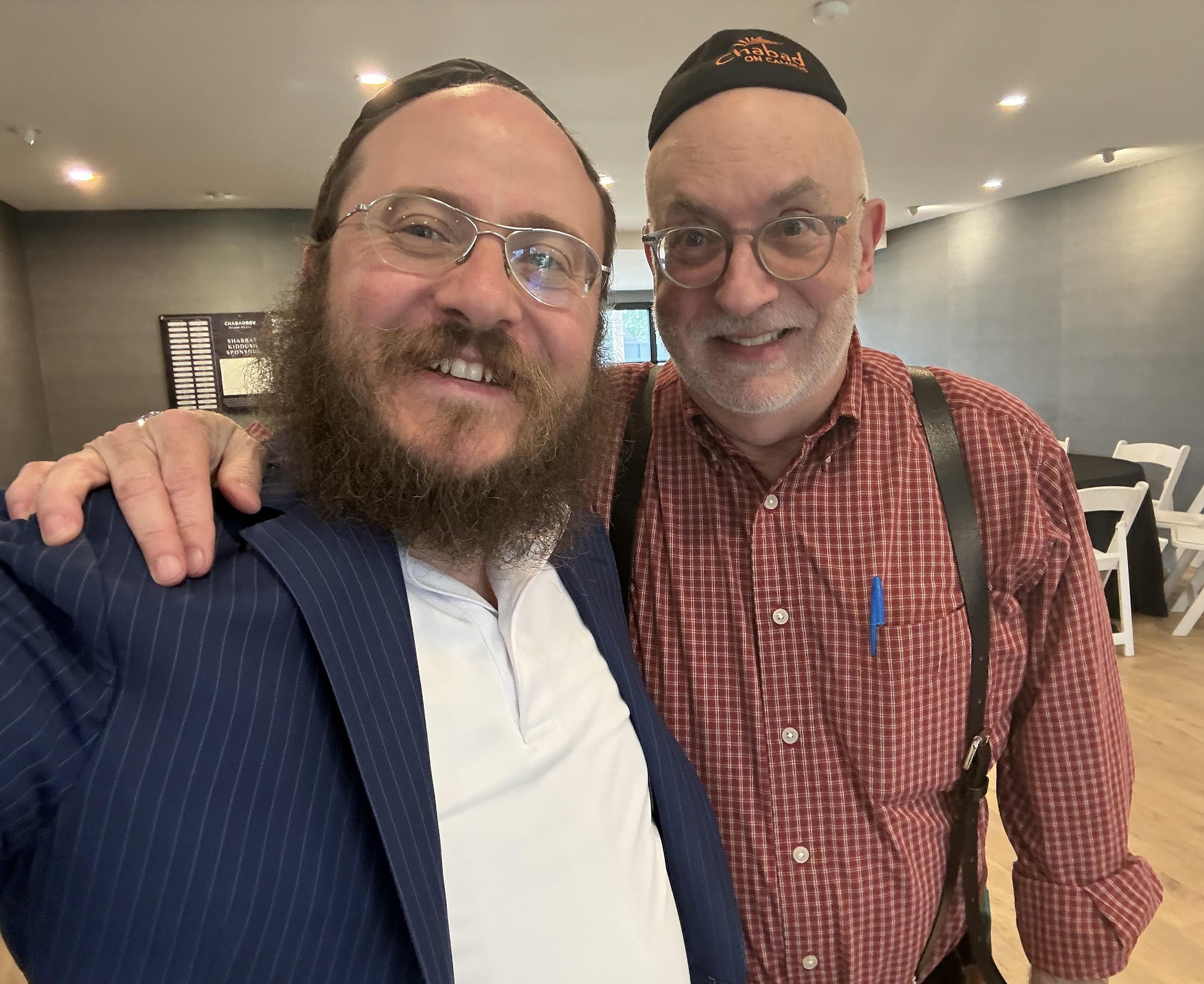
The author and Rabbi Asher Hecht (photo courtesy of Rabbi Hecht).
Whenever I travel, I visit Jewish sites, sometimes as a tourist as in Budapest and Vienna, other times as a participant in services. The latter includes Dublin, San Salvador, Dresden, São Paulo and, most recently, McAllen, in Hidalgo County, Texas.
I flew into McAllen, on the Texas-Mexico border, in mid-June to attend my 50th reunion at Mission High School in the nearby town of Mission. On past trips, I attended services at McAllen’s Temple Emanuel, where my parents were married in 1955. This time, however, my first trip to the Mission-McAllen area since my 2011 reunion, I decided to attend the 7:15 a.m. Thursday minyan at Chabad of the Rio Grande Valley (Chabad RGV). I sent a note to Rabbi Asher Hecht introducing myself and my connection to the Valley, and he invited me to come on over.
After a decade of involvement with Chabad shuls in Bedford, NY, and now Wakefield, Mass., I know and strongly connect with the movement, its enthusiasm and focus on finding your mission in life (what could resonate more with a native of a town called Mission?). The notion of Chabad in deep South Texas, a region with a small Jewish presence in the midst of a staunchly Catholic and Protestant majority, astounds me—as much as when I found a Starbucks in McAllen during the 2006 reunion. The region anchors a far corner of the country, hundreds of miles away from the Jewish centers of San Antonio, Austin and Houston. I thought to myself, Chabad in the Valley? Is this one of the birthpangs of the coming of Moshiach?
But for Chabad, distance and a lack of a Jewish infrastructure are part of the opportunity and challenge. I’ve personally seen the growth process in Bedford and Wakefield. The emissaries go where the need is. Anyway, what’s distance for a movement that sends shluchim worldwide? No place is too far from 770 Eastern Parkway, not even Hidalgo County, Texas.
I arrived after getting a 6:30 a.m. flight from Boston to Austin to McAllen. While the reunion began Friday evening, I came early to explore where I grew up and graduated from the same high school my mother did, 40 years later. I settled in to my hotel, the Bungalows on Shary, in a neighborhood of gated communities that consisted mostly of orchards and vegetable fields when I grew up in Hidalgo County in the 1960s and 1970s. A pre-reunion session with friends at the Bungalows, lubricated by shots of Tito’s Vodka straight outta Austin, got the Valley experience off to a memorable start.
The morning minyan
Up by 6 a.m. on Thursday, I set the GPS in my rented Buick SUV for Chabad RGV on West Dove Avenue. I steered the car along streets that were both familiar and utterly reshaped by the area’s relentless growth. North-south avenues were now as wide as highways, shopping centers reached far north into what had been the country and Mission and McAllen had essentially merged. After missing the turn into the Chabad Center—I thought the entrance went to an apartment complex—I finally entered the parking lot, adjusted my snazzy “Chabad on Campus” kippah from Chabad of Princeton University, nodded to the security guard and took a tallis.
Upstairs, the service was underway. I introduced myself to R’ Asher, who provided tefillin for me. From experience I know that using unfamiliar tefillin always feels new and slightly awkward for me, as I navigate the choreographed dance of wrapping with a unfamiliar partner, so to speak. That slows me down and encourages me to think afresh about the meaning of the act. I know the steps, but I had to get a handle on the new rosh and yad.
The siddur was new to me, in that it didn’t quite match others I’ve used, even at Chabad. With a page reference from another congregant, I caught up and my basic knowledge of Hebrew, the prayers and their order in siddurs helped me along. They all sounded very familiar, just, as with the tefillin, heard through fresh ears.
The early-morning participants were friendly, mostly my age, and I enjoyed talking to them about the Jewish scene at the breakfast afterward. I spoke about my Jewish journey from Mission to the Northeast, from seeing myself as the simple son at the seder to one with a little more learning. R’ Asher got a selfie of the two of us together, a great way to mark the day.
After the service R’ Asher, a native of Forest Hills, in the New York borough of Queens, filled me in on how he landed in McAllen. He grew up as the son of a Sephardic Chabad rabbi with the goals, he said, of “getting married and going to an underserved area.”
As a yeshiva student, he and other students spent time in places with limited Jewish infrastructure. Given his interest in camping, R’ Asher helped set up a Jewish summer camp for the children of Israeli residents of South Padre Island, on Texas’ Gulf Coast. While working at the camp he began meeting members of the Jewish community of the Valley. After working for two years in Montreal, R’ Asher and his wife Dina felt a gravitational pull to the Valley and the opportunity work with a Jewish community of about 600 people from South Padre Island up the Rio Grande to Laredo. In between those two points, McAllen has served since 2010 as an ideal center of operations for Chabad RGV, which has grown to include a mikvah opened in 2021 and Valley Kosher Market & Deli.
From Chabad RGV I switched gears and I met Edward, a high school friend who drove me to a ranch way out in the country, where the roads have no names and aren’t even paved, for a tour. That’s a topic for another blog post. I can say the time on the ranch gave me an invaluable first-hand view of a part of where I grew up that I never really experienced.
Discussing Parsha Shelach in the Valley
But wait, there’s more Jewish excitement from this special day! That evening I used my cell phone to join the regular Thursday night Tanya discussion on Zoom led by Rabbi Sruly Brook of Chabad of Wakefield, Mass. The session shifted from Tanya to that week’s parsha, Shelach, about the spies. One insight that struck me was the Israelites were living on God’s credit card, so to speak, in the Wilderness, with manna delivered six days/week tailored to their specific tastes.
But then the spies brought back a sobering report that shook people up. The Israelites were going to leave the dream state in the Wilderness for the opportunities and challenges of the Promised Land. Belief in God’s promises is easy when life is good; when life becomes more challenging on the way to the Promised Land, the mentality must change. Egypt, receding in the rearview mirror, starts to look more appealing than the unknown ahead. Result: 40 years of bumpy attitude adjustment.
The Jewish spirit continued to add flavor to the reunion as several classmates asked about my connections to Israel and said they prayed for the country. I appreciated their concerns and support.
Back home, I thought about the connection of the morning minyan and the evening discussion of parsha Shelach. What meaning could I extract from the Judaism dawn to dusk experience—with an afternoon in the literal midbar (wilderness) right in the middle of the day? To paraphrase a witty line I once read about the Mossad, “Nothing in Judaism is a coincidence.”
I had a long trek through a spiritual wilderness to find and embrace Judaism. Due to family dynamics, I lacked exposure to the Jewish life in the Valley. I had no GPS for most of the journey but I wandered in the right direction, and I’m still learning. My few hours at the ranch, a scorching dry place with snakes, thorns, wild beasts and biting insects, showed me just how hazardous a real or spiritual desert can be. And the McAllen morning minyan stands as the opposite of the desert: Friendship, learning, connection, a Jewish home in the Valley. The same blessings flow like milk and honey from Chabad of Wakefield, where I experience them in person. So that’s my impression of studying Shelach in the Valley.
Looking ahead
While I wasn’t able to make Chabad RGV’s Shabbat service, I’m sure I’ll be back, and I hope that’s well before the next Class of ’76 reunion. I want to explore more of the region, especially the hidden Jewish background of the Valley, the presence of crypto-Jews who came over from Spain and Portugal to Mexico and what became the U.S. Southwest to escape the Inquisition. Several high school friends have told me about their Jewish background and I’d like to do more on-the-ground research on the topic. My instinct: My fellow Jews were around me—and we had no way of knowing one another in the Valley.
But now we are starting to know.
Related Topics
Related Posts