
From Kibbutz to the global stage
Judean Desert: Did the Copper Scroll Preserve Ancient Water Projects?
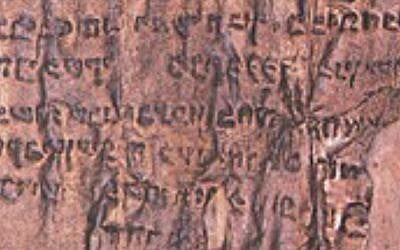
The high-tech professionals of their time.
In July, we published two articles here presenting a research hypothesis that may open the way for a reassessment of the ancient water systems at Ramat Rachel and in the Judean Desert.
The hypothesis may also carry a broader message concerning the need to make the archaeological and historical heritage of Ramat Rachel and the Judean Desert more accessible to both the public and the research community.
This new hydro-engineering hypothesis could represent a conceptual breakthrough and lead to a renewed examination of ancient water infrastructure at Ramat Rachel, on its surrounding slopes, and in the Judean Desert. It offers a modern perspective on the possible hydraulic planning of the sites at Ramat Rachel, along the neighboring ridge, and at Nahal Sekhakha during the Iron Age, Persian, and Hellenistic periods.
In presenting these hypotheses, I do not claim to have solved the mysteries surrounding these sites. My purpose is to encourage researchers and the public to examine the subject more deeply and to explore new directions.
1. The hypothesis and its potential to encourage new thinking
A topographical and hydraulic analysis of the ridge between Mar Elias and Ramat Rachel suggests a new model.
A peripheral storage and circulation system
According to our assessment, the underground tunnel discovered recently north of Kibbutz Ramat Rachel, with an estimated capacity of approximately 750 cubic meters and situated at elevations of roughly 760–770 meters above sea level, may not have been an isolated feature.
Together with the unplastered channels and dams in the area, it may have formed part of a modular system for drainage, storage, circulation, and infiltration along the 770–780-meter contour lines.
Hydraulic independence during emergencies
The model suggests an intelligent, two-season design that enabled the collection of surface runoff and the circulation of water around the site.
Such a system could have provided a strategic response during periods of siege or drought and may have offered the site a high degree of water independence, without complete reliance on external sources.
2. The publications and their international recognition
The hypothesis and model presented in our recent articles have generated considerable interest and discussion among researchers in Israel and abroad.
The first article: The Nahal Sekhakha tunnels and runoff systems in the Judean Desert
The first article in the series presented the hypothesis that the unplastered infiltration tunnels at Nahal Sekhakha may have been used to capture flash-flood water:
Secrets of the Judean Desert: The Mysterious Unplastered Tunnels of Nahal Sekhakha.
The second article: The possible adaptation of Persian qanat technology from Ramat Rachel to the Judean Desert
The second article expanded the hydraulic analysis eastward from Jerusalem and Ramat Rachel toward the Judean Desert:
Jerusalem to Judean Desert: Was Persian Qanat System Adapted in the Biblical Age?
Recognition by Bible Gateway and archaeological platforms
The research and its hydraulic hypotheses were cited and discussed in Bible Gateway’s international archaeological news feature, Bible News Roundup, as well as by platforms including Bible Places and Explorator.
3. International expert responses: IPOGEA
We have exchanged views with senior experts on traditional water-management systems, foremost among them Professor Pietro Laureano, director of the international research center IPOGEA and an adviser to UNESCO.
Professor Laureano recognized that the hypothesis may point toward sophisticated planning involving runoff agriculture and water storage in semi-arid environments.
A 2016 article had already emphasized the unresolved contradiction at Ramat Rachel between the site’s elaborate palace, flourishing gardens, and extraordinarily high level of water consumption — described as both extravagant and ostentatious — and the absence of any known major water source nearby.
The 2016 article described striking findings
“The palace was discovered to be far larger than originally thought and was occupied at different times by the Assyrians, Persians, and Babylonians. Remarkably, despite the fact that there is no major water source anywhere in the vicinity, the site includes a large collection of bathing pools and water cisterns.”
Our model proposes the possible existence of a sophisticated water system combining intelligent agriculture, recycling, efficiency, storage, and infiltration. It may offer an explanation for a contradiction that has not yet been investigated sufficiently.
An academic dialogue
We are continuing a dialogue with senior professors, hydrologists, and geologists in an effort to encourage a reassessment of conventional interpretations of ancient water systems at Ramat Rachel and in the Judean Desert.
4. A vision for field investigation and further research
We believe that one practical step that could help test our hypothesis would be the immediate and controlled removal of sediment from the tunnel discovered approximately three months ago north of Kibbutz Ramat Rachel.
Such work may expose the tunnel’s presumed drainage and intake openings.
The tunnel could potentially become a unique and important hydro-archaeological attraction within the Ramat Rachel archaeological park.
We also call upon the Israel Antiquities Authority and the Staff Officer for Archaeology in Judea and Samaria to disclose the locations of two additional tunnels reportedly discovered in the Nahal Sekhakha and Hyrcania Valley area during the past 15 years.
The excavators have previously reported their existence.
These tunnels should be cleared of accumulated sediment so that researchers and the public can examine their entrances and exits and investigate whether they are connected to the two tunnels already uncovered at Nahal Sekhakha during excavations completed in 2009.
The northern tunnel is approximately 60 meters long, while the southern tunnel extends for approximately 120 meters.
The Copper Scroll
Following the publication of the previous articles, we recently received additional material concerning the Copper Scroll that may offer a new perspective on the scroll and its contents.
In his 1963 book, The Copper Scroll from the Judean Desert, Professor Ben-Zion Luria proposed that the scroll had been written during the period of the Bar Kokhba Revolt.
More than 60 years later, Professor Shimon Gibson of the University of North Carolina has advanced a similar dating. His argument followed artificial-intelligence analyses conducted by Professor Mladen Popović and his students at the University of Groningen in the Netherlands, although Gibson’s conclusions concerning the Copper Scroll were not directly based on their findings about the Qumran scrolls.
Several weeks ago, Professor Gibson published an article arguing that the Copper Scroll was indeed written during the Bar Kokhba period.
The Copper Scroll in the context of water, topography, and drainage.
When examining the scroll in relation to our previously published articles, we noticed that it does not appear to use Latin place names such as Hyrcania or Herodium.
When the scroll refers to Sekhakha, using the name of the biblical settlement, it may possibly be describing a broader geographical region.
We also noted two striking features
Approximately two-thirds of the scroll’s 64 entries contain words that may be associated with water and infrastructure, including cistern, aqueduct, pit, excavation, spring, drain, and shaft.
Approximately one-quarter of the entries refer to topography or drainage through terms such as valley, plain, cliff, cairn, wadi, and terrace.
A large proportion of the scroll’s entries therefore concern subjects related to water, drainage, infrastructure, and landscape.
This raises a new possibility.
According to one interpretation presented by Professor Gibson, the scroll may have been intended to commemorate the actions of supporters of Bar Kokhba. Could it also have preserved information about major water projects in Judea?
If the correct hydraulic terminology can be connected to the scroll’s entries, the document might teach us something about ancient water installations throughout Judea.
It is also possible that one purpose of the Copper Scroll was to preserve knowledge of these water projects for those who might discover it after it had been concealed.
The decision to inscribe the text on durable copper rather than on papyrus may have been motivated, at least in part, by a desire to preserve and commemorate the achievements of ancient water engineers.
Ancient water engineers were the high-tech experts of their age
Professor Yoav Sagiv recently remarked in a Yad Ben-Zvi podcast that ancient water engineers were the high-tech professionals of their time.
Water was among the most important elements in the survival of populations and political communities in antiquity. It is therefore possible that supporters of the Bar Kokhba Revolt considered it necessary to preserve their hydraulic knowledge in copper for future generations.
Possible hydraulic terminology in the Copper Scroll
We attempted to examine several Copper Scroll sections associated with Nahal Sekhakha.
Five of the scroll’s 64 entries appear to refer to Sekhakha, indicating the site’s possible importance and centrality.
Sections 20–24 concern Sekhakha. The original text is difficult and its reading and reconstruction remain disputed.
The following are preliminary possibilities concerning the language, measurements, and formulas that may have been used by the scroll’s authors in relation to Nahal Sekhakha and the settlement of Sekhakha.
Sections 20 may refer to the structure at Nahal Sekhakha discussed in our earlier article, which may have been intended to direct water into the southern tunnel or channel.
Hyrcania Fortress is situated above this area. It may not have been mentioned by its later name because the scroll’s authors perhaps regarded it as part of the broader Sekhakha region and did not use Latin or Hellenistic place names.
One hypothesis worth examining is whether “silver” could represent a particular quantity of runoff or floodwater rather than a financial treasure, while “gold” might possibly describe spring water or cleaner water.
The reference to silver in the Sekhakha entries could be consistent with our proposed interpretation of a system designed to collect flash-flood water.
Another possibility is that each “talent” of silver represented a hydraulic unit: perhaps one cubic meter of stored water, one cubic meter per hour of flow, or a multiple of five or more units.
Additional words that may deserve reconsideration
Another difficult term in the scroll is “Kohalit” or “Kahlat.”
We believe it may be worthwhile to investigate whether the word refers to the mouth of the Jordan River where it enters the Dead Sea. When the water of the Jordan mixes with the Dead Sea, its appearance may take on a blue or turquoise shade.
In antiquity, the lower Jordan and its outlet into the Dead Sea may have been considerably broader because there was no modern Degania Dam and water consumption from the Jordan River was far lower.
This raises the possibility that the term may somehow derive from a description of color, although the matter requires further linguistic, geographical, and historical investigation.
The word biv, generally associated with a drain or sewer, may also have referred to water drained from domestic use or to collected runoff. This too requires further study.
A possible connection to the tunnel at Ramat Rachel
Attention should also be drawn to Section 3 of the Copper Scroll:
“In the large cistern in the courtyard of the peristyle, in the bottom of which there is a sealed opening filled with sand, opposite the upper entrance: 900 talents.”
This may describe an enormous storage installation containing 900 units, sealed or blocked by sand.
The entry may perhaps indicate that the installation could be entered or cleared through an upper opening or ventilation shaft.
This description presents a similarity that deserves examination in relation to the large underground tunnel discovered at Ramat Rachel in May 2026.
It is therefore highly desirable that the investigation and excavation at Ramat Rachel continue and be completed as soon as possible so that the tunnel’s hidden features and its relationship to the surrounding water systems can be properly examined.
An invitation to multidisciplinary research
The purpose of presenting these hypotheses is to encourage and mobilize experts from a wide range of fields — archaeology, geology, hydrology, geography, linguistics, ancient metrology, and others — to examine the Copper Scroll from different perspectives.
One of those perspectives should be the possible connection between the scroll’s terminology, ancient hydrology, and water infrastructure.
The Copper Scroll may still contain information whose significance has not yet been recognized
Only a careful multidisciplinary investigation can determine whether its many references to cisterns, aqueducts, shafts, valleys, channels, and other landscape features describe hiding places for treasure alone — or whether they also preserve traces of the hydraulic knowledge and water projects that enabled ancient Judean society to survive.
Related Topics
Related Posts