
Kanaani: A Name in Which the Wisdom of King Solomon Still Echoes
Mishlei (Proverbs) 8:22
ה׳ קָנָנִי רֵאשִׁית דַּרְכּוֹ קֶדֶם מִפְעָלָיו מֵאָז
“The Lord acquired me (or created me) at the beginning of His way, before His works of old.”
At the heart of this verse stands the word קנני — kanani.
There are texts a person may read for many years and only truly understand at a certain moment in life. This happens not because the words have changed, but because the person has changed. Then what once seemed like scattered details begins to gather into one living picture.
Every Shabbat, after Kiddush and the meal, when I recite the blessing after food and reach the words about the rebuilding of Jerusalem, I pause again. Their central meaning, as our rabbis teach, is the fullness of redemption, the revealed holiness of Jerusalem, and the rebuilding of the Third Temple. Yet it is impossible not to notice something else as well: history itself has begun to move, and ancient words sound new again. Israel exists. Jerusalem has returned. The people have been gathered from the corners of the earth. The language of the prophets lives once more.
We still await the age of Mashiach, yet we already see the first rays of dawn. We still pray for complete redemption, yet we are already witnessing the rebirth of Israel, the return of biblical memory to our land, and a renewed greatness that recalls the days of King David and King Solomon. I rely on our prophets because time does not weaken their words—it reveals their depth.
Then the whole puzzle begins to come together.
The schools of Hillel and Shammai are not merely a disagreement of sages, but two rhythms of one truth. The way of Hillel is patience, gentleness, and gradual repair of the world. The way of Shammai is greater severity, clarity, and elevation. They are not two camps, but two phases of one Divine design.
The same inner pattern appears elsewhere in our tradition. So it is with Moses and David. One brings Torah and forms a people. The other reveals kingship, song, and the line of future redemption. One is linked with humility and inward depth; the other with sovereignty and open strength. In the Book of Psalms, associated with David, we also find Psalm 90—the prayer of Moses, the man of God. Even this shows that the line of Moses and the line of David meet in one sacred stream.
Thus, in the image of Mashiach, these lines unite: spiritually from Moses, royally from the house of David. Humility and dignity. The shepherd’s heart and the king’s greatness.
So too with the lion and the cat.
The lion is the sign of Judah, the symbol of the house of David, the image of royal strength. Yet beside the lion stands the cat, and here a subtler line of meaning appears. Moses is called the most humble of men, while the sages said that if the Torah had not been given, modesty could be learned from the cat. The lion expresses the majesty of the throne; the cat preserves the dignity of silence. The lion is revealed power; the cat is hidden protection. They are not opposites, but complements—like David and Moses, kingship and humility.
That is why the cat also has its place in Jewish tradition. It is mentioned in the Talmud, and with the name of Rav Papa are associated teachings about homes made safer by the presence of cats. In the Land of Israel, this is especially understandable: here there are not only cities, but desert, snakes, scorpions, and landscapes where vigilance is part of life itself. The cat here is not decoration, but an ally.
Here we also touch the mystery of Perek Shirah, where every creature sings its own song to the Creator. If King David gave Israel the songs of the human soul, Perek Shirah reveals the song of all creation. One source speaks through many voices. It is therefore not surprising that some traditions connect the song of the cat with the words of the prophet Obadiah about the proud eagle brought low from the heights. Many saw in that eagle the image of empires that forget a Higher Judge stands above history.
From that same light grows another connection: Eden, Canaan, and Israel are not three disconnected ideas, but one line of holiness—one promised land revealed through different ages and different names. Eden as beginning. Canaan as promise. Israel as return.
And here another sign appears: the very name Kanaani.
This is not merely a modern breed name. In the Book of Proverbs—Mishlei, written by King Solomon—the key word qanani / kanani (קנני) comes from the Hebrew root קנה, which can mean to acquire, to obtain, to establish, to make one’s own possession, or to hold as something precious. Classical commentators explain it in different ways. Rashi understands it as “acquired me” or “made me His own.” In the context of the chapter, the verse speaks of Wisdom existing at the beginning of creation.
That means the name Kanaani can be heard far more deeply than as a simple label.
It carries the echo of something found.
Something treasured.
Something rooted in the beginning.
Something connected with wisdom.
Something that appears in the world not by accident.
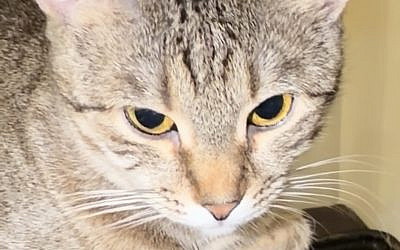
This is why the name moves me so deeply. Kanaani is not only a cat breed—it is a name that sounds as though it comes from an ancient memory.
In the 1990s, in Jerusalem, Kanaani cat emerged as the first and only Israeli cat breed. It was created through the work of Doris Pollatschek, a woman who survived the Holocaust. The story began not in a laboratory, but in compassion. She fed street cats near her home, as many people in Israel still do, where care for animals has long been part of a living culture of kindness.
Among those animals was an injured African wildcat of the Felis lybica line, one of the ancient roots of the domestic cat world. She saw something in his eyes, and he sensed goodness and safety in her. Thus began a story that cannot be reduced to breeding alone.
When he recovered, kittens were born from him and local cats—beautiful, but still too wild for domestic life. Then compassion was joined by disciplined knowledge. Specialists were brought in, and through years of careful work a stable line was formed. In this way natural strength was joined with life beside human beings, and Kanaani was born.
Even the mark on the forehead, resembling the letter M, can be read symbolically. For one person it is simply a pattern. For another, a reminder of Moses, the great teacher of humility. For another, a hint of Mashiach, in whom the humility of Moses and the kingship of David are joined. The lion bears royal grandeur; Kanaani carries the secret of humility.
And so I say this only as a personal belief, not as an obligation for anyone else. I believe that the Kanaani cat with the letter M on its forehead is not accidental. As Baal Shem Tov taught, even a leaf does not fall from a tree without the will of Heaven. How much more difficult it is for me to see mere coincidence in the fact that the first and only Israeli cat breed was created in Jerusalem, by a Holocaust survivor, and bears this sign.
Some will say it is only a natural marking. Some will smile and say it is M because cats say “meow.” Everyone has the right to see differently. I do not argue. I only share my own sense: there are coincidences in which hidden providence shines.
And this story did not end then. It continues in our own days—through war, distance, and new encounters. During the war, the Kanaani line once again passed through human судьбы. In this way the cats came to me and to Lyudmila Vlasova through an Israeli woman named Leah, whose path crossed ours in Holon. We still search for Leah, because some people disappear from sight, yet never disappear from history.
In Jerusalem there also stands The Temple Institute, a sign that for many people waiting has already become preparation, study, and responsibility. They do not only pray for the Temple—they prepare for it.
And everything returns to one root: Hillel and Shammai, Moses and David, lion and cat, Perek Shirah and Psalms, Obadiah and David, Eden, Canaan, and Israel, nature and holiness, longing and fulfillment. These are not separate stories. They are one story flowing from one Source.
And so Kanaani is not merely a rare breed. Kanaani is an Israeli cat with nefesh for a Jewish neshamah.
P.S. The lion guards Israel as a sign of strength and kingship. Kanaani guards Israeli homes and streets as a sign of silence, vigilance, and hidden protection. There are still very few of them today, but Lyudmila Vlasova and I, with God’s help and with your support, hope to change that. Sometimes what appears small carries within it a spark of great light.