Where Objectivity Meets Reality
Kauft nicht bei Juden
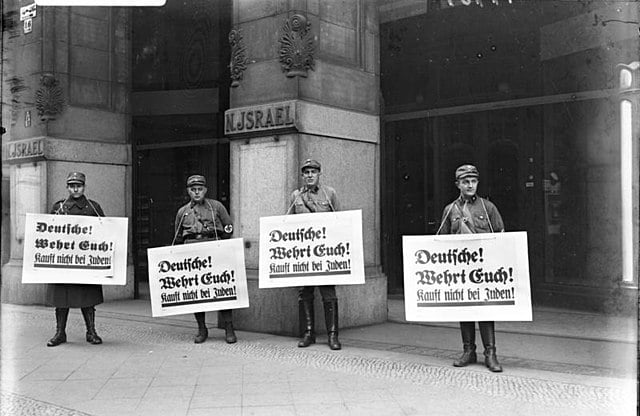
Nationalsozialistische Boykott-Posten vor dem Warenhaus Israel in Berlin. (unknown author, Licence CC-BY-SA 3.0 / Bundesarchiv, Bild 102-14469)
In the echo of a chilling slogan from the 1930s, contemporary boycotts—disguised as political protest—are increasingly targeting Israeli and Jewish presence across academia, culture, economy, and sport. This is not criticism; it’s exclusion.
Kauft nicht bei Juden
The slogan “Kauft nicht bei Juden” still sends shivers down the spine today. In the 1930s, it was the weapon the Nazis used to systematically purge public life of Jewish presence. Initially, not through deportations or violence, but through boycotts, social exclusion, and moral pressure. Shops, theaters, universities, and sports clubs were closed to Jews. The process was gradual, but the end goal was clear: the Jewish voice had to vanish from society.
Today, in 2025, debates about Israeli sports teams, academics, artists, and businesses reveal a troubling reality. History does not repeat itself exactly—but the echo is unmistakable. Under the guise of political activism, Israeli—and often more broadly Jewish—individuals and institutions are increasingly targeted for exclusion. This occurs not only in the economy or academic sphere, but also in culture and sports.
From academic to cultural boycott
On university campuses and in research centers, campaigns for an academic boycott have become increasingly frequent. Collaborating with Israeli universities is deemed morally unacceptable. Researchers with no political affiliation see their projects jeopardized simply because they come from Tel Aviv or Haifa. Their work is judged not on its content, but on their passport.
In 2025, multiple examples illustrate this trend. Students at the University of Amsterdam occupied the Maagdenhuis, demanding that the university sever all ties with Israeli institutions. The occupation led to police interventions and damage to the building. Similarly, Radboud University Nijmegen suspended collaborations with Israeli universities after campus protests and occupations. These actions are part of a broader movement spanning several Dutch universities.
In the cultural realm, the same logic is evident. The Eurovision Song Contest, once a celebration of European cultural diversity, has increasingly been overshadowed by vocal protests against Israeli participation. In Basel, where the 2025 contest took place, mass demonstrations attempted to pressure artists to withdraw in solidarity with the Palestinian cause. Some performers refused to perform entirely simply because Israel was present. What was meant as a festival of music and connection has been reduced to a stage for exclusion.
Economic pressure and sporting exclusion
The same pattern extends to the economy: boycott Israeli products, pressure companies to withdraw, and create political-economic leverage. While every consumer has the right to make individual choices, when such choices are organized and imposed through ideological campaigns, they risk evolving into systematic exclusion of a country—and the people associated with it.
In sports, the trend is increasingly visible. The most recent example is the Vuelta a España 2025, where the team Israel-Premier Tech became the focal point of pro-Palestinian protests. Demonstrators blocked roads, disrupted stages, and even demanded that the team voluntarily withdraw from the race. No other team faced such demands. The mere presence of “Israel” on the jersey was enough to effectively hijack an international cycling event.
Vuelta director Javier Guillén responded firmly:
We cannot simply exclude a team that has earned its place according to UCI rules. To do so would be discriminatory and set a dangerous precedent.
A rider from Israel-Premier Tech similarly stated:
We are here to race, not to be turned into political pawns. Cycling should unite people, not divide them.
The slippery slope of exclusion
Proponents of these boycotts argue that they are legitimate political action: Israel must be pressured for its policies toward the Palestinians. But where does it end? When scholars are barred, musicians are silenced, athletes blocked, and products systematically boycotted—are we still talking about criticism of a government? Or are we erasing an entire population from public life?
The resemblance to the 1930s is alarming. Back then, it began as “civilized”: no violence, only “pressure.” No deportations, only “moral choices.” Step by step, Jewish presence disappeared from public spaces, defined by origin/religion rather than action. Today, that same logic risks gaining traction again, albeit in a modern form.
The danger of hypocrisy
There is also a considerable degree of hypocrisy. Why is this moral pressure applied only to Israel? The world is full of regimes guilty of wars and human rights abuses. Yet few call for systematic exclusion of teams or artists from countries like China, Saudi Arabia, or Qatar. On the contrary, these countries invest billions in global events and universities and are welcomed openly.
The selective nature of these campaigns suggests that this is not just about political principles, but a deeper hostility toward Israel as a Jewish state. That is the point at which legitimate criticism crosses into discrimination.
Criticism yes, exclusion no
Israel is not above criticism—robust debate over policy is essential in a democratic society and in international discourse. But there is a fundamental difference between criticizing government policies and collectively excluding people, institutions, or cultural expressions simply because they are Israeli or Jewish. The former is political debate; the latter is discrimination.
History teaches that exclusion never stops at the first domain. Once academics are barred, culture follows. Once culture is excluded, sports and the economy follow. And each time, the public is told that this is “peaceful” and “legitimate.” Until, eventually, little space remains for nuance, dialogue, or human presence.
Conclusion: vigilance required
Kauft nicht bei Juden remains etched in memory as a warning. It started with stickers on shop windows and ended in extermination camps. The trajectory is not identical today, but the mechanism of exclusion and stigmatization is frighteningly recognizable.
Vigilance is required. Criticism of Israeli policy must remain possible, but excluding Jewish or Israeli presence from academia, economy, culture, or sport does not contribute to peace or justice. It is a repetition of an old mistake, repackaged in modern slogans.
As a society, we must insist on distinguishing between political debate and ethnic or national exclusion. Failing to do so risks allowing the echo of the 1930s to reverberate once more through our streets, universities, concert halls, and sporting events—signaling a true defeat for anyone claiming to fight for justice.
References
-
Reuters. (2025, September 3). No Vuelta stage 11 winner after protesters disrupt finish line. Retrieved from https://www.reuters.com
-
AP News. (2025, September 3). Spanish Vuelta stage cut short because of disruption by pro-Palestinian protesters. Retrieved from https://apnews.com
-
Wikipedia. (n.d.). 2025 pro-Palestinian protests on university campuses. Retrieved from https://en.wikipedia.org/wiki/2025_pro-Palestinian_protests_on_university_campuses
-
Wikipedia. (n.d.). 2025 University of Amsterdam pro-Palestinian campus occupations. Retrieved from https://en.wikipedia.org/wiki/2025_University_of_Amsterdam_pro-Palestinian_campus_occupations
-
Wikipedia. (n.d.). 2025 Radboud University Nijmegen pro-Palestinian campus occupations. Retrieved from https://en.wikipedia.org/wiki/2025_Radboud_University_Nijmegen_pro-Palestinian_campus_occupations
-
BBC News. (2025, May 15). Israel qualifies for Eurovision final after protests disrupt rehearsal. Retrieved from https://www.bbc.com/news
-
Israel Hayom. (2025, May 12). Eurovision director calls protests ‘peaceful’ as Israel files complaint. Retrieved from https://www.israelhayom.com
-
The Times of Israel. (2025, May 3). Israel warns travelers to Eurovision to avoid protests, not show Jewish, Israeli symbols. Retrieved from https://www.timesofisrael.com
-
TRT World. (2025). ‘No applause for genocide’: Eurovision 2025 faces backlash over Israel’s inclusion. Retrieved from https://www.trtworld.com
-
The Guardian. (2025). Eurovision crew member hit with paint amid bid to disrupt Israeli performance. Retrieved from https://www.theguardian.com
Related Topics