
London based entrepreneur, cybersecurity analyst doing a PhD in AI
Keeping your mouth fresh.
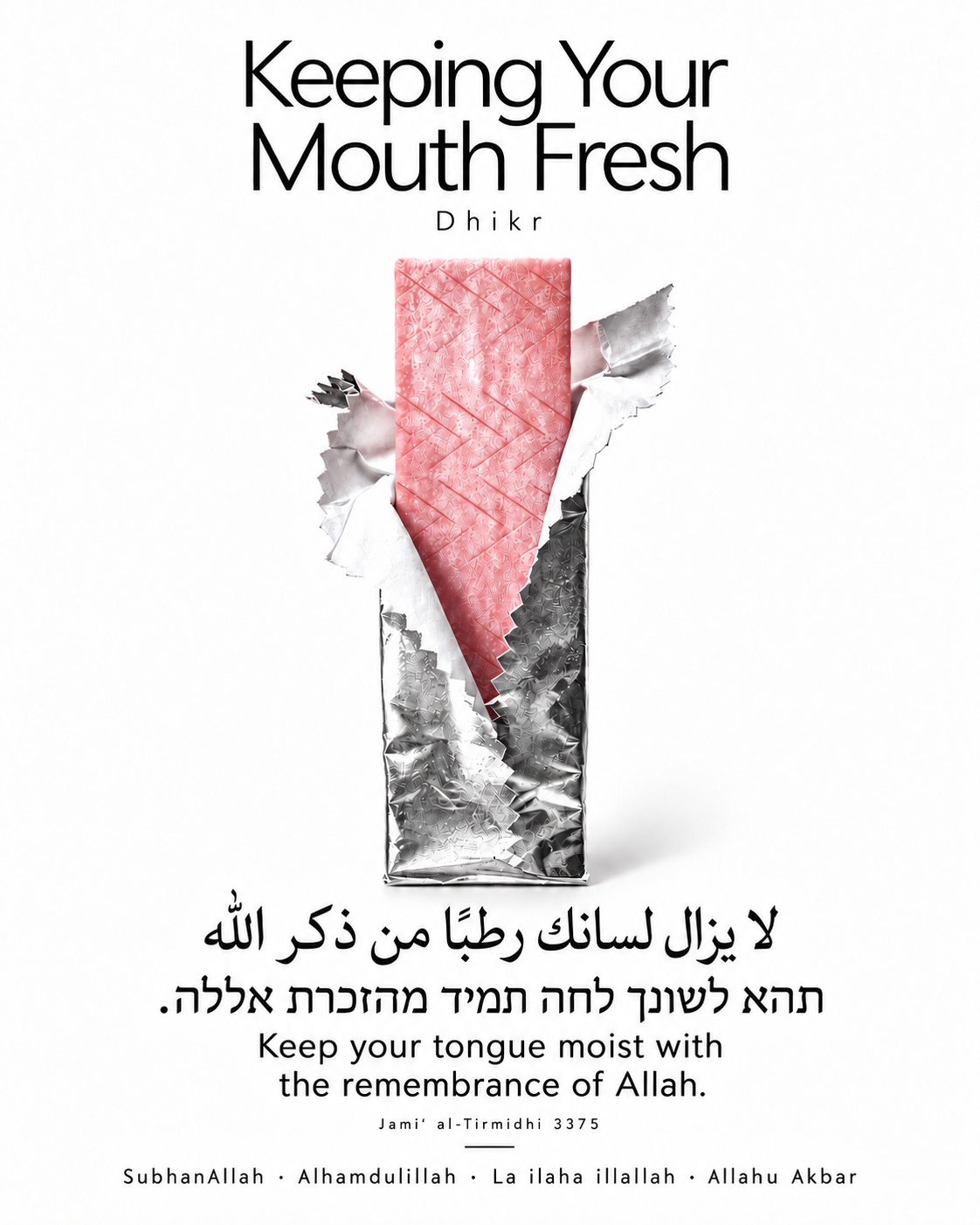
Keeping Your Mouth Fresh – Chewing Gum and Dhikr
We think carefully about how our breath smells. How carefully do we think about the words it carries?
Before a meeting, we reach for chewing gum. Before a conversation, perhaps a mint. We brush, rinse and check that we are presentable. Some people, like me, are quite particular about flossing.
There is something considerate about this. We understand that what comes out of our mouths affects the people around us.
Yet a perfectly fresh mouth can still deliver a cruel sentence.
Mint cannot sweeten slander. Mouthwash cannot rinse dishonesty out of a conversation. Someone can have immaculate teeth and leave everyone they speak to feeling smaller.
This suggests another question alongside the familiar concern about fresh breath: what keeps our speech fresh?
In Islam, one answer is dhikr: the remembrance of Allah.
A man once approached the Prophet Muhammad ﷺ feeling overwhelmed by the many religious teachings he was trying to follow. He asked for something to hold on to.
The reply was remarkably simple:
لَا يَزَالُ لِسَانُكَ رَطْبًا مِنْ ذِكْرِ اللَّهِ
“Let not your tongue cease to be moist with the remembrance of Allah.”
The narration appears in Jamiʿ al-Tirmidhi, 3375, where it is classified as hasan. (sunnah.com)
Consider the tenderness of that answer.
A person arrives feeling burdened. He receives a practice he can carry into ordinary life: keep returning to God with your tongue.
The image is vivid. A tongue kept moist, active and alive with remembrance.
Chewing gum provides the everyday analogy. We already understand repetition. We already carry small habits through journeys, queues and the spaces between appointments. Dhikr asks us to bring intention and meaning into those otherwise unclaimed moments.
The comparison concerns habit, of course. Remembrance is worship; the hadith is not a claim about dental hygiene.
But the question remains useful: if we can remember to refresh our breath, can we also remember to refresh what we do with it?
The Prophet ﷺ offered another striking image while travelling towards Mecca. He declared:
سَبَقَ الْمُفَرِّدُونَ
“The mufarridūn have gone ahead.”
Asked who they were, he explained:
الذَّاكِرُونَ اللَّهَ كَثِيرًا وَالذَّاكِرَاتُ
The men and women who remember Allah abundantly. This is recorded in Sahih Muslim, 2676. (sunnah.com)
We spend much of life wondering who is ahead.
Who earns more? Who has more influence? Who has been promoted? Whose name appears on the invitation?
Here is another measure of progress, one that may remain completely invisible to an audience.
An elderly woman quietly remembering God. A father walking home from work. A student waiting outside an examination room. Someone washing dishes after everyone else has gone to bed.
None needs a platform to begin.
The Qur’an addresses believers with a corresponding instruction: remember Allah abundantly and glorify Him morning and evening. The rhythm is explicit: remembrance belongs throughout the day. — Qur’an 33:41–42. (quran.com)
This is where masnūn duʿās—supplications taught by the Prophet—become especially useful.
They give ordinary moments a vocabulary of gratitude, dependence, repentance and hope. Waking becomes an occasion for thanks. Leaving home becomes an acknowledgement of uncertainty. Eating becomes a reminder that provision should never be taken for granted.
Dhikr includes praise and glorification; duʿā includes asking Allah for help. Together, they allow a person to keep returning to Him as circumstances change.
The following is a practical selection, with simplified transliteration and meanings. Where a particular count is given, it comes from the cited narration. The list itself is a suggested way of organising these practices, rather than a single prescribed routine.
- When you wake: begin with gratitude.
Alhamdu lillāhilladhī aḥyānā baʿda mā amātanā wa ilayhin-nushūr.
Meaning: Praise belongs to Allah, who restored us to life after causing us to die; to Him is the resurrection.
These are the Prophet’s words on waking, recorded in Sahih al-Bukhari, 6324. Before the messages, headlines and demands arrive, the day begins with recognition that waking itself is a gift. (sunnah.com) - In the morning: acknowledge who sustains you.
Allāhumma bika aṣbaḥnā, wa bika amsaynā, wa bika naḥyā, wa bika namūtu, wa ilaykan-nushūr.
Meaning: O Allah, through You we reach morning and evening; through You we live and die, and to You is the resurrection.
— Sunan Abi Dawud, 5068.
There is room here for ambition, effort and planning. There is also an acknowledgement that our existence exceeds our control. (sunnah.com) - Morning and evening: return to the final three surahs.
Recite Surah al-Ikhlāṣ, Surah al-Falaq and Surah al-Nās three times each, morning and evening.
The practice is taught in Sunan Abi Dawud, 5082. These chapters affirm Allah’s oneness and seek His protection from evil, including the evil of whispering. (sunnah.com)
Their repetition gives the beginning and end of the day a familiar point of return. - Morning and evening: keep a short phrase close.
Subḥānallāhi wa biḥamdih.
Meaning: Allah is free from every imperfection, and I praise Him.
Sahih Muslim, 2692, teaches saying this one hundred times in the morning and one hundred times in the evening, describing its great reward. (sunnah.com)
The words are brief enough to learn quickly. Their meaning deserves more attention than their length might suggest. - When leaving home: carry trust through the door.
Bismillāh, tawakkaltu ʿalallāh, wa lā ḥawla wa lā quwwata illā billāh.
Meaning: In Allah’s name; I place my trust in Him. All ability and strength depend upon Allah.
— Sunan Abi Dawud, 5095. (sunnah.com)
We leave home with plans, but we cannot command everything we will encounter. These words place that uncertainty before God while we go about our responsibilities. - At meals: put gratitude around the ordinary.
Begin with Bismillāh—in Allah’s name.
Afterwards, say Alḥamdulillāh—praise belongs to Allah.
The instruction to mention Allah’s name before eating appears in Sahih al-Bukhari, 5376. Sahih Muslim, 2734a, describes Allah’s pleasure with a servant who praises Him after food or drink. (sunnah.com, sunnah.com)
A sandwich at a desk and a glass of water can both become occasions for recognition. Gratitude need not wait for a banquet. - In the spaces between tasks: remember four phrases.
Subḥānallāh — Allah is free from every imperfection.
Alḥamdulillāh — praise belongs to Allah.
Lā ilāha illallāh — none is worthy of worship except Allah.
Allāhu akbar — Allah is greater.
The Prophet ﷺ identified these four as the words most beloved to Allah, explaining that one may begin with any of them. — Sahih Muslim, 2137a. (sunnah.com)
A queue, a walk or a quiet household task can become an opportunity to say them thoughtfully. These are practical opportunities, rather than special rituals assigned to those activities. - After prayer: give remembrance a regular place.
One established form is to say Subḥānallāh 33 times, Alḥamdulillāh 33 times, and Allāhu akbar 33 times, then complete the hundred with:
Lā ilāha illallāhu waḥdahu lā sharīka lah, lahul-mulku wa lahul-ḥamdu, wa huwa ʿalā kulli shayʾin qadīr.
Meaning: Allah alone deserves worship, without any partner. All sovereignty and praise belong to Him, and His power encompasses everything.
— Sahih Muslim, 597a. (sunnah.com)
The prayer has already interrupted the day. These words allow that pause to continue a little longer. - Throughout the day: make room for repentance.
Astaghfirullāha wa atūbu ilayh.
Meaning: I ask Allah to forgive me, and I turn back to Him.
The Prophet ﷺ said that he sought Allah’s forgiveness and turned to Him in repentance more than seventy times daily. — Sahih al-Bukhari, 6307. (sunnah.com)
Repentance invites an honest question: what should I change? A harsh reply may require an apology. A dishonest statement may require correction. The words should help us become more willing to make those repairs. - When anger rises: seek refuge before answering.
Aʿūdhu billāhi minash-shayṭānir-rajīm.
Meaning: I seek Allah’s protection from Satan, the rejected.
In an incident involving an angry man, the Prophet ﷺ identified these words as a means of removing his anger. — Sahih al-Bukhari, 3282. (sunnah.com)
Think of the modern occasions: the email written too quickly, the argument rehearsed in the car, the reply intended to humiliate.
Remembering Allah can become the moment in which we reconsider what we are about to say. - When worry and grief become heavy: name them before Allah.
Allāhumma innī aʿūdhu bika minal-hammi wal-ḥazan, wal-ʿajzi wal-kasal, wal-jubni wal-bukhl, wa ḍalaʿid-dayni wa ghalabatir-rijāl.
Meaning: O Allah, grant me refuge from anxiety and sorrow, helplessness and idleness, cowardice and stinginess, crushing debt and being overpowered by others.
— Sahih al-Bukhari, 6369. (sunnah.com)
This supplication is strikingly attentive to ordinary human burdens. It gives a person words for emotional pain, stalled action, financial pressure and vulnerability. - In distress: remember the prayer of Jonah.
Lā ilāha illā anta, subḥānaka, innī kuntu minaẓ-ẓālimīn.
Meaning: None deserves worship but You. You are perfect; I have indeed been among those who did wrong.
These are the words of Yūnus—Jonah—recorded in Qur’an 21:87. (quran.com)
The prayer combines faith, praise and an admission of fault. Even in darkness, a person can turn towards God with honesty. - During the day: send blessings upon the Prophet.
A simple form is:
Allāhumma ṣalli ʿalā Muḥammad.
Meaning: O Allah, bestow Your blessings upon Muhammad.
Sahih Muslim, 408, records that Allah bestows ten blessings upon the person who invokes a blessing upon the Prophet once. (sunnah.com)
This gives the tongue another habitual direction: gratitude for the messenger through whom these teachings were conveyed. - At bedtime: close the day with praise and trust.
Say Subḥānallāh 33 times, Alḥamdulillāh 33 times, and Allāhu akbar 34 times.
This is the bedtime remembrance taught to Fāṭimah and ʿAlī, recorded in Sahih al-Bukhari, 5361. (sunnah.com)
The Prophet ﷺ also said before sleeping:
Bismika Allāhumma amūtu wa aḥyā.
Meaning: In Your name, O Allah, I die and live.
— Sahih al-Bukhari, 6324. (sunnah.com)
The final words of the day can express trust, even when its problems remain unresolved.
There is a danger, however, in reading a list like this and immediately turning it into another source of pressure.
Learn gradually. Understand the meanings. Begin with practices you can sustain, then build upon them. The Prophet ﷺ taught that the deeds most beloved to Allah are those maintained consistently, even when small. — Sahih al-Bukhari, 6464. (sunnah.com)
The aim is to develop a relationship with the words.
When I say Alḥamdulillāh, do I notice what I have received?
When I say Astaghfirullāh, am I willing to acknowledge what I have done?
When I say Allāhu akbar, can I let a petty grievance become smaller?
These questions bring remembrance into conduct. We still need to listen carefully, carry out our work and attend to the people who need us. A tongue occupied with praise should also become a tongue that is safer for others.
The Prophet ﷺ gave a closely related instruction: whoever believes in Allah and the Last Day should speak well or remain silent. — Sahih al-Bukhari, 6475. (sunnah.com)
Sometimes the next act of care is a kind sentence. Sometimes it is an apology. Sometimes it is leaving an insult unsaid.
And there is a supplication for the person who wants to remember Allah but struggles to remain consistent:
اللَّهُمَّ أَعِنِّي عَلَى ذِكْرِكَ وَشُكْرِكَ وَحُسْنِ عِبَادَتِكَ
Allāhumma aʿinnī ʿalā dhikrika wa shukrika wa ḥusni ʿibādatik.
O Allah, help me to remember You, thank You and worship You well.
The Prophet ﷺ taught this to Muʿādh ibn Jabal, instructing him not to neglect it at the end of each prayer. — Sunan Abi Dawud, 1522. (sunnah.com)
Even the ability to remember can be something we ask God to help us with.
So keep the toothbrush. Keep the mint. Keep the consideration for the person sitting beside you.
And, as you go through the day, consider what else your mouth might carry: gratitude at breakfast, trust at the doorway, repentance after a mistake, restraint in an argument, praise before sleep.
Fresh breath makes a conversation more pleasant.
A tongue trained in remembrance should help make the person speaking more considerate, too.
Related Topics
Related Posts