
Ki Teitzei: Belonging Is a Fence, Not Just an Open Door
Why does a home need a fence before it needs a mezuzah? It is a strange question, but it is the one this week’s parsha, Ki Teitzei, quietly puts to us. “When you build a new house, you shall make a parapet, a ma’akeh, a protective fence, for your roof, so that you do not bring bloodguilt on your house if anyone should fall from it” (Deuteronomy 22:8).
In the world of the Torah, roofs were flat, and people used them the way we use a porch. A railing was simply common sense. What is striking is how far our tradition takes it. The Netziv taught that “a house is more halachically dependent on a ma’akeh than on a mezuzah.” You may live in a home with no mezuzah on the doorpost; you may not live in one with no fence on the roof. A missing mezuzah is a sin; a missing fence is a danger. Sometimes love looks less like a blessing on the door and more like a railing at the edge.
I have been thinking a lot about fences lately, because I have been thinking about belonging. (I wrote about belonging not long ago, so forgive me for circling back to the theme.) We spend so much of our energy making sure people feel welcomed in, that a seat is waiting for them. The ma’akeh is the other half of that same sentence. Belonging says, there is room for you here. The fence says, and we will keep you safe now that you are in.
Of course, a fence can just as easily wall people out; the same instinct that protects can harden into exclusion. But notice what kind of fence the Torah asks for. A ma’akeh is low and open, a railing and not a wall, built to catch someone who stumbles and never to keep people off the roof. The point was never to keep anyone out. It was to make sure that no one falls.
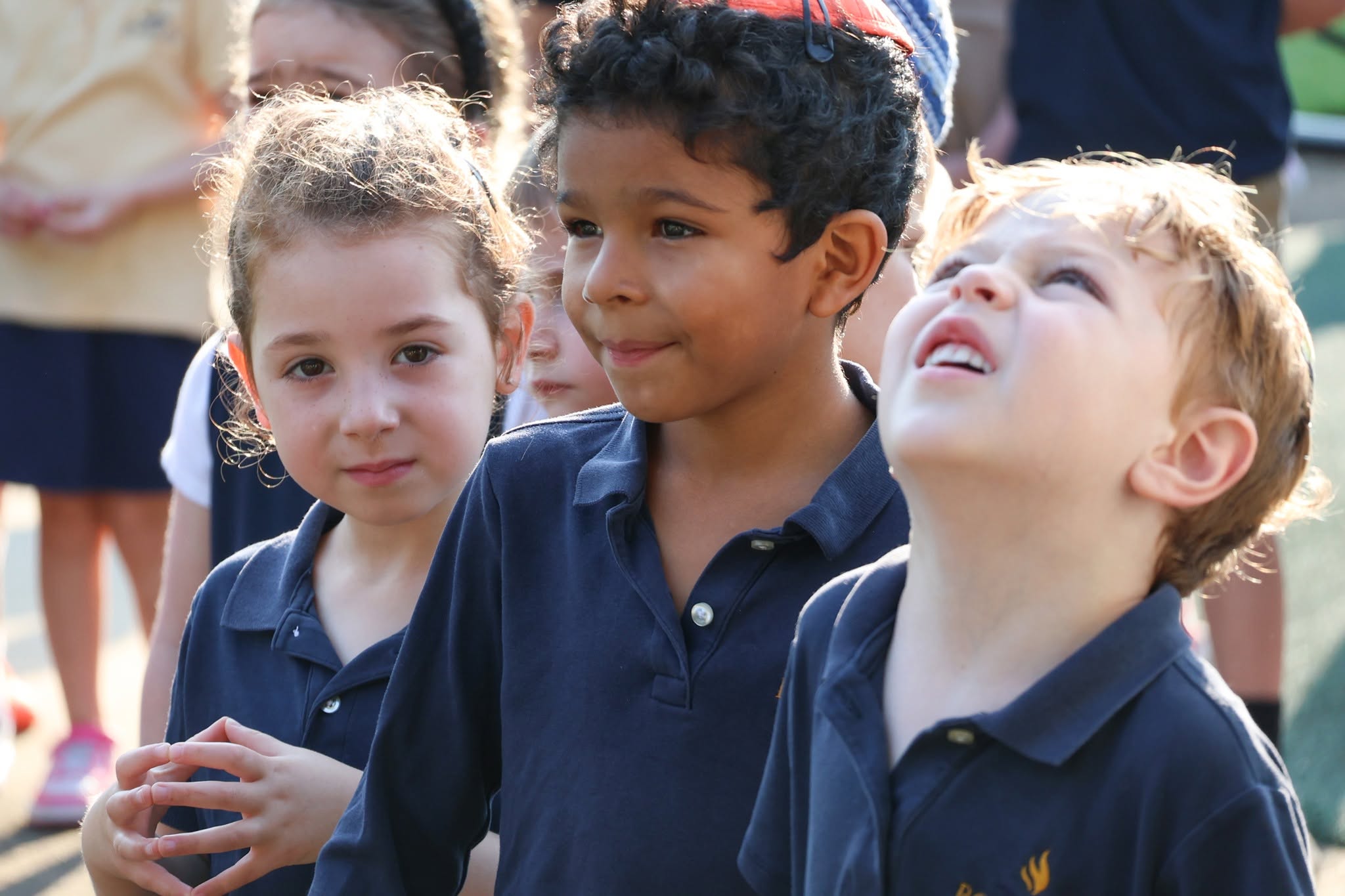
I have watched both halves of that sentence come to life in these first two weeks of school. On the first morning of the second week, a kindergartner arriving at drop-off noticed a classmate who had missed the opening week, took her by the hand, and walked her into class. An eighth grader told me, unprompted, how excited she was for the chance to grow as a leader in our middle school. A fourth grader zipped a laptop into its bag for the very first time, ready to carry it from one class to the next on his own. Welcome and structure, the open door and the steady railing, in three small people moving through an ordinary Monday.
The rabbis noticed something else. The Hebrew word for “your roof,” gagecha, carries the numerical value of 26, the very same as the four-letter name of God. Secure your roof, they suggested, and you are tending to your relationship with the Holy One. A guardrail, it turns out, is a spiritual instrument. The same is true of a bayit.
Our tradition loves to stretch the word bayit, house, until it means far more than a building. The Talmud goes so far as to say that a person’s spouse is his home; Rabbi Yossi, we are told, never spoke of “my wife,” only of “my home.” The synagogue is a beit knesset, a house of gathering. The school where I spend my days is a beit sefer, a house of the book. Each of these houses asks the same two questions of us: are we building it, and are we fencing it?
After several cross-country moves over the past 25 years (my wife will tell you I am far better at counting the moves than at packing for them), I have come to believe that the fence we build is not in any one house. It is in the marriage itself, and in the community we keep choosing. When we arrived in Memphis, we had barely hung our mezuzot when my father-in-law passed away. A piece of our fence came down. And it was this community, still mostly strangers to us then, who quietly stepped into the gap and helped us hold the edge.
The parsha does not speak only of roofs; it speaks of children, even the “wayward and defiant son,” whom the Torah says should be brought to the elders and stoned. It is a hard passage to sit with, until you learn that the rabbis could not sit with it either. The Talmud declares that such a case “never was and never will be,” and that the law was written “only so that we may study it and receive reward” (Sanhedrin 71a). The harshest verses in the parsha turn out to be a lesson, not an instruction. I confess I also cannot read them without hearing the band Kansas somewhere in the back of my head (yes, the 1976 song): “Carry on, my wayward son; there’ll be peace when you are done.” Our task as parents, and as a school, is not only to fence our children in from danger. It is to build them a house worth staying in, and then to trust the home we made even when their choices are not the ones we would have made.
It is no accident that we read all of this in Elul, the month whose name our sages read as an acronym for Ani l’dodi v’dodi li, “I am my beloved’s and my beloved is mine,” a line recited by so many brides on their wedding day after circling their groom. Elul is the season for walking the perimeter and checking our fences, in our homes, our marriages, our shuls, our schools, and our own souls, and mending the places where the railing has worn thin. A home is not complete the moment the mezuzah goes up. It is complete when we have made it safe enough for the people we love to stand at the very edge and not fall. Our Jewish Day Schools are meant to be exactly that kind of home: a community, a fence, a place to belong. So too, every child who walks through our doors, or the doors of all of our Jewish Day Schools, and every family who trusts us to hold the edge, my prayer for this new year is that we prove to be your fence, the one that lets you stand tall at the very edge, unafraid.