Koach on the Court: Why Basketball Is a Jewish Sport
(Image courtesy of author)
“It is not your duty to finish the work, but neither are you free to desist from it.” — Pirkei Avot 2:21
From the Santa Monica Y to the public courts of New York — and even to the bright lights and cushy seats of NBA arenas — basketball has followed me like a faithful shadow.
It still surprises me sometimes — how unlikely it all was. For a religious girl with dreams of Hollywood, movie stars, and a life scored to a Beach Boys soundtrack, I somehow traded it all in to become a gym rat. I found my stories not under studio lights, but beneath fluorescent ones — in the rhythm of bouncing balls, the scent of varnish and popcorn, and the chorus of sneakers singing across the floor.
The rhythm was always the same — sneakers squeaking, coaches shouting, the whoosh of the net — and it became the heartbeat of home.
Then came a long silence. Local politics and the war kept me out of the gym for three years. The familiar echo of the ball faded, replaced by headlines, tension, and the kind of exhaustion only uncertainty can bring.
And then Yohai Ezra, Josh Nzeakor, and my young friends in Tzfat brought me back. Yohai kept the team going despite drastic cuts by the mayor and the sports authority — fighting for every shekel, every hour of court time, every kid who still believed in the game. His determination was contagious.
But the pressure is still on. Sponsorships and ticket sales notwithstanding, we still need to raise 250,000 shekels (about $65,000) to keep this dream alive — to cover travel, uniforms, equipment, and all the invisible costs of keeping a small city’s big dream from collapsing.
And then, as if on cue, a new chapter arrived.
I didn’t know Josh Nzeakor three weeks ago. But from the moment we met, I was back in familiar territory — an enthusiastic, talented player looking to me for knowledge, grounding, and a little confidence to guide him off the court. I immediately felt the old, familiar magic return — that spark that happens when experience meets potential, and two people recognize the same love of the game from opposite ends of the court.
Word spread fast in Tzfat. A new player — six foot eight, power forward, from Mesquite, Texas — had arrived. For the kids here, it was like a celebrity sighting. My young friend Or Yosef kept asking, “How big is six-eight?” I told him, “When you meet him, shake his hand — your hand will disappear.”
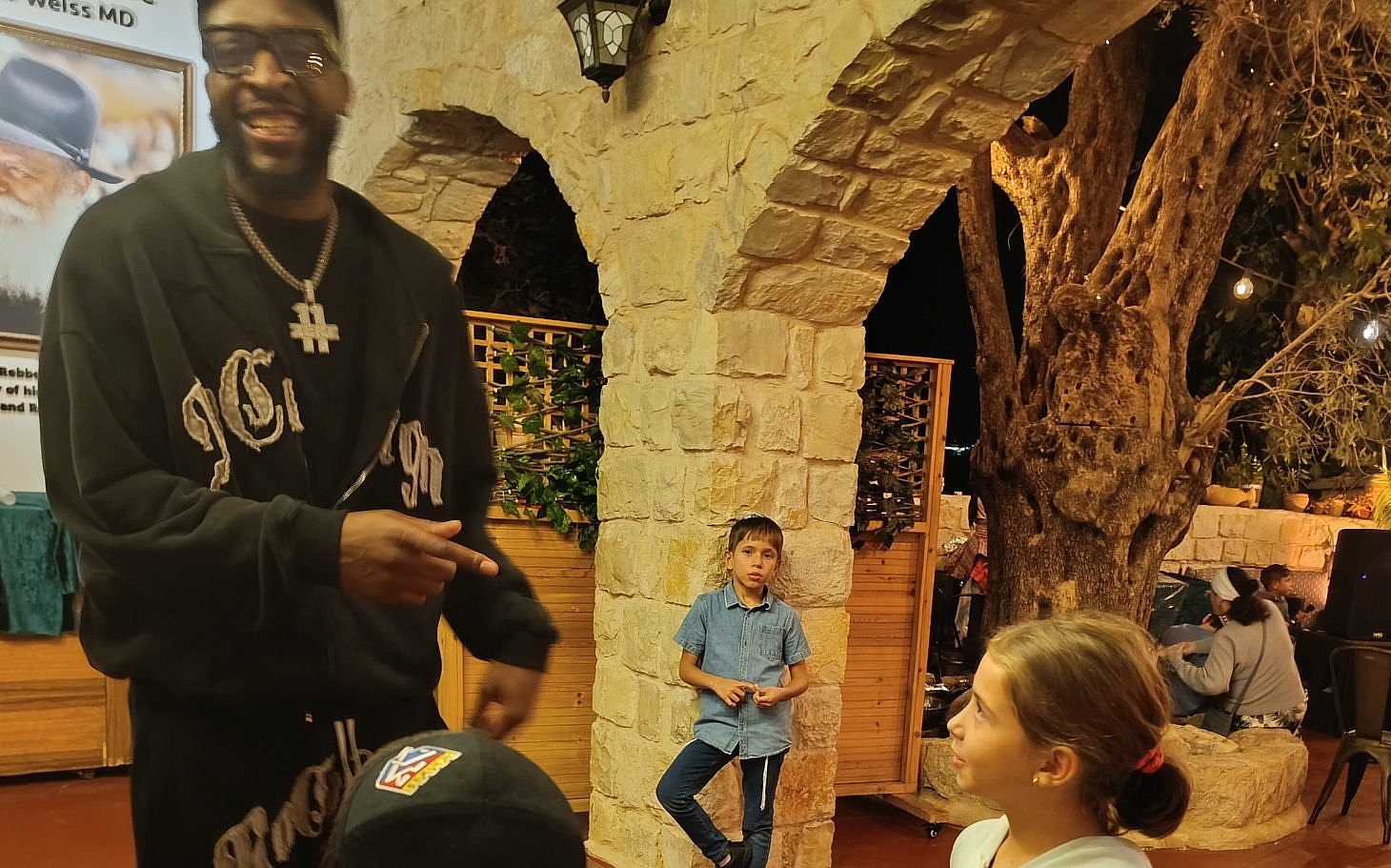
When Josh finally walked into our Sukkot barbecue in our synagogue’s courtyard, heads turned. His size, his calm, his easy smile — it all landed at once. Within minutes, he was talking with fans, laughing with kids, and fitting right in as if he’d been part of our community forever. He took pictures, tasted the grilled chicken, and asked about the city like someone who genuinely wanted to belong.
But Josh’s road to Tzfat wasn’t a straight one. His professional career has taken him to eight countries before landing here — from South America to Europe to Asia. He played in those places, yes, but he didn’t connect there. He was an athlete doing a job, not a man discovering a home.
Israel has been different from the start. Despite the naysayers — and his parents’ entirely reasonable concern about voluntarily heading into a war zone — Josh said, “I’m going to see what’s really going on in Israel.”
From the moment he stepped off the plane at Ben Gurion, something shifted. He wasn’t just an athlete chasing a championship anymore; he became an ambassador for Israel and the Jewish people — not because anyone asked him to be, but because he chose to see with his own eyes. It took only a few minutes for him to realize that the false narrative he’d been hearing bore no resemblance to the truth he was living.
When he arrived in Tzfat, Josh found something he hadn’t expected. This wasn’t Tel Aviv nightlife or Jerusalem intensity. It was quiet, ancient, a little eccentric — a place where mystics and musicians walk the same cobblestones, where everyone knows everyone, and where the line between the sacred and the everyday blurs by about noon.
For now, he’s still finding his footing. The alleyways twist, the Hebrew comes fast, and the rhythm of Tzfat takes time to learn. But I can already see it — the day he’ll be standing in line for pizza on Jerusalem Street, taking selfies with kids after practice, waving from my golf cart as naturally as if he’d always been here.
Because that’s what happens in this city. It folds you in. Slowly, warmly, and without ceremony. And I think Tzfat is going to do that for Josh. Maybe it already has.
It was a buzz to see Rabbi Traxler gaze into Josh’s eyes — two men of faith, from different worlds, yet instantly comfortable as two Texans and two believers. No theology, no politics — just that quiet recognition that faith can sound the same, even in different languages.
And then there was Chana — officially Mrs. Traxler, but to everyone here she’s just Chana — standing nearby with that unmistakable glow. She was talking about her hometown team, the Chicago Bulls, her sister the sports photographer, and her family’s shared love of the game. In that courtyard, between the laughter and the smell of grilled food, you could feel something larger happening: contrasts merging through simple, joyful sharing.
That’s Tzfat at its best — a city where mystics, artists, rabbis, and basketball players can all find common ground over a plate of barbecue and a good story.
Standing there in the synagogue courtyard that night, I realized this wasn’t just about basketball. It was about what the game awakens — belief, trust, connection — the same things that build a city, or heal it.
Basketball has always been a language of motion, of second chances and teamwork. But here in Tzfat, it’s also become a kind of prayer — one made of layups instead of liturgy, where the court becomes a sanctuary and the players, in their own way, are saying hineni — I’m here.
For me, coming back to the gym wasn’t nostalgia. It was renewal. After years of headlines, politics, and worry, I’ve rediscovered the simple joy of watching people lift each other up — literally and figuratively. Yohai’s stubborn devotion, Josh’s courage, the kids’ laughter echoing through the stone courtyards — it’s all part of the same melody.
Maybe that’s what Tzfat has always known: faith and resilience aren’t opposites — they’re teammates. Under these blue hills, a new team is proving that hope still plays here.
—
Susan Cohen is a career journalist and community advocate, the second of four generations of her family to live in Tzfat.
Related Topics
Related Posts