Korach and the Mob
Korach and the Mob
Korach is one of the most dangerous political figures in the Torah because he says something that sounds true. In Numbers 16, Korach and his men rise against Moses and Aaron and say: “You have gone too far. For all the congregation, all of them, are holy, and the Lord is among them. Why then do you raise yourselves above the assembly of the Lord?” It is a magnificent sentence because it sounds like equality, like protest against monopoly, like resistance to a closed center that decides who may speak, who may lead, who may approach, and who must remain outside.
That is precisely why Korach is dangerous. He does not begin with atheism, cynicism, or open violence. He begins with a phrase that almost sounds democratic. His error is not that he rejects holiness, but that he converts holiness too quickly into a political claim. He takes a truth about the community and turns it into an entitlement to the center. He wants access without threshold, function without burden, authority without the discipline that makes authority bearable. He confuses the holiness of the people with the right of a faction to dissolve every distinction that allows the people to remain a people.
The usual English word “holiness” is too weak here. The Hebrew field is more severe. Havdalah names structural separation: the establishment of a boundary that prevents incompatible orders from dissolving into one another. Kedushah names the charged condition of being set apart. It is not moral superiority or religious elevation. It is a dangerous regime of access, burden, and responsibility. Something kadosh is not simply “better.” It is insulated, charged, exposed to danger, and placed under a different law of approach.
Korach’s error is not that he affirms the dignity of the whole congregation. His error is that he collapses structural setting-apart into a slogan. He takes the fact that Israel is set apart and turns it into the claim that every internal threshold has lost its legitimacy. In other words, Korach confuses collective election with functional interchangeability. He confuses the holiness of the people with the right of any faction to enter any charged position without the required discipline, insulation, and burden.
Korach does not merely challenge Moses and Aaron. He tries to discharge the system into the crowd. He takes a structured field of access, danger, function, and responsibility and attempts to flatten it into immediate collective entitlement. This is why his revolt is not only against men. It is against form.
Korach does not come alone. He comes with a mob, and that word should not be treated merely as an insult. A mob is not simply a crowd. A crowd may still contain order, memory, roles, and restraint. A mob is what remains when collective energy has lost internal differentiation. It speaks in the name of the whole, but it no longer preserves the thresholds that allow the whole to exist.
This is why the rebellion of Korach is not merely a political quarrel. It is a crisis in the inner geometry of Israel. Korach and his mob do not simply ask whether Moses and Aaron have too much authority. They attempt to dissolve the very system by which authority, access, danger, and responsibility are distributed. Their revolt is not only against a hierarchy. It is against the possibility that any position might require a threshold.
Moses does not answer Korach with a theory of leadership. He does something far more severe. He establishes a test. The rebels are told to take fire-pans, place fire in them, put incense upon them, and stand before the Lord. This is not ritual theatre. It is an operation of admissibility. Incense will show who can approach the center without destroying himself and the community. If Korach is right, his claim will survive the test. If he is wrong, the procedure itself will reveal that access without the proper threshold is not liberation but catastrophe.
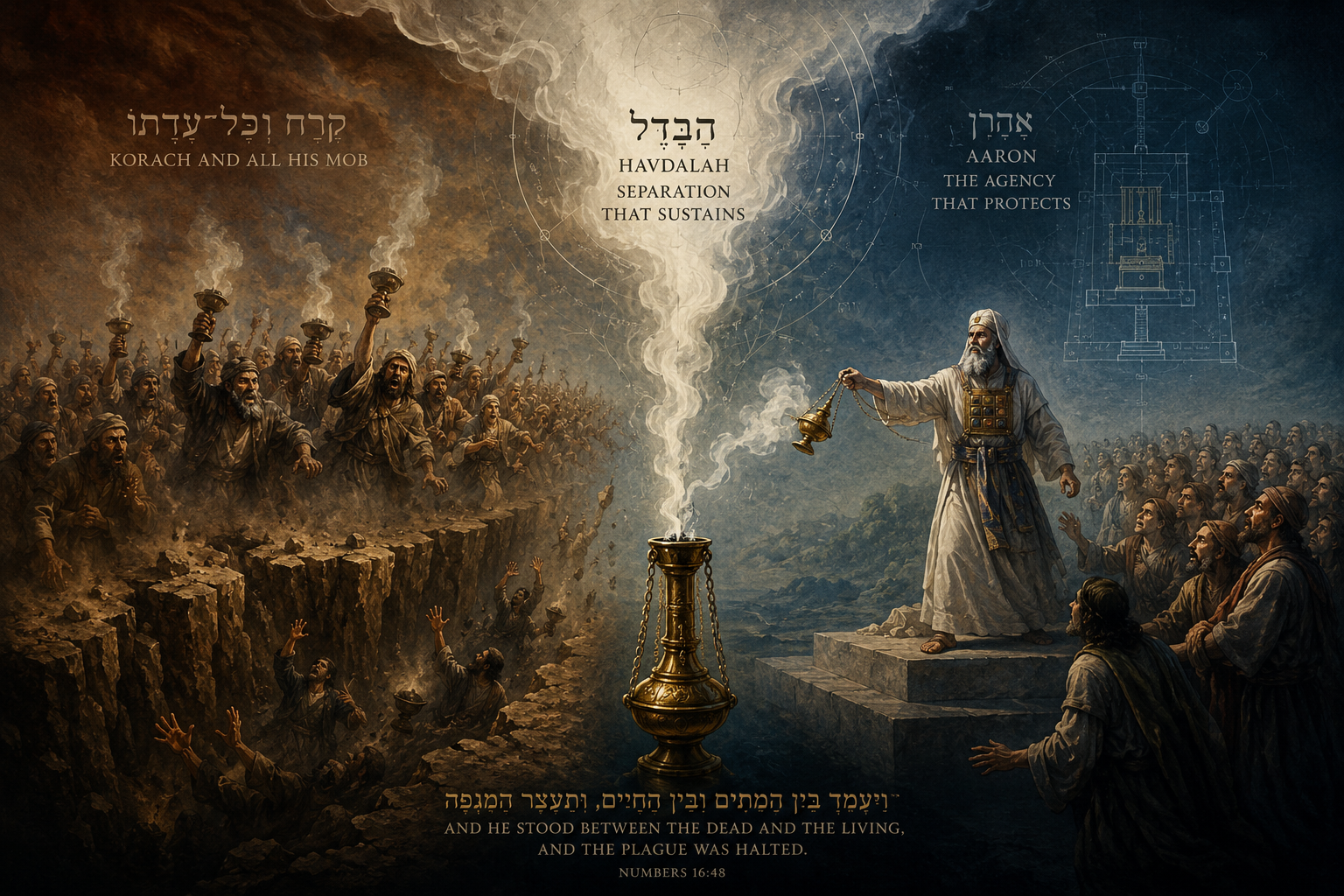
And this is what happens. The earth opens its mouth and swallows Korach, Dathan, Abiram, their households, and those attached to them. Fire comes out from the Lord and consumes the two hundred and fifty men who offered incense. The rebellion is not simply refuted. It is inscribed into space as the collapse of ground. This is the terrifying precision of the biblical scene: a false claim to the center does not end with a lost debate. It ends with the loss of the ground itself.
Yet the Torah does not allow the episode to disappear into punishment. The fire-pans remain. The vessels used in the unauthorized approach are not thrown away. They are gathered from the burning and hammered into plating for the altar. The residue of catastrophe becomes a boundary marker. What had been an instrument of usurpation becomes a visible warning. The altar itself now carries the memory that not every access is admissible, not every intensity is holy, and not every slogan of equality can bear the weight of responsibility.
The most powerful scene comes later. The whole congregation begins to murmur against Moses and Aaron, and a plague breaks out. Moses tells Aaron to take his fire-pan, put fire from the altar into it, add incense, and go quickly into the congregation. Aaron runs into the middle of the catastrophe and stands “between the dead and the living.” The plague stops. Few images in the Torah are more politically and ritually exact.
Aaron does not give a speech. He does not explain history. He does not organize a discussion about unity. He does not flatter the people, and he does not imitate Korach’s language. He stands at the threshold between life and death. The incense is not a symbol of pleasant reconciliation. It is a barrier, a controlled act of structural setting-apart, an intervention that arrests a destructive process before it consumes the whole.
Only here does the full contrast become visible. Korach and Aaron both use a fire-pan, but they do not perform the same act. Korach uses the fire-pan to force access to the center. Aaron uses the fire-pan to save the community from disintegration. Korach brings incense as a claim. Aaron brings incense as responsibility. Korach stands at the head of a mob that wants the center without the ground. Aaron stands between the dead and the living so that the ground will not disappear beneath everyone.
This is not ancient. It is painfully modern. Political helplessness today rarely appears as open slavery. It usually appears as realism. People say: this is geopolitics, this is America, this is Trump, this is Iran, this is Europe, this is the region, this is the price of oil, this is how great powers behave, this is war, this is necessity, this is the world. Much of this may be partly true. But partial truth can become the most efficient form of surrender when it is arranged in such a way that responsibility disappears.
False realism does not need to lie. Its technique is more refined. It tells the truth in a way that abolishes agency. It shows conditions but hides decisions. It names external forces but erases internal responsibility. It describes constraint but remains silent about those who deepened the constraint, used it, benefited from it, or turned it into a method of political survival. This is the most convenient political theology of our time: man no longer has to answer because geopolitics answers for him.
But citizens were not given the right to choose power so that they could later say that history decides everything. They were not given the right to criticize power so that they could remain silent while leaders turn strategy into spectacle, institutions into bargaining chips, national security into rhetoric, and dependency into proof of their own indispensability. The right to criticize power is not left-wing or right-wing, religious or secular, liberal or conservative. It is one of the elementary forms of political responsibility.
A people that cannot criticize its own leaders is not united; it is managed. A people that cannot ask its leaders for a political project is not realistic; it is disarmed. A people that repeats “geopolitics” where it should ask “what have you done with the state entrusted to you?” diminishes its own agency. This is the sadness of learned political helplessness: a person has rights but no longer connects them with his own life.
He has the right to vote, but uses it as a ritual of belonging. He has the right to criticize, but treats criticism as betrayal. He has the right to demand a political project, but accepts permanent emergency, symbolic loyalty, and another explanation that the real causes are always elsewhere. Then the bill arrives as war, debt, inflation, isolation, dependence on foreign ammunition, foreign patience, foreign elections, foreign interests, and foreign doors. Then people say: we were betrayed. Perhaps. But very often, before that, they gave away their own agency.
Korach is therefore a double warning. On one side, he shows the danger of false revolt: a revolt that speaks the language of the community but refuses the burden of responsibility. On the other side, he reminds us that authority cannot be exempt from questioning. Moses is not protected in the Torah because power is always sacred. Quite the opposite: the Hebrew Bible is one long archive of disputes with kings, priests, prophets, the people, God, and history.
This is what is too easily forgotten. Jewish thought is not the art of obedient silence. Judaism did not survive because it prohibited questions. It survived because it made questioning a form of life. Disagreement was not an ornament added to tradition. It was one of its internal conditions. Commentary was not decoration. It was a way of sustaining responsibility before text, law, community, and God.
But not every disagreement is thought. Korach also questions. Korach also challenges. Korach also speaks against the center. That is why his figure is so important. He teaches that criticism alone is not enough. Criticism can be an act of responsibility, but it can also become a way of seizing power without accepting the burden that power carries. A mob can quote a truth and still destroy the form that makes truth livable.
The choice is not between obedience and rebellion. That is too simple, and the Jewish tradition is more exacting than that. The real task is to distinguish thought from gesture, responsibility from claim, project from performance, criticism from resentment, realism from surrender, holiness from usurpation, unity from managed silence, and community from mob. False realism tells the citizen not to ask too much because the world is dangerous. Jewish thought answers that precisely because the world is dangerous, one must ask.
False realism says not to criticize power because the enemy is watching. Jewish thought answers that if power is leading the community toward catastrophe, silence also becomes participation. False realism says not to demand a project because conditions are too difficult. Jewish thought answers that difficult conditions are exactly where leadership must be asked for more than slogans of loyalty.
There is no romantic innocence here. The world is real. War is real. Enemies are real. Dependencies are real. Ammunition, money, oil, borders, technology, alliances, and great powers are real. But the decisions of one’s own leaders are also real. The coalitions they build are real. The institutions they weaken or strengthen are real. The privileges they grant are real. The burdens they distribute or refuse to distribute are real. The illusions they sell as strategy are real. The dependency they deepen while speaking endlessly of sovereignty is real.
This is why citizens do not have the right to say that nothing can be done. Perhaps they cannot do everything, but they can refuse to surrender judgment. They can ask questions. They can demand a project. They can stop treating criticism as treason. They can understand that daily life is not disconnected from political decisions. They can stop pretending that history acts alone.
Korach is swallowed by the earth because his claim has no ground. But a community that stops asking questions also loses the ground beneath it, only more slowly, more administratively, with more press conferences, experts, flags, slogans, and reassuring explanations. The greatest danger is not rebellion as such. The greatest danger is losing the ability to distinguish rebellion that demands responsibility from rebellion that merely wants to seize the center, realism that recognizes conditions from realism that justifies helplessness, and unity that protects the community from unity that forbids thought.
Korach and his mob show that a beautiful sentence can become a catastrophe when it lacks the ground of responsibility. But power that forbids questions also prepares catastrophe. Between these two dangers, Jewish thought begins: not obedience without judgment and not revolt without burden, but the question that refuses to let either power or the mob occupy all of reality.
Jewish thought begins wherever a person refuses to give away his question: not to the market, not to empire, not to the leader, not to the party, not to geopolitics, not to fear, and not to Korach, who comes with a beautiful sentence, but without the ground capable of bearing its consequences.
Yochanan Schimmelpfennig