
Kurdistan and Israel in the New Middle East
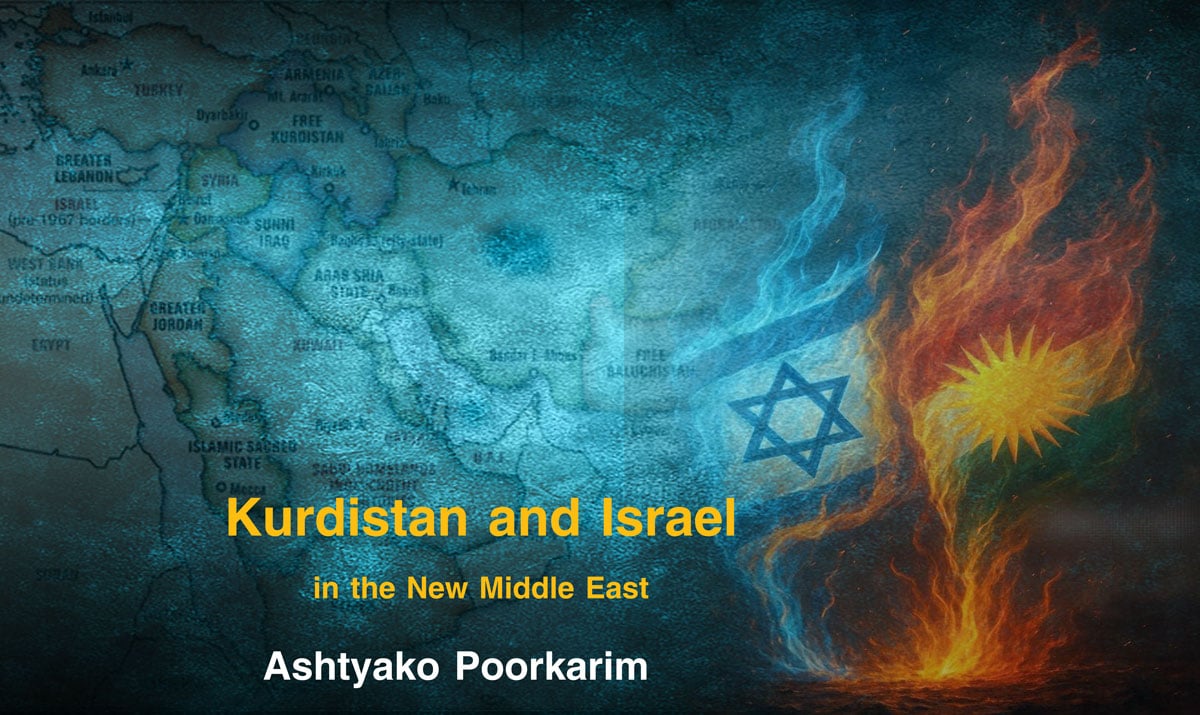
By Ashtyako Poorkarim (“Jamal”)
Leader, Kurdistan Independence Movement
A shared past, a shared horizon
The Middle East is being rewritten—sometimes by diplomats around polished tables, more often by people forced to choose between flight and resistance. In that rewriting, two nations with ancient roots and modern scars stand out: the Kurds and the Jews. One built a state after genocide; the other has survived repeated genocidal campaigns without sovereign shelter. If Israel proved that a people can return from exile and ensure “Never Again” through statehood, then Kurdistan can prove that lesson was universal, not exceptional.
This is an argument about strategy, law, and morality—but above all, about security. For a century, the Kurds have been partitioned and punished for simply wishing to exist. For millennia, the Jews were hounded for being themselves. Our trajectories converged in the twentieth century’s darkest chapters—the Holocaust and the Anfal—where industrial and state-planned annihilation became policy. Our trajectories can—and should—converge again in the twenty-first century to build a different Middle East: one anchored in sovereignty, accountability, and the right of nations to self-determination.
From “stateless” to “occupied”
The vocabulary we use matters. The label “stateless nation” implies deficiency. It suggests Kurds lacked the capacity or the legitimacy to govern themselves. History says otherwise. Kurdistan was not “naturally” stateless; it was made so—by Sykes–Picot, by Lausanne, and by successor regimes that fused authoritarianism with homogenizing nationalisms. A better term is occupied nation: a people with historical statehood whose land was divided, whose institutions were dismantled, and whose identity has been administratively criminalized.
This reframing is not academic wordplay. It clarifies responsibility. If a nation’s lack of a state is an accident of empire and a project of occupation, then the remedy is political and legal: de-occupation, recognition, and statehood. The Jewish people learned this in the hardest way possible. The Kurds live it still.
The machinery of enmity
Authoritarian regimes manufacture enemies to survive. Iran’s theocracy, Ba’athist Iraq and Syria, and successive Turkish governments each turned the Kurds into a permanent “security problem,” and Israel into a metaphysical enemy. The script is familiar: brand the other as a traitor, deny their language, erase their toponymy, displace their villages, then criminalize any attempt to organize. In the Kurdish case, this escalated to genocide—Anfal and Halabja are not footnotes but warning flares visible from the past into the present.
The ideological drivers—Islamist fundamentalism and extreme nationalism—often appear opposed. In practice, they cooperate against pluralism. Both demand a singular “nation,” a singular “truth,” and a singular “enemy.” Both thrived because the international system indulged them when convenient and looked away when costly. The result is a region where genocide has a history, but impunity has a longer one.
Strategic convergence: why Kurds and Israel need each other
There is nothing inevitable about alliances. They happen when interests overlap and values rhyme. Today they do.
-
Shared threats: The IRGC’s regional network, militias aligned with Tehran, jihadist remnants, and neo-Ottoman revanchism in Ankara all target Kurdish self-rule and Israel’s security.
-
Complementary strengths: Israel brings intelligence, technology, deterrence, and global diplomatic reach. Kurds bring geography, battlefield credibility against ISIS, and a population whose democratic aspirations have proven resilient wherever they’ve had space to breathe.
-
Moral clarity: Linking the memory of the Holocaust and the Anfal is not rhetorical theater—it is a diplomacy of memory that grounds strategy in lived truth: peoples without sovereignty are the easiest to kill and the last to be mourned.
A Kurdish–Israeli strategic compact would not be a conspiracy of minorities; it would be a coalition for regional stabilization. Its pillars are straightforward:
-
Security cooperation: Training, force protection, cyber defense, and early-warning architectures in Kurdistan’s mountains that harden the frontiers of freedom against proxies and predators.
-
Energy and water partnership: Transparent, legal routes for Kurdish oil and gas to Mediterranean markets alongside Israeli investment in water management and agritech that make Kurdish communities more resilient than the militias that threaten them.
-
Knowledge economy bridges: Joint research centers, scholarships, and hospital-to-hospital linkages that turn Kurdish cities into hubs rather than hinterlands.
-
Diplomacy of memory: A twin-museum initiative—Anfal & Holocaust—in Erbil and Jerusalem; coordinated remembrance that educates publics and anchors policy in “Never Again” for everyone, not just some.
Law is on our side—if politics catches up
The UN Charter and the International Covenants affirm peoples’ rights to determine their political status. Precedents—from the Baltics to South Sudan—prove that when genocide and denial are documented, recognition can follow. Kurdistan meets every legal test that the modern system claims to value: historical nationhood, an identifiable territory, sustained self-government where possible, and a clear record as a victim of internationally recognized atrocities.
The obstacle has never been law; it has been geopolitical timidity. That is where a Kurdish–Israeli alliance, coupled with synchronized lobbying by the Jewish and Kurdish diasporas, can convert moral capital into policy outcomes. What AIPAC, EJC/WJC, and community institutions learned over decades does not have to be reinvented by Kurds—it can be adapted and shared.
The corridors that will shape tomorrow
Talk of a “New Middle East” often collapses into clichés. Strip away the slogans and you find corridors—energy lines, fiber optics, logistics chains—that will define who prospers and who depends. Three realities follow:
-
If the new map bypasses Kurdistan, it strengthens the very regimes that seek to erase us.
-
If Kurdistan is included without sovereignty, it becomes a mere passage—resources extracted, dignity denied.
-
If Kurdistan is sovereign, it becomes a stabilizing hinge linking Mediterranean to Gulf, Caucasus to Levant, West to East—with accountability baked in.
Israel has an obvious interest in such a hinge. So do Europe and the United States, which cannot afford another generation of wars and refugee flows produced by authoritarian misrule. A recognized Kurdistan—democratic by design because pluralism is in our DNA—anchors corridors in law rather than in intimidation.
Models and milestones, not mirages
Statehood is a process. There are multiple on-ramps; all require discipline.
-
Government-in-exile (near-term): A provisional body in Europe to consolidate diplomacy, standardize policy, and speak with one voice to allies—Israel first among them.
-
Federative transition (mid-term): Deepen and legalize Kurdish self-government where it exists (Iraq, Syria), align defense and foreign-affairs competences, and codify mutual defense.
-
Recognition and UN seat (end-state): The logical outcome once genocide is adjudicated, institutions are consolidated, and regional security partners accept that a responsible Kurdish state lowers—not raises—risk.
None of these steps is guaranteed. All are accelerated when Israel’s experience, advice, and advocacy are embedded in the project from the outset.
To friends in the West: your interests are at stake
For Washington, Brussels, London, Berlin, and Paris, this is not charity. It is strategy.
-
You cannot defeat Islamist extremism while outsourcing Kurdish security to regimes that incubate it.
-
You cannot stabilize energy markets while denying legal export routes to one of the region’s major reserves.
-
You cannot credibly preach human rights while ignoring the documented genocide of the Kurds.
Support for Kurdish independence—sequenced, conditioned, and verified—advances Western interests: fewer wars to manage, fewer refugees to receive, and more partners who share your political DNA.
A new social contract for a new state
Kurdish independence is not a flag alone; it is a covenant: constitutional guarantees for minorities (Assyrians, Yazidis, Turkmen, Arabs, Armenians, Jews), decentralization to avoid replicating the centralist states that oppressed us, and civilian control over the armed forces that defended us. The Kurdish struggle has always been multiethnic in practice; our state must be so in law.
Conclusion: From remembrance to responsibility
The Holocaust taught that memory without power is elegy; Anfal taught that documentation without sovereignty is an archive for future prosecutors, not a shield for living people. The lesson is unsentimental and urgent:
-
Without independence, Kurds will continue to face the conditions that make genocide possible.
-
Without a strategic alliance with Israel, the path to that independence will be longer, costlier, and less secure.
A Kurdish–Israeli compact is not a provocation. It is a peace project: to end cycles of extermination, to replace proxy warfare with accountable borders, and to make self-determination the region’s norm rather than its exception.
The map of the New Middle East is already being drawn. The only question is whether it will be drafted by those who believe in freedom under law, or by those who believe that some peoples exist only at another’s pleasure. Israel answered that question in 1948. Kurdistan is ready to answer it now.