Solicitor & foreign policy adviser
Labour’s Israel policy is electoral pandering
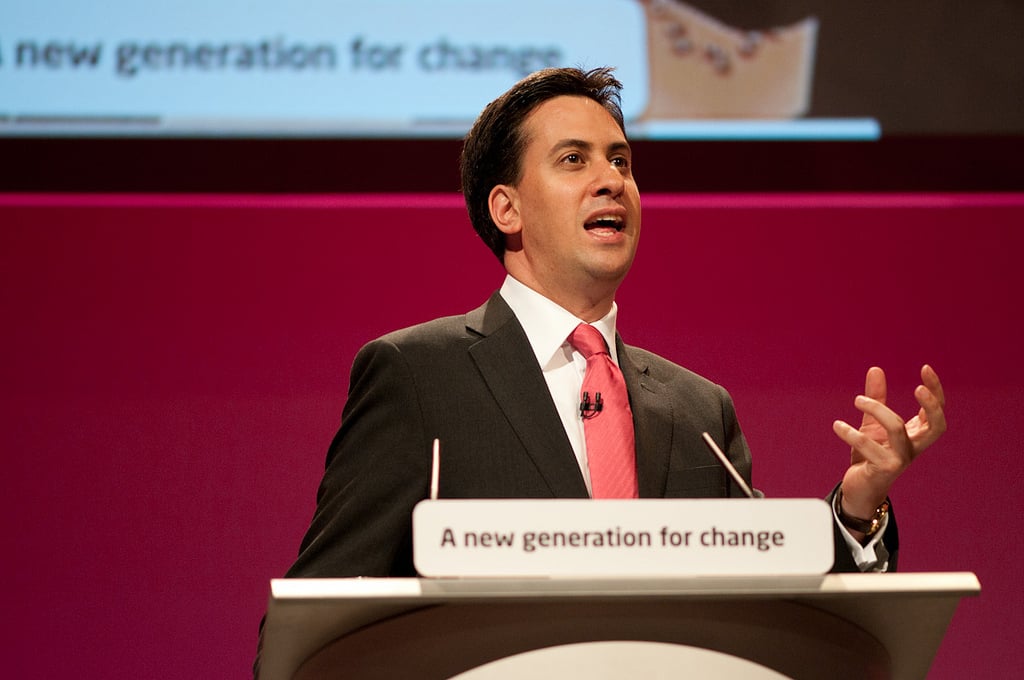
Photo by Ed Miliband on Flickr
There is something almost admirable about the efficiency with which Andy Burnham and Ed Miliband have converted a modest trade restriction into a diplomatic crisis with Israel. But then again, Labour has a peculiar knack for turning domestic token gestures into major foreign-policy blunders.
On Tuesday, Britain announced a ban on imports from Israeli settlements in the West Bank and restrictions on British businesses dealing with them. Then, Ed Miliband went considerably further. The Foreign Secretary accused “extremist settlers” of “ethnic cleansing,” charged Benjamin Netanyahu’s government with enabling it, and adopted the position that Israel’s continuing occupation of the Palestinian territories is unlawful. The commercial significance of the measures is small. Their political significance is anything but.
Israel responded accordingly. Foreign Minister Gideon Sa’ar announced the closure of the British consulate in East Jerusalem. Britain is to be removed from the American-led Gaza coordination mechanism. Its role in training Palestinian Authority security forces will end. Twelve British political figures are to be denied entry. A sanctions package designed principally to make a political statement has therefore achieved the remarkable feat of reducing Britain’s ability to influence Israelis and Palestinians alike. This is what happens when foreign policy becomes an extension of Labour Party electoral management.
The origins of the policy lie much closer to Manchester and Westminster than to Jerusalem. Burnham advertised the change before entering Downing Street. In July, he apologised for Labour’s previous position on Gaza, saying that the party “didn’t get it right,” and promised greater pressure on Israel. Contemporary reporting understood the manoeuvre for what it was: a political reset intended to recover voters Labour had been losing on its progressive flank, including Muslim voters who had deserted the party over Gaza. Gaza has continued to arise on the doorstep in by-elections and local contests. Earlier this year, the Greens successfully exploited precisely this issue in Gorton and Denton, Burnham’s own political backyard. Labour now faces an organised electoral market in which pro-Palestinian independents and the Greens compete for voters dissatisfied with any insufficiently punitive policy toward Israel.
There is nothing improper about British Muslims voting according to their views on Palestine. They are as entitled as anyone else to make foreign policy an electoral priority (albeit, if you keep importing Muslim voters, you should hardly be surprised when their political priorities begin to shape your foreign policy). The problem begins with the politicians. A government that discovers that punishing Israel can purchase domestic communal support acquires an obvious incentive to keep bidding. Burnham appears to have learned precisely this lesson. In July came the apology and the promise of greater pressure. Two months later comes the punishment. The sequence may be presented as an evolution in British Middle East policy. It looks suspiciously like the foreign-policy component of Labour’s electoral reconstruction.
Miliband, a self-proclaimed atheist, is particularly useful to this exercise because he can perform it while invoking his Jewish ancestry and professing his attachment to Israel. His biography becomes political insulation. The Foreign Secretary can accuse Israel of facilitating ethnic cleansing and simultaneously insist that his quarrel is merely with its government.
Israelis, however, are entitled to find the distinction less comforting than Miliband does. Zionism begins with an observation European history has repeatedly confirmed: Jews ultimately require the capacity to defend themselves rather than depend upon the goodwill of foreign governments. Israel is the political expression of that proposition. One need not endorse every settlement, every minister in Netanyahu’s coalition or every decision of the IDF to understand why Israelis react differently when European governments reach so readily for an exceptional moral vocabulary when judging the Jewish state.
Labour’s selective moralism is especially striking. Britain inhabits a world containing territorial occupations, ethnic persecution, religious repression and governments whose domestic conduct makes Israel’s loud, argumentative democracy look positively Scandinavian. Yet it is the Jewish state that repeatedly becomes the object of political theatre at Westminster. That theatre now has a domestic audience.
British politics has progressively transformed Israel into an identity question. Palestine is no longer merely a foreign-policy cause. It has become a badge of political affiliation, particularly within parts of the progressive coalition, and an instrument of electoral mobilisation. Labour is peculiarly vulnerable because Gaza has opened a breach through which the Greens and explicitly pro-Palestinian candidates can attack constituencies the party once regarded as secure. Burnham’s response has been accommodation rather than resistance. Call it electoral responsiveness if one prefers. Pandering has the advantage of brevity.
The consequences extend beyond the indignity of allowing communal electoral arithmetic to influence relations with a democratic ally. Britain says that it wants influence over the peace process while pursuing policies that diminish precisely that influence. Israel’s immediate response has deprived London of institutional access in Jerusalem, Gaza and the Palestinian security apparatus. Britain has not strengthened the Palestinians by doing this. It has made itself less relevant to their future. The American reaction makes the failure still clearer. Washington has declined to follow London’s settlement-import policy, while the Israeli retaliation removes Britain from a Gaza coordination mechanism led by the United States. Britain has managed simultaneously to antagonise Jerusalem and reduce its usefulness to Washington.
All of this yields no benefit. The settlement trade affected by these measures is sufficiently small that the sanctions are principally symbolic. They will not determine Israel’s borders. They will not dismantle the settlements. They will not create a Palestinian state. They will not moderate Hamas. They will not persuade Israelis, facing another election next month, that foreign governments understand their security predicament. They will, however, allow Burnham to tell a restive section of Labour’s electoral coalition that Britain is finally “doing something” to Israel. That may be good Labour politics. It is dreadful statecraft. Britain once understood that influence in the Middle East depended upon access, credibility and the ability to speak to parties that profoundly disagreed with one another. Burnham and Miliband have exchanged some of that influence for an economically marginal sanction and the applause of people who were demanding that Labour prove its hostility to the Israeli government.
Labour wanted a gesture. It got a diplomatic rupture. It turns out that performative politics can have remarkably non-performative consequences.
Related Topics
Related Posts