Language — and the courage to humanize — matters.
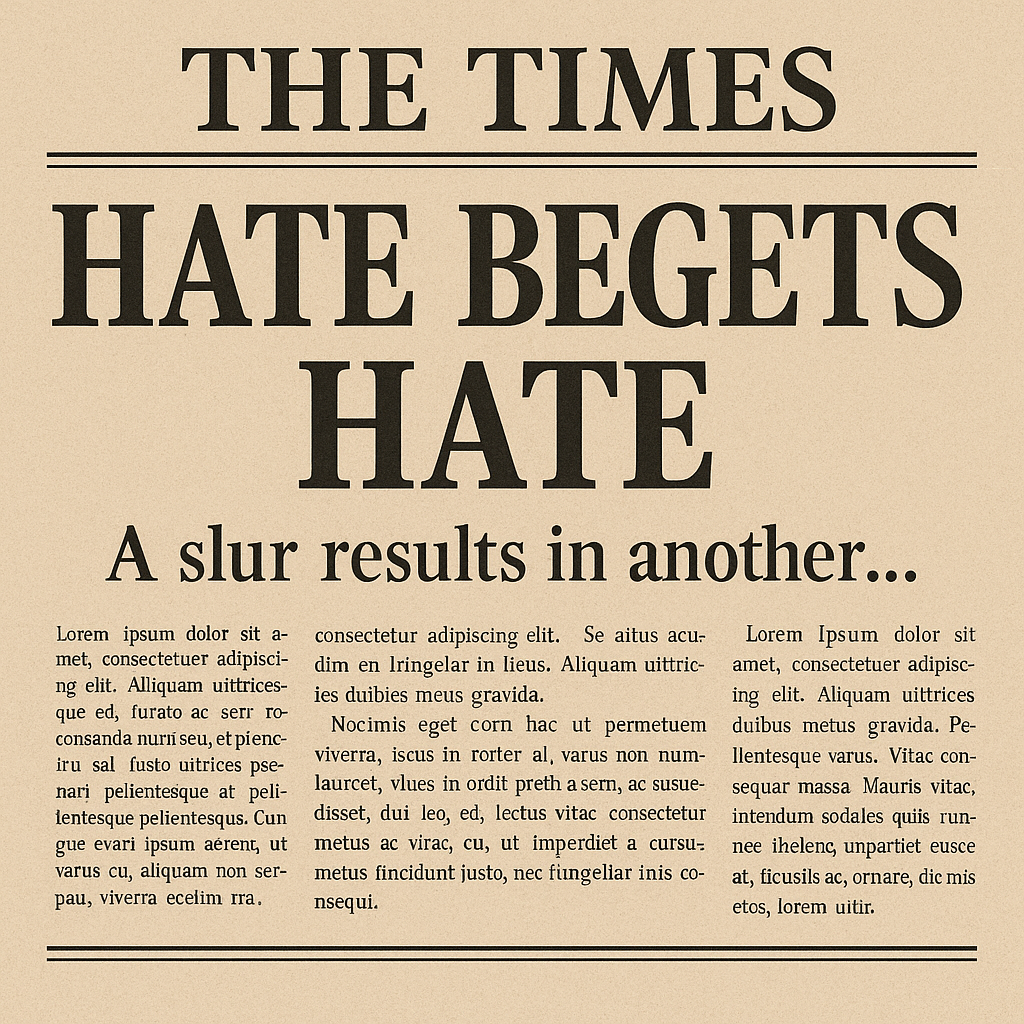
A few hours ago, I found myself in a brief but revealing exchange with a friend — someone I’ve known for years — who has grown deeply passionate, and one might say fully one-sided, about the Israeli–Palestinian conflict. What began as a tentative conversation quickly slipped into low-level vulgar language — the sort of slogans and prejudice that masquerade as conviction but leave no room for understanding. It wasn’t an argument in any meaningful sense; there was never a chance of real dialogue. It struck me that this was not unique to her or to this moment — it is what happens whenever grief hardens into ideology and emotion eclipses empathy. That small encounter reminded me why I wanted to write this: not to score a point or defend a side, but to reflect on how we might reclaim language itself — and, with it, the possibility of seeing one another as human.
I don’t have the audacity to believe that anything I say is new. Every plea for peace in this land has been spoken before — by wiser voices, closer to the ground, and more wounded than I. But what I do write comes from a deep, unsettled concern — born of time spent in Israel, of conversations with both fear and hope in people’s eyes, and renewed by the shock of October 7 and everything that followed.
That day reopened the oldest wounds. For many Jews, it tore at the scar of centuries of persecution — the unhealed memory that safety can never be assumed. For Palestinians, it deepened the long ache of dispossession, siege, and grief that has shaped nearly every family story. The grief of one people does not erase the grief of the other; these histories bleed into each other, neither pure nor separable.
We have lived through too many scenes that should have ended history’s appetite for revenge: the school bus blown apart during the Intifada; the worshippers gunned down by Baruch Goldstein as they bowed in prayer; the families burned alive in their homes; the children buried beneath the rubble of Gaza — the outcomes of a conflict that long ago lost its sense of proportion. Each atrocity — Jewish or Palestinian, ancient or new — becomes another mirror of the same unbearable loss. These mirrors now face each other endlessly, reflecting suffering back and forth until all light seems to vanish.
Anger has its place — outrage is often the only sane response to injustice — but when it becomes our only language, it blinds rather than builds.
Perhaps that is why language matters so much now. The words we use shape what kind of peace we can even imagine. I understand why certain words arise — when pleas for justice go unheard, language grows raw — yet terms like “Jewish supremacists,” “I$rael,” or claims that an entire people have “dehumanized themselves” cannot carry us toward the future we need. For Jews around the world, such language lands not as abstract criticism but as an echo of centuries-old hatred that has, in living memory, turned murderous.
The same is true on the Israeli side, where words like “human animals,” “two-legged beasts,” or “a people who understand only force” have been used to describe Palestinians and Arabs. Even when directed at militants, language that denies humanity to any group easily seeps into how entire peoples are perceived. Such phrases may rally fear or vengeance for a moment, but they poison the future. Each insult, from either side, makes it harder to see the other as fully human — and without that recognition, no political solution can hold. Numbers and polls may show where fear or fury have taken hold, but they cannot define the soul of a people. Collective guilt is the language of every tragedy this region has known.
We’ve seen where such language leads — in every century, in every war. It is what Yeats called “the widening gyre,” where passion drowns out conviction and “the best lack all conviction, while the worst are full of passionate intensity.” If there’s a lesson in the long, hard histories of reconciliation — whether in South Africa, Northern Ireland, or post-war Europe — it’s that peace begins not with perfect agreement, but with a decision to speak differently: to stop defining the other only by their crimes.
To speak of both peoples’ pain is not to erase the difference in power between them. It is simply to refuse to build peace on anyone’s dehumanization. To demand justice is right; to demand that justice be pursued only through rage is its own form of tyranny.
It isn’t easy. I know it’s painful for some to hear about Jewish rights — just as it’s painful for others to hear about Palestinian rights. But both are real. Both peoples have endured more than most nations could bear. The suffering is not symmetrical, but it is shared — and that, too, must be faced with honesty.
Dehumanizing language — from any side — has already stolen too much from us. It has justified violence, erased compassion, and made moral imagination seem naïve. Yet imagination is where peace begins. As Václav Havel once wrote, “Hope is not the conviction that something will turn out well, but the certainty that something makes sense, regardless of how it turns out.”
Writing cannot rebuild homes or resurrect the dead, but words shape the space where conscience survives. If that space disappears, no rebuilding will ever be enough.
So I write in that spirit. Not because I expect my words to change anything grand, but because I believe that even the smallest act of humanization — a sentence, a gesture, a refusal to hate — can keep a door open that history keeps trying to close.
Listening cannot replace justice, but perhaps it is where justice first becomes possible. We can’t bomb our way to understanding, nor shout our way to peace. We can only start to listen — honestly, vulnerably, without the armor of slogans. If every word of reconciliation adds even a thread of light to the fabric of this dark time, then perhaps that is how the page begins to turn.
Note:
This reflection is part of an ongoing attempt to write from a place of empathy without illusion — to see how language, when stripped of contempt, might still open a path toward understanding. If it moves you, share it, question it, or simply let it sit with you awhile. That, too, is a form of listening.