English Professor; Executive Director, Writing on the Wall
Laughing at Auschwitz?

Rembrandt, 'Jeremiah Lamenting the Destruction of Jerusalem' (Google Art Project)
We need our stories to survive.
Tisha B’Av, which we mark this Sunday, commemorates the destruction of both Temples in Jerusalem. It feels like the abrupt end of a story—a rupture that leaves us in a present without promise, a story without a future.
In Jeremiah Lamenting the Destruction of Jerusalem, Rembrandt paints the prophet who had warned of the city’s imminent destruction. With his face resting on his left palm, the city burning behind him, his right arm disappears into shadows, echoing the Psalmist: “If I forget thee, O Jerusalem, let my right hand wither.” Rembrandt’s Jeremiah, eyes down, in despair, has already started to forget.
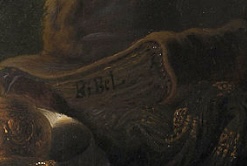
The closed Bible (“BIBeL”) on which the prophet’s elbow rests is, however, the center of the painting. The Temple aflame, the Book is shut, the Jewish future canceled. The People of the Book, without their book, become an exhibit, suitable for the ‘Museum of an Extinct Race’ that Hitler imagined.
But the painting resists disappearance. Even in this image of catastrophe—the prelude to galut, to exile—there remain glimmers of geula, redemption. The book may be closed, but the painting gestures, quietly, toward a future.
The prophet’s exposed right foot, his toe pointing away from the blaze, shows him en route, out of the painting to Rembrandt’s studio, to Amsterdam of the 17th century, and to us today. The Book is closed, but Rembrandt bequeaths Jeremiah to our future. Rembrandt knew the Infinite Book of the Jews is the Source of all Things, that for civilization, Jewish and Western to survive the Book must survive.
Over a thousand years earlier, Rabbi Akiva also struggles in the face of rupture to keep the Book alive.
From the distance of Mount Scopus, Rabbi Akiva and three other sages – R. Gamliel, R. Elazar ben Azaryah, and R. Yehoshua – upon seeing the destroyed city, rend their clothing in mourning.
What Does the Fox Say?
As they approach the Temple Mount, they see the ruins up close, a fox crawling out of the place where the Ark of the Covenant had been kept, the Holy of Holies. The other rabbis are beside themselves with grief, while Akiva laughs among the ruins.
The rabbis undergo a double trauma. The Temple built once by Solomon was destroyed in 586 BCE, only to be rebuilt in the time of Cyrus 70 years later. They witness the second seemingly final destruction. And Akiva laughs.
The three sages rebuke him, quoting Scripture, giving Akiva a lesson in reading: “No stranger shall approach the sanctuary.” “How can a fox now trespass on what was once God’s dwelling place?” they ask. The verse from the Book of Numbers becomes an epitaph. The book is not a source of comfort, but a reminder of its irrelevance. For the other rabbis, Akiva’s laughter is not hopeful—it is obscene. He might as well be laughing at Auschwitz.
But Akiva remains determined. He goes back to the Book—Isaiah, Zechariah, Jeremiah—and finds undiscovered resources for a new beginning. Through reading and rewriting the past, Akiva finds both exile and redemption, extending sacred time into his present and ours – into a future not yet written. Rabbi Akiva does not simply remember, he reanimates. He goes back to the Book he reveres and, from out of it, creates a future.
A Remembered Future
Akiva’s Book is as Ben Bag-Bag, a student of Hillel, describes it: ‘everything is in it,’ even, especially, the messianic prophecy of Zechariah: “Old men and women will dwell in Jerusalem, while boys and girls play in the streets.” Zechariah’s prophecy, still unfulfilled, becomes, through Akiva’s heroism of reading, part of a living future, not a dead past.
His laughter is not the serene laughter of one removed from history, but the joy of shaping the future—drawn from the inexhaustible depths of the Infinite Book.
In these Nine Days leading up to 9 AV, and the terrible history we have shared since October 7th, we live with a paradox: we mourn, we grieve. But we also remember into a future which is upon us to create.
The Infinite Book remains open.
We must read and write our futures together.
Related Topics
Related Posts