
An Aging Jewish Feminist
Naso and Ruth : A Season for Reflection
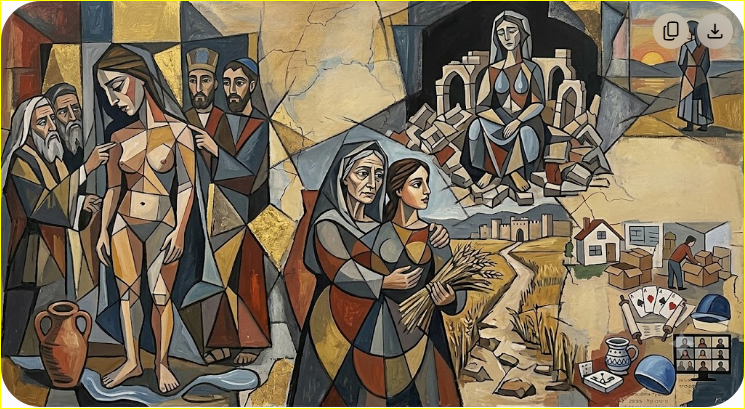
Gemini image for Naso and Shavuot in style of the cubist, Picasso. It captures the tension between the vulnerability of the Sotah on the left; the central, enduring bond of Ruth and Naomi holding the wheat; the sorrowful figure of Lamentations weeping over the ruins above; and the personal transitions on the right.
Almost four years ago, in June 2022, I began writing a blog for the TOI. At the time, I did not imagine it would become a weekly practice—one in which I try to weave together the weekly parsha with the world around us, and with my own life. Yet here I am, four years later still intersecting with these three.
This week’s Parshat Naso, one of the longest in the Torah, seems an appropriate marker. It is sprawling, repetitive at times, yet filled with powerful and unsettling material: the priestly blessing, the laws of the Nazirite, vows, and most disturbingly, the ritual of the Sotah—the suspected adulterous wife.
The Sotah passage has always troubled me. A woman, guilty or not, is subjected to a humiliating ordeal because of a husband’s jealousy. There is no symmetry here—only suspicion, control, and the public exposure of a woman’s body and dignity. Even if we read the ritual as a way of preventing greater violence, it remains an institutionalized form of degradation.
That theme of jealousy and suspicion does not end in the Torah portion. It echoes in the haftarah, in the story of Manoach’s wife, who encounters an angel announcing the birth of Samson. Her husband’s reaction—his insecurity, even jealousy—mirrors the emotional undercurrent of the Sotah. Once again, a woman’s experience is filtered through male anxiety. And yet, when we turn from Parshat Naso toward Shavuot, we encounter a very different text: the Book of Ruth.
Shavuot and Personal Space
Shavuot has always marked a turning point for me—not only liturgically, but personally. The weeks that follow, leading up to Tisha B’Av, form the longest stretch in the Jewish calendar without a major holiday. It is, on the surface, a quiet time. But for me, it is filled with memory and associations: I was married just after Shavuot—and so was my eldest daughter. Had my husband lived, we would have celebrated 63 years of marriage this June. My grandson read Parshat Naso for his bar mitzvah eighteen years ago. My mother died a few days after Shavuot in 1999. After Shavuot in 1967, the year my husband graduated rabbinical school, we decided to come to Israel for just two years. We arrived that August—59 years ago. This very month, I am in the process of selling the home in which our family lived from 1975. Finally, my youngest daughter, will be ordained as a rabbi in June, becoming the third of my children to become rabbis (one Conservative, another Reform and she, the latest, to become a Bud-Jew Rabbi). These are not just dates. They form a kind of private calendar layered onto the Jewish one—a calendar of beginnings, losses, and continuities.
Ruth, Naomi, and Changing Selves
Every year on Shavuot, we read the Book of Ruth—a story of return, loyalty, and renewal. For decades I have taught it, argued with it, and even rewritten it. When I was younger, I identified with Ruth—the outsider, the woman forging a new path, seeking belonging. I even wished my mother had named me Ruth. Now, I find myself identifying with Naomi.
Naomi, who has lost everything.
Naomi, who returns emptied out.
Naomi, who nevertheless grasps onto life, maneuvering, planning, insisting on continuity.
My relationship to the characters has changed over time. I once judged Naomi harshly—manipulative, even ruthless. Now I ask different questions: How did she survive that journey from Moab to Bethlehem? What did she feel in the silence between her and Ruth? What does it mean to rebuild when everything has been stripped away?
Having moved to a protected facility, to be nearer to my daughter, hours away from the community to which I devoted my life, I wonder about the toll it must have taken on Naomi. To leave behind friends, furniture, books, memories, in an age that did not have easy access to staying in touch—I identify with her even more.
Over the years I have pushed even further—questioning the traditional readings. What if Ruth is vulnerable to exploitation? What if Naomi uses her? What really happened on the threshing floor? And why does Ruth, in the end, disappear into Naomi’s story? These questions led me, years ago, to write a counter-midrash—giving voice to characters who are usually silent, exposing motivations we prefer not to see. It may be cynical, but it is also an attempt to humanize the text, to see the shadows in redemption stories.
From Ruth to Lamentations
But the story does not end with Ruth. Nine weeks later, we read Eicha—Lamentations—Av, being the month, I was born. If Ruth and Naomi’s story is one of return to the land, Lamentations is a story of exile from it. If Ruth offers hope, Eicha is a tale of devastation. And yet, both share a haunting image: widowhood. “Jerusalem sits alone… like a widow.” Not truly a widow—because that would mean God is gone—but as if abandoned. This is the language of hester panim, the hiding of God. Not absence, but concealment.
This tension—between presence and absence, hope and despair—defines this entire season for me. We move from the loyalty of Ruth to the desolation of Lamentations in a matter of weeks. The question is unavoidable: Is the movement reversible? Can we remain in the world of Ruth—of return, kindness, and rebuilding? Or are we destined, again and again, to arrive at Lamentations?
Living in the In-Between
This year, that question feels particularly sharp. I have been a widow for more than a year and a half—a reality I have adjusted to. I have made a big change in my life and once I sell my home, it will be a permanent change. Over the past four years—through caring for an ill person, COVID, wars—I found small anchors: swimming, when possible; teaching and learning on Zoom; daily study at Beit Avi Chai; word puzzles, which relaxed my mind before sleep. These routines sustained me. They were my way of holding onto structure when the world felt unstable. And now in my new home, I have added on new routines: I have new study groups; I’ve taking up ceramics (love the feel of clay); I go to a different exercise class daily (as well as swimming); I’ve even taken up Bridge!
At the same time, I find myself increasingly troubled by the state of public discourse. We no longer listen—we shout. We confuse volume with truth. Despite the great respect for “senior” citizens in my new abode, in the real world, the concept of honoring us elders for our experience has eroded. Perhaps we have to raise our voices because we suspect that no one is listening. We are not destroying one another physically yet, but civil discourse is being drowned out through contempt and disregard.
A Small Story, A Larger Truth
I am reminded of a moment from years ago. My husband and I took a taxi in Tel Aviv; the driver overcharged us outrageously. When I protested, he replied: “The prime minister is a thief—why should I be different?” It was said half in jest, half in truth. But it stayed with me. Because it reflects something deeper: when leadership models corruption or disrespect, it filters downward. It becomes normalized.
The Question That Remains
And so I return, once again, to this stretch of time between Shavuot and Tisha B’Av. Ruth and Naomi returned to Bethlehem with nothing—and built a future. The Sotah of Parshat Naso, whether guilty or innocent, must also move forward after humiliation and suspicion. Her body is marked by ordeal, yet the text insists that if she is cleared, she will once again “be sown with seed.” Thus her future is reopened in the most physical, vulnerable way. However, female Jerusalem, in Lamentations, loses everything—and sits in ruins.
We stand somewhere between these texts—between degradation and renewal, between exile and return, between the possibility of new life and the reality of devastation. The question is not only textual. It is personal, national, and immediate. Can we choose a different ending? Or are we, once again, walking a path whose conclusion we already know? I do not have the answer.
Chag sameach and Shabbat shalom.
Related Topics
Related Posts