
Leadership and Responsibility
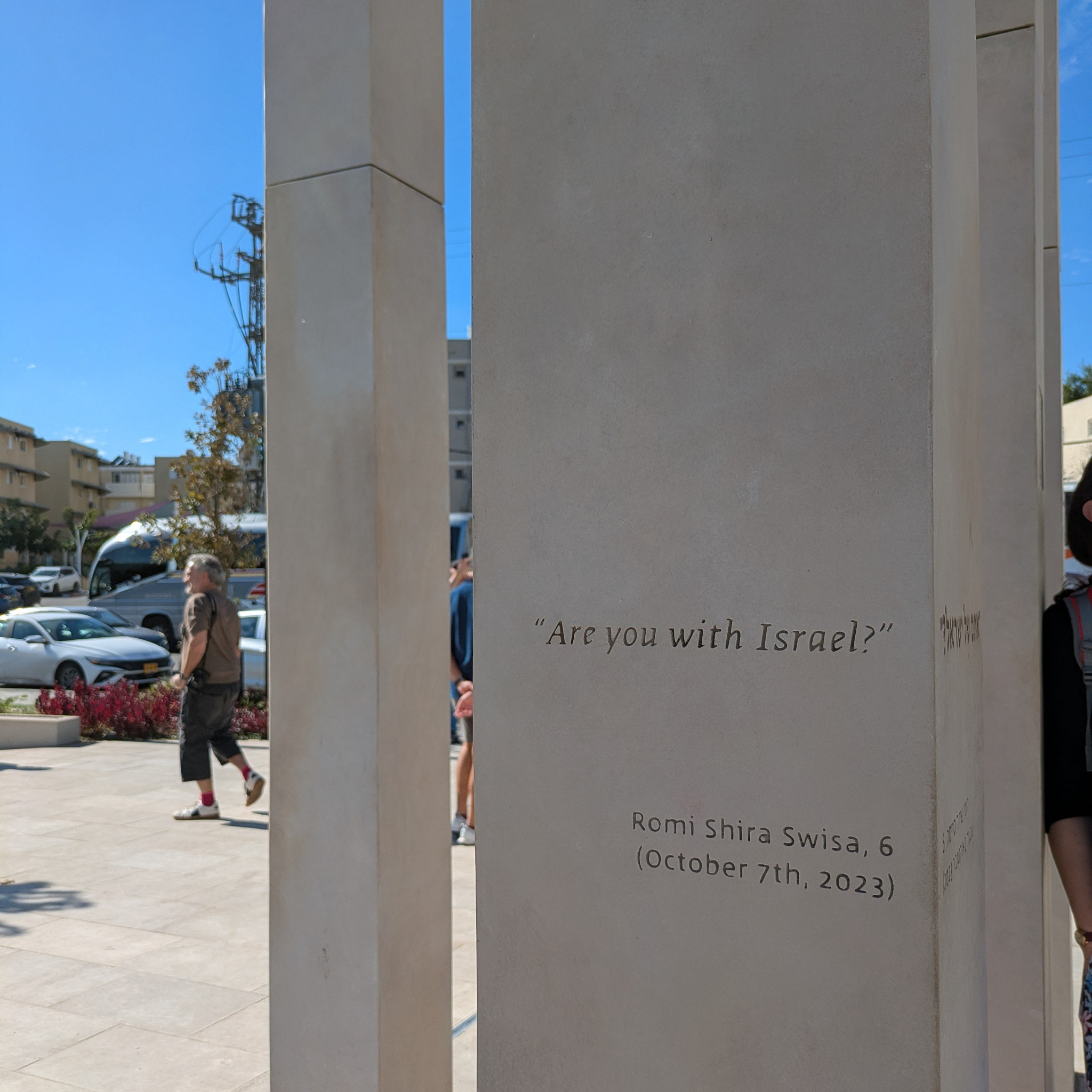
What Israel taught me this week about what it truly means to lead.
Leadership is one of those words we use so easily that we forget what it costs.
Titles are cheap. Platforms are plentiful. Opinions are everywhere.
But responsibility — real responsibility — reveals itself only in the moments when someone has every reason to collapse and somehow chooses not to.
This past week in Israel, I encountered people who are not “leaders” in the formal sense, yet embodied the deepest form of Jewish leadership: the kind built not from authority, but from presence, truth-telling, and moral courage in the aftermath of unthinkable pain.
Their stories reshaped my understanding of what responsible Jewish leadership really requires.
1. Leadership begins with witnessing
Witnessing is not passive. It is not merely seeing.
Witnessing is a form of leadership because it is a form of responsibility.
Standing in front of someone whose world has been broken — and not looking away — is an act of moral solidarity. It says:
“Your pain is real.
You matter.
I am here.”
In Judaism, leadership has always been relational.
Moshe Rabbeinu led because he could not walk past suffering without stopping.
The prophets led because they insisted on naming truths the people wished to avoid.
The rabbis led because they preserved memory in times of rupture.
Leadership begins with the courage to stand in front of another human being and hold their truth.
This week, I saw that courage everywhere.
2. The Kibbutz Resident — responsibility in grief
One of the quietest, strongest leaders I encountered was not a politician, nor a rabbi, nor an activist.
She was a woman from one of the kibbutzim which was overrun on October 7th and which suffered loss and murders, a survivor whose voice trembled but did not break.
She told us:
“They built our safe rooms.”
Five words.
Five words that contained betrayal, devastation, and the shattering of a worldview.
She was not speaking to the media.
She was not campaigning.
She was not performing.
She was educating us.
She was teaching us why Israelis feel the way they do now — not out of hatred, but out of ruptured trust. She spoke with dignity, clarity, and an honesty that many public figures could learn from.
Leadership is the choice to speak truth even when truth is unbearable.
3. The Nova survivor who teaches by standing
Our encounter with a Nova survivor was one of the most humbling moments of the mission.
He did not frame himself as a hero.
He did not dramatise his story.
He simply stood there — grounded, gentle — and spoke about surviving something no one should ever see.
He said:
“People think survival ends when you reach safety. It doesn’t. That’s where it begins.”
Leadership is not loud.
Sometimes it is the ability to articulate pain without cynicism.
Sometimes it is the refusal to allow trauma to turn into hatred.
Sometimes it is speaking softly because shouting would be easier.
He reminds us that leadership often emerges from trauma, not power.
4. The Israeli inward turn — and what responsibility now looks like
Over and over, Israelis told us a version of the same truth:
“We wanted peace. We meant it. But after October 7th… something inside us shifted.”
This was not anger.
It was grief.
It was exhaustion.
It was the pulling inward that wounded people do instinctively.
And yet — here was the surprising part:
Even in this inward turn, there was no call for revenge.
No bloodlust.
No triumphalism.
Instead:
-
“We need to take care of ourselves now.”
-
“We must rebuild before we can look outward again.”
-
“Coexistence requires trust. Trust was destroyed.”
This, too, is leadership: the refusal to pretend that a shattered emotional landscape can be repaired overnight.
It is responsible to name the wound.
It is responsible to protect your community.
It is responsible to rebuild slowly, not recklessly.
5. Diaspora responsibility — different, but real
Our synagogue prays weekly for the welfare of all innocents — Israelis and Palestinians alike.
It is a prayer rooted in compassion and conscience.
But during the mission, I found myself wondering:
If the people we met heard that prayer in our shul, how would it land?
Would it comfort them?
Would it hurt them?
Would it feel premature?
This is not a criticism of our community’s practice.
It is an acknowledgement that in times of trauma, compassion lands differently depending on where one is standing.
Diaspora Jews have responsibilities too — but they are not the same responsibilities Israelis carry.
Our task is not to mirror their pain, nor to dictate solutions.
Our task is not to fix.
Our task is not to posture.
Our task is to show up.
To listen.
To honour complexity.
To resist turning another people’s suffering into commentary.
To stand beside, not above.
This is leadership, too.
6. What leadership is not
This week made something very clear:
Leadership is not the performance of certainty.
It is not the easy moralising from afar.
It is not using other people’s trauma as a platform.
And it is not the selective compassion of those who only empathise when it costs nothing.
Leadership is costly.
Responsibility is costly.
Anything cheap is something else — not leadership.
7. What I am learning to ask of myself
As a Jewish writer, a criminologist, a doctoral researcher, and a person whose life has also known rupture and rebuilding, I ask myself:
What does responsible leadership look like for me?
And I think the answer is something like this:
-
To speak with integrity, not theatre.
-
To be transparent in my beliefs and accountable in my errors.
-
To elevate compassion without erasing complexity.
-
To understand that every story I tell belongs first to the person who lived it.
-
To honour survivors, not centre myself.
-
To refuse the seduction of easy moral clarity.
-
To build bridges without denying wounds.
-
To remember that leadership is not about being followed, but about being trustworthy.
Leadership is not a role.
It is a posture.
A stance toward the world.
And responsibility is the weight that keeps it honest.
Closing
On our final day in Israel, someone said to us:
“Thank you for coming now. Thank you for seeing us.”
That sentence has stayed with me.
Leadership is not always about deciding.
Sometimes it is simply about showing up when it matters,
listening when it hurts,
and carrying home the truth of what people entrusted to you.
If that is all I do with this platform —
if leadership means nothing more than being a faithful witness —
then perhaps that is enough.