
CFO | Empower Society for Good I Author
Sharing the Burden, Sharing the Blessing
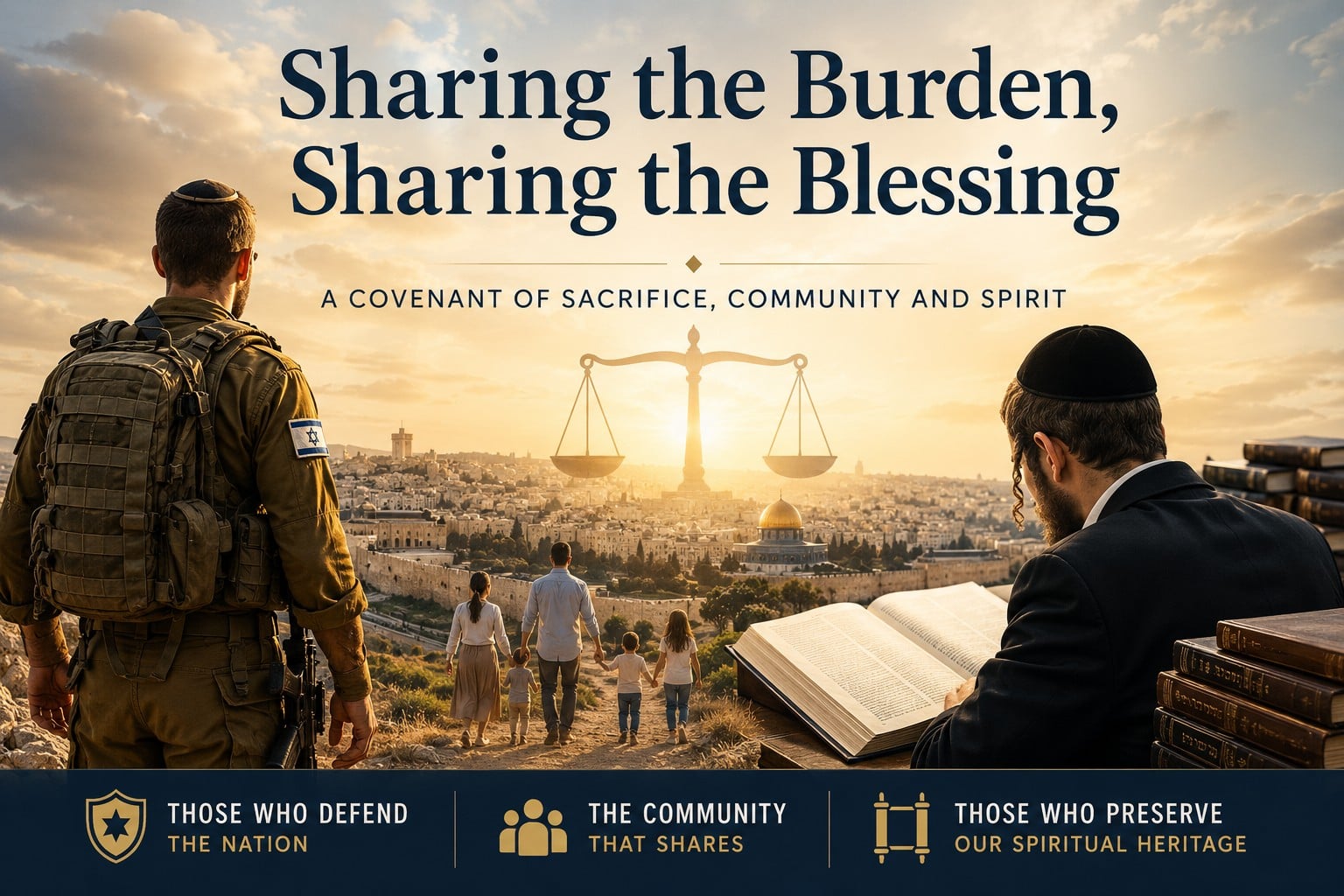
“Take an inventory of the plunder… Divide the plunder equally between those who took part in the war and the entire community. From the warriors’ share set apart a levy for the Lord… From the Israelites’ half take one portion out of every fifty and give them to the Levites, who have charge of the Lord’s Tabernacle.”
Numbers 31:25–30
At first glance, this appears to be little more than an ancient accounting exercise.
The battle has ended. The spoils are counted. Assets are valued. Shares are allocated.
But beneath the numbers lies a profound social philosophy.
The Torah does not allow the victors simply to keep everything. Nor does it ignore the sacrifices made by those who fought. Instead, it creates a covenant of shared responsibility.
The Torah’s Distribution
The Torah is remarkably precise.
The spoils are first divided into two equal halves.
- One half belongs to the 12,000 soldiers who fought.
- One half belongs to the rest of the nation, even though they did not go into battle.
From the soldiers’ half, one out of every 500 is given through Eleazar the priest as a contribution to God.
From the nation’s half, one out of every 50 is given to the Levites, who are entrusted with the service of the Tabernacle.
The Torah therefore recognizes three distinct groups:
- Those who bore the physical burden of defending the nation.
- The wider community, on whose behalf the battle was fought.
- Those entrusted with preserving the nation’s spiritual life.
The Torah strikes a remarkable balance.
It neither says that only soldiers matter, nor that every contribution should be rewarded identically.
It gives half of the entire spoils to the 12,000 men who accepted the dangers of battle, while ensuring that the wider nation also shares in the blessing and that the nation’s spiritual foundations are sustained.
In just a few verses, the Torah balances reward, gratitude, public benefit and spiritual responsibility.
This reflection is not about recreating biblical Israel or applying ancient laws literally. It is about asking whether the Torah’s wisdom still offers practical principles for building a good society in the twenty-first century.
The Torah is teaching something far greater than how to divide the spoils of war. It is offering a blueprint for how a society should distribute the blessings that flow from collective sacrifice.
A Debate Happening Today
This reflection is remarkably timely.
This week, Israel is debating the place of Torah study, military service and public recognition. The discussion is not merely political or legal. It is deeply religious and philosophical. It asks a question that has accompanied the Jewish people throughout history:
How should a Jewish state honor those who defend it physically while also recognizing those who dedicate their lives to preserving its spiritual inheritance?
Parashat Mattot offers an important perspective.
The Torah does not erase different forms of contribution, nor does it pretend they are identical.
Those who went out to battle received a distinct share because they accepted extraordinary risk.
The wider nation also shared in the blessing because the battle was fought on behalf of everyone.
The Levites received support because they fulfilled a unique spiritual role in the life of the nation.
The Torah neither elevates one contribution while dismissing the others, nor does it treat every contribution as the same. It recognizes different responsibilities, different sacrifices and different forms of national service.
Perhaps the challenge facing Israel today is not to choose between Torah study and military service.
We need both.
We need courageous men and women willing to defend the nation.
We need Torah scholars who preserve the spiritual and moral foundations of Jewish life.
The Torah itself teaches that these roles are complementary, not competing.
At the same time, it also teaches that those who bear extraordinary risk deserve extraordinary recognition. Valuing Torah study does not require treating every contribution identically. The Torah itself gives half of the spoils to those who risked their lives in battle while ensuring that the wider nation and the Levites also shared in the blessing.
A Modern Application
This reflection is not proposing that the biblical distribution should be copied literally.
The circumstances are different. The institutions are different. The economy is different.
But the underlying principles remain remarkably relevant.
If Israel chooses to use part of its Sovereign Wealth Fund, natural gas revenues or other national assets to strengthen society, perhaps the same three questions should guide the discussion:
- How should those who risk their lives defending the nation be honored?
- How should national prosperity benefit the whole of society?
- How should Israel sustain the spiritual, educational and moral institutions that preserve its identity?
The answers belong to today’s democratic process. But the questions are ancient. Perhaps we should also ask a more provocative question.
What if Israel made a national decision that every combat soldier who fulfilled active duty and years of reserve service would receive truly life-changing long-term benefits—through housing, education, pensions, healthcare or long-term investment?
Would that transform attitudes towards military service?
Would more young Israelis choose combat units?
Would it encourage greater enlistment, even among communities that have traditionally opposed military service, including parts of the Haredi community?
If the Torah reserved half of the spoils for the 12,000 men who accepted the dangers of battle, perhaps it is reminding us of an enduring principle:
Extraordinary sacrifice deserves extraordinary recognition.
The question is not whether Israel should value Torah study or military service.
It should value both.
The challenge is to build a covenant in which both are honored, while recognizing that those who bear different burdens may rightly receive different forms of public recognition.
What Makes a Good Society?
A good society recognizes sacrifice. It shares prosperity. It invests in future generations. It sustains its moral and spiritual foundations. It creates opportunities for every citizen to contribute.
Parashat Mattot reminds us that prosperity should never simply be consumed. It should be distributed in a way that strengthens the covenant between a nation and its people.
The question facing every generation is not simply how wealth is created, but how it is shared.
Parashat Mattot suggests that a good society remembers three things:
- Those who defended it.
- The values that sustain it.
- The generations that will inherit it.
Prosperity is not an end in itself.
It is an opportunity to strengthen the covenant between a nation and its people.
Questions to Ponder
- What lasting obligations does a nation owe those who defend it?
- Can a society honor both military service and Torah scholarship without treating every contribution identically?
- If national wealth creates new opportunities, what principles should guide its distribution?
- How can Israel strengthen the covenant between those who defend the nation, those who preserve its spiritual life, and the society they both serve?
- What can modern democracies learn from the Torah’s model of recognizing sacrifice while investing in the common good?
Perhaps the deepest lesson of Parashat Mattot is this: a good society does not ask whether it should value soldiers or Torah. It values both. But it also recognizes that different callings carry different burdens, and that justice sometimes requires different forms of recognition. The Torah’s vision is not one of identical rewards, but of a shared covenant in which sacrifice is honored, society flourishes, and the nation’s spiritual foundations endure.