Leading Schools From the Balcony
A member of the faculty who taught me a new understanding of adaptive leadership at a conference last year reached out recently with a question that sounds simple and isn’t: How are you actually using it?
It’s a fair question to ask a head of school at the end of a summer (and being in the South, that’s right around the corner), with a building about to fill back up with children. The honest answer is that I use adaptive leadership most on the days that don’t go according to plan, which, in a school, is most days. But the deeper answer is that it has changed how I see the institution I’m entrusted to lead.
Adaptive leadership draws a distinction I’ve come to rely on. Some problems are technical: the air-conditioning fails, the schedule has a conflict, a form needs signing. They can be frustrating, but we know how to solve them, and expertise gets the job done. And I work with a team of experts. Other challenges are adaptive: they can’t be fixed with a procedure because they ask people to learn, to grow, and sometimes to change what they value. Building a culture of character in children. Helping a community imagine its future. Deciding together what kind of school we want to be. No manual solves those. No chatbots solve those (I’ve tried). They require the patient, shared work of a whole community.
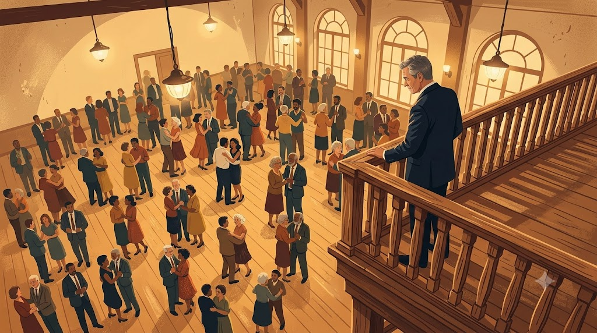
The teachers of adaptive leadership have a favorite image for this: get up on the balcony. In the middle of the dance floor, caught in the music and the motion, you can only see the couples nearest you. Step up to the balcony and you see the patterns, who’s dancing, who’s sitting out, how the whole room moves together. As someone who is rarely if ever on the dance floor, I spend a lot of time watching. Leadership, they teach, is the discipline of moving between the two: close enough to act, high enough to see.
Moving between the two takes a particular kind of listening. In another leadership program, I learned to notice three levels of this listening: listening that is really about me and my own next move; listening that is focused entirely on the person in front of me; and a wider, global listening that takes in the whole room, the mood, what isn’t being said, and the pattern behind the words. A head of school who only ever listens at the first level never makes it to the balcony. And a person who is always on the balcony, doesn’t learn to dance with others.
That kind of listening reframes much of a head of school’s day. I was taught that behind almost every complaint is a request. When a parent or a teacher comes to me frustrated (and they do), the frustration is rarely the real message; the real message is something they want and haven’t yet found the words to ask for. If I can listen past the complaint to the request inside it, an adversarial moment becomes a shared one. There is, as my teachers put it, a gift hidden in the complaint, if you are willing to look for it.
This summer I gave myself a balcony exercise. I sat down and mapped everyone our school serves and answers to. I arranged them not as a list, but as a set of rings, radiating outward from the center.
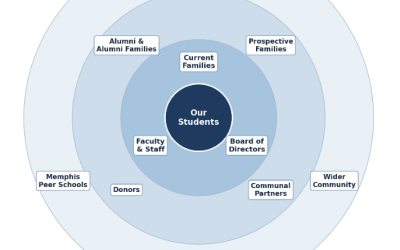 A stakeholder map I drew this summer, with our students at the center. (Graphic by the author.)
At the very center are our students. They are the reason the school exists; every decision we make is ultimately for them. Around them, in the closest ring, are the people who bring the mission to life each day: the families who partner with us in raising their children, the faculty and staff who are the school in every classroom and hallway, and the board members who steward our vision and safeguard our future.
The next ring out is the community that sustains us over time; a little further from the daily rhythm, but no less essential. Prospective families considering whether this is home. Alumni and alumni families who carry our story forward. Generous donors who believe in Jewish education. And our communal partners: the Jewish Federation, the Jewish Foundation, the Jewish Community Center, and the synagogues whose shared constituents and shared purpose make a school like ours possible. We do not do this alone, and we were never meant to.
The widest ring is the broader ecosystem that shapes the world we work in: Prizmah and the national network of Jewish day schools, from whom we borrow wisdom and to whom we lend our own; our peer independent schools here in Memphis; and the wider community whose friendship enlarges our children’s world beyond our own walls.
Seeing it all mapped out was clarifying in a way a to-do list never is. From the balcony, a school stops looking like a building with a budget and starts looking like what it actually is: a web of relationships, held together by a common belief that our children are worth this much care. The adaptive work of my job, the part no procedure can do for me, is to keep that whole web in view without ever losing the center. To remember, when I’m deep on the dance floor solving the technical problem in front of me, that there are rings and rings of people out there who love this place, and that my task is to keep them all pointed toward the same true north: the child at the center.
That, I think, is what I’d tell the faculty from my course last year. Adaptive leadership didn’t hand me a set of answers. It gave me a place to stand. It taught me to keep climbing back up to the balcony, to look at the beautiful, complicated dance of a school and its community, and to feel, before I feel anything else, grateful to be the one asked to help lead it.
Our doors open again in a few days. I’ll be on the dance floor soon enough. But I’m trying to spend these last quiet mornings on the balcony first, listening to the music.