
An Aging Jewish Feminist
Leaving Comfort and Security for the Unknown: Parshat Bo and the Courage to Go
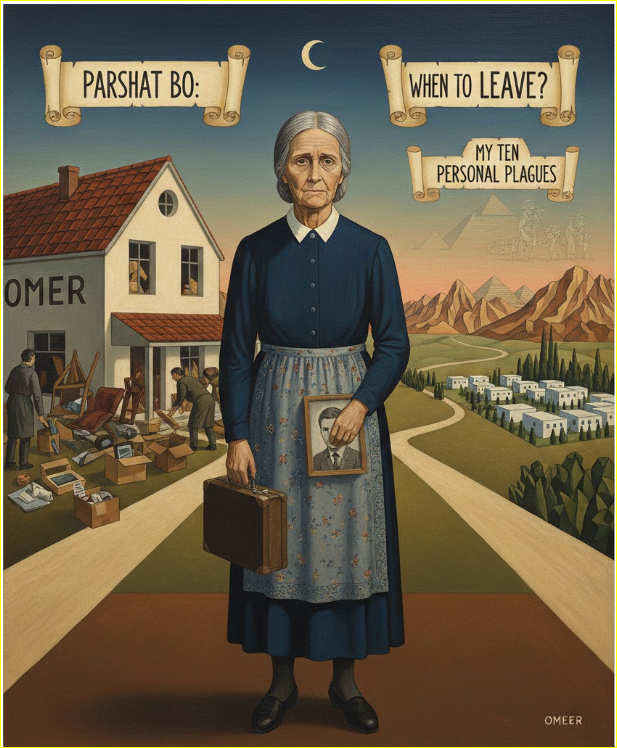
For the last few months, I have been mulling over my decision to leave Omer, where I have lived for more than 50 years with my late husband and raised three children. This decision was not taken lightly. I feel that now is the time to discuss it, especially since this week’s parshat Bo deals with the Israelites leaving Egypt for the unknown.
Parshat Bo is usually read as a story of power: God versus Pharaoh, miracles versus stubbornness, redemption versus slavery. But this year, as I am on the threshold of leaving my home and moving into a retirement village, I am paying attention to a different question: When is it time to leave? And perhaps even more unsettling: What does it take—for a people as well as for an individual—to actualize leaving?
WERE THE PLAGUES ONLY FOR PHARAOH?
We read that God tells Pharaoh:
“Go to Pharaoh. For I have hardened his heart and the hearts of his courtiers, in order that I may display these My signs among them… so that you may recount… how I made a mockery of the Egyptians… in order that you may know that I am the Lord” (Exodus 10:1–2).
Traditionally, the plagues are understood as punishments meant to break Pharaoh’s will. But what if the plagues were also for the Israelites? If Pharaoh had let the people go immediately—after Moses’ first appearance—would they have gone? Would any of us have gone? Leaving slavery is one thing; leaving the familiar is something else entirely. The Israelites needed time—not only to witness God’s power, but to loosen their own attachment to Egypt. The plagues did not just dismantle Pharaoh’s resistance. They dismantled the people’s illusions that Egypt represented safety, that stability was guaranteed, that tomorrow would look like yesterday. Only after ten escalating crises did leaving become more imaginable.
WHAT TO TAKE AND WHAT TO LEAVE BEHIND
At the beginning of Exodus, God tells Moses:
And I will give this people favor in the sight of the Egyptians; and it shall come to pass, that, when you go, you shall not go empty; But every woman shall borrow from her neighbor, and from her who sojourns in her house, jewels of silver, and jewels of gold, and garments; and you shall put them upon your sons, and upon your daughters; and you shall plunder the Egyptians ( Exodus 3: 21-22).
When I think about my own leaving, this passage hits close to home. Do I take the gold and silver? What dishes do I take? Pots and Pans? Furniture? Rugs? I have a list. And what about clothing? Do I want to look good in a new place? Whom am I trying to impress? How important is weather when the facility has all that I need without ever leaving. Do I ever need to dress up? Will I be entertaining? The good China? The sterling silver that we got as wedding gifts? I’ll be going to my daughter for Pesach—I don’t need all my Pesach dishes. What to do with all the accumulation of years. And don’t get me started on my library—and of course, my husband’s!!
Neighbors say: “Don’t worry—we’ll help.” … “If you can’t give things away, we’ll take care of it.” … “We’ll figure it out.” Will they follow through? I don’t know.
But like the Egyptian women offering gold and clothing, the offers themselves matter. They soften the terror of departure. They tell you that you are not invisible. And yet—accepting help from friends and neighbors is complicated. Is it generosity? Is it obligation? Is it guilt? Is it kindness? I don’t know how to resolve this discomfort. How sincere are the offers? How do I reciprocate? Am I taking advantage of my friends. They all say they will miss me. I reassure them–and myself–I am only a telephone call away.
In this week’s parsha as the Israelites prepare to leave, we read two versions of their interactions with their Egyptian neighbors:
“Tell the people to borrow, each man from his neighbor and each woman from hers, objects of silver and gold.” יהוה disposed the Egyptians favorably toward the people. Moreover, Moses himself was much esteemed in the land of Egypt, among Pharaoh’s courtiers and among the people (Exodus 11:2–3).
“The Israelites had done Moses’ bidding and borrowed וַֽיִּשְׁאֲלוּ֙ from the Egyptians objects of silver and gold, and clothing. And יהוה had disposed the Egyptians favorably toward the people, and they let them have their request; thus they stripped וַֽיְנַצְּל֖וּ the Egyptians (Exodus 12:35–36).
We can read these different versions as the Egyptians, perhaps out of admiration, guilt, fear, or recognition of injustice, freely giving to their neighbors. A situation where Moses is “esteemed.” There may even be solidarity and sympathy. The Egyptians bestow on them gifts out of good will.
Or we can read this as the Israelites taking advantage of the Egyptians—exploiting their generosity. They may have felt that this was owed to them–past wages etc.–and they therefore took only what was theirs. Perhaps both versions are true, and the tension unresolved. perhaps intentionally, by preserving two versions. Maybe the Egyptians wanted to give. Maybe the Israelites needed to take. Maybe the narrator, uncomfortable with receiving kindness from the enemy, rewrites generosity as plunder.
There is a discussion in the Talmud which suggests there were Israelites who did not even want to take the gifts which the Egyptians showered upon them, and that the Almighty was finally forced to beg them to agree so that His prophecy to Abraham would be fulfilled: “and after that they shall go out with great wealth.” One of the reasons that they did not want the vessels showered upon them, was because of the burden of carrying a heavy load on a long journey (BT Berachot 9a-b). With that I can certainly identify.
MY TEN PERSONAL PLAGUES
This move is almost as bad as the ten plagues. I can view them not as punishments, but the processing of a lifetime of memories. But this is rationalization and doesn’t make it easier.
- Sorting through possessions
- Distinguishing between what is meaningful and what is a burden
- Giving things away without knowing if they’ll be valued
- Selling a home that encapsulates who you are
- Accepting help while fearing dependency
- Friends who say, “You’re making a mistake”
- Nights of doubt and insomnia
- Fear of illness, money, regret
- The paralysis of waiting—doing nothing because everything hurts
- The grief of knowing it is time to leave before you are forced to leave
These are not dramatic plagues. No frogs, no blood, no hail, no locusts.
But these plagues exhaust me–decisions, decisions, decisions!
I identify with Pharaoh, who postpones the inevitable. I delay decisions. I lie in bed and think, I’ll do it later. I started watching Netflix—escaping the reality that is confronting me. That, too, is a kind of hardening of the heart. A small death before the larger one.
HARDENING THE HEART: A NECESSARY CRUELTY?
I have always been disturbed by the Torah’s insistence that God hardens Pharaoh’s heart:
“And the LORD strengthened (ויחזק) Pharaoh’s heart…” (Exodus 10:20)
Why deny him repentance? Why override free will?
And yet—the same root appears later when God takes Israel out of Egypt with a yad chazakah, a mighty hand. Sometimes, leaving requires cruelty—to others or to oneself. Pharaoh could not be allowed to relent halfway. Moses could not negotiate partial freedom. The people could not leave “a little bit.” And I, too, must harden my heart—not against compassion, but against paralysis. I have made the deposit. I have set the date. In two weeks I will find a mover. I have chosen to leave while I am still myself: the me who is still teaching, writing, listening, forming new friendships—before circumstances choose for me. The Israelites had to trust God and Moses. I only have to trust myself. And that is no small task. What if I get sick? What if I run out of money? What if I was wrong?
Israel’s wandering in the wilderness is not romanticized. There are rebellions, regrets, longing for Egypt, forty years of wandering. Salvation is messy, unpredictable. But staying—staying until there is no choice—that is its own kind of slavery.
Parshat Bo ends with motion. Night. Urgency. People walking without certainty, only resolve. I’m in a similar state. I am not Moses. I am not Pharaoh. Those who left (and not all of them did) chose to leave Egypt. Freedom is not only about being pushed out. Sometimes it is about having the courage to go—even when your heart trembles, even when you doubt, even when the wilderness is real. Yet all the paths we take on our journeys may close some doors, but open others to opportunities.
Related Topics