
Russian-American-Israeli Palestinian. Palestine is Israel.
Why Time Feels Faster as We Age
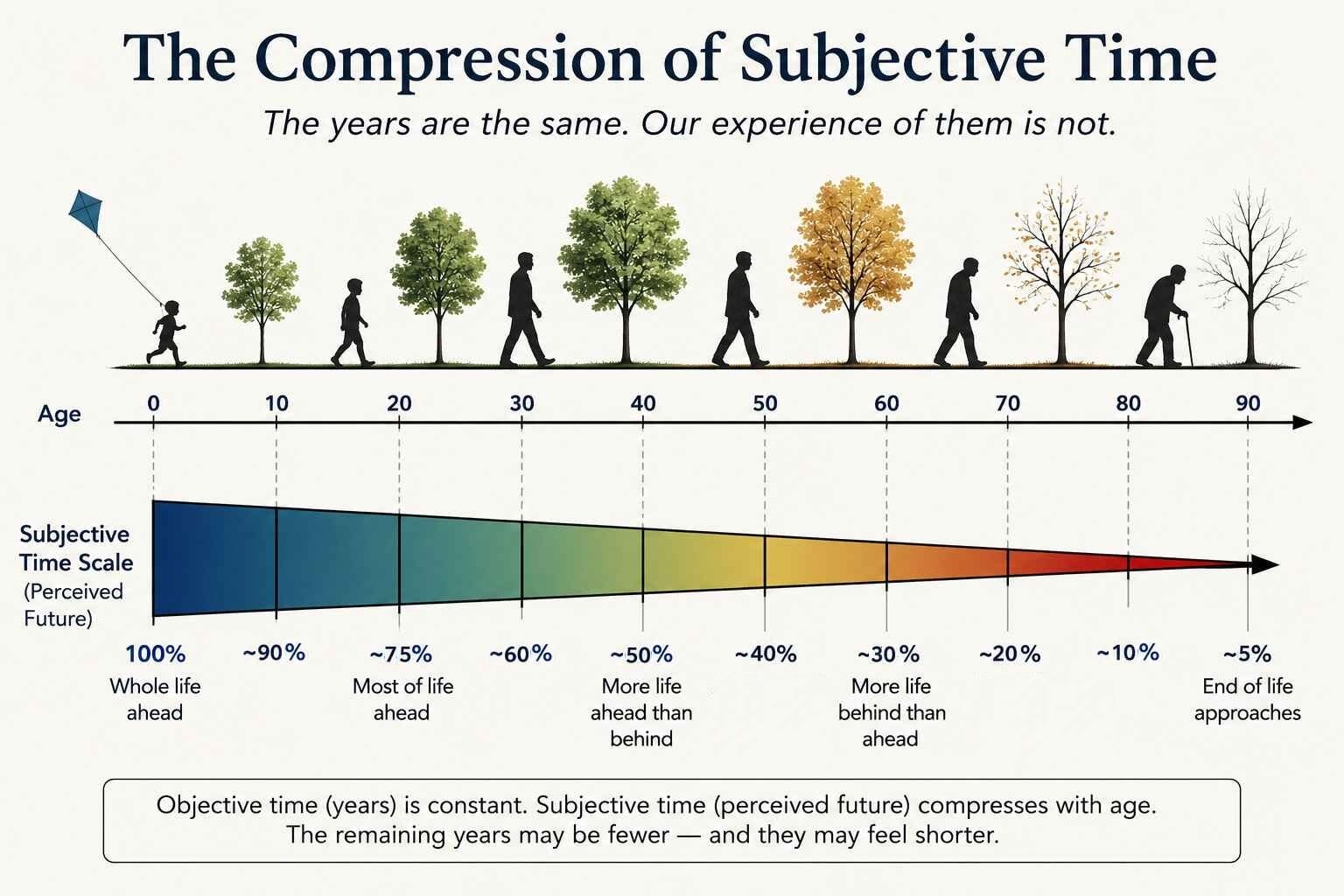
Time feels faster as we age — same years, different density. Image © Ivan Bassov, 2026. Licensed under CC BY 4.0.
Theories of Time Perception and a Life-Remaining Model
In Life Remaining: Rethinking Time and Perspective, I explored a simple question:
Instead of asking “How old am I?”, what if we asked “How much life do I actually have left?”
Using life expectancy data, life remaining percentages, and the concept of a finite number of months, the article proposed a different way to view human life—not through age, but through time remaining.
Near the end of that article, I made a brief observation:
And yet, later months are not the same as earlier ones. Time seems to accelerate as we age; life passes faster with each year.
Most people immediately recognize this phenomenon.
A summer seemed endless when we were children.
A year felt enormous.
A decade felt unimaginable.
Yet many older adults report that years pass almost as quickly as months once did.
Why?
Nobody knows with certainty. But several theories offer possible explanations.
Theory 1: The Brain’s Clock Slows Down
One explanation comes from neuroscience.
When we are young, the brain processes vast amounts of new information. Nearly everything is unfamiliar.
New places.
New people.
New skills.
New experiences.
The brain records these experiences in extraordinary detail.
As we age, much of life becomes familiar. The brain no longer needs to devote the same resources to processing routine events.
At the same time, reaction times gradually slow. Cognitive processing becomes less rapid. Memory formation changes.
Some researchers have suggested that our internal “sampling rate” decreases.
Imagine two cameras.
One records 120 frames per second.
The other records 24 frames per second.
The first captures far more detail.
If the brain records fewer mental “frames” per unit time, a month may feel shorter because less information has been packed into it.
The clock itself has not changed.
The observer has.
This theory remains debated, but it provides an intuitive explanation for why life may appear to accelerate.
Theory 2: The Hangover Model of Aging
A more recent perspective comes from inflammation research.
In the TEDxBoston talk “Tomorrow-Proof: How Mastering Hangovers Reveals the Science of Longevity,” pharmacist and researcher Jackie Iversen proposed a striking analogy:
A hangover may function as a miniature model of aging.
Most people assume that hangovers are caused primarily by dehydration.
Modern research increasingly points toward inflammation as a major contributor.
During a hangover, people often experience:
- Brain fog
- Slower thinking
- Reduced concentration
- Fatigue
- Altered perception
- Reduced motivation
In other words, the mind becomes slower and less responsive.
Aging appears to involve many of the same biological pathways, although in a much milder and chronic form.
Low-grade inflammation has been linked to numerous age-related conditions:
- Arthritis
- Cardiovascular disease
- Cognitive decline
- Dementia
- General loss of resilience
If chronic inflammation gradually reduces cognitive sharpness, it may also contribute to the altered perception of time many people experience as they age.
A hangover compresses a temporary version of this state into a few hours.
Aging may stretch similar processes across decades.
The analogy is not perfect.
But it offers an intriguing possibility:
Perhaps one reason time appears to move faster is that the mind is processing the world more slowly.
Theory 3: The Relative-Life Theory
The third explanation requires no neuroscience at all.
It is purely mathematical.
A reader of Life Remaining summarized it this way:
For a five-year-old, one year is one-fifth of life. For a fifty-year-old, one year is only one-fiftieth. The year is the same length, but it occupies a very different proportion of lived experience.
This observation may be the simplest explanation of all.
At age five:
- One year equals 20% of life experience.
At age ten:
- One year equals 10% of life experience.
At age fifty:
- One year equals 2% of life experience.
At age eighty:
- One year equals 1.25% of life experience.
Objectively, the year never changes.
Subjectively, it becomes smaller and smaller relative to the life already accumulated.
As our personal timeline expands, each additional year occupies a smaller fraction of it.
The result is a powerful illusion:
Life appears to accelerate.
Beyond the Three Core Theories
The three theories outlined above form the core explanatory framework of this article. However, time perception is an active interdisciplinary field, and several additional perspectives exist. For completeness, we briefly outline them below.
› Memory-based (storage density) theories
This is the family you’re already close to, but it’s often treated as its own cluster: time feels faster when fewer distinct memories are formed per unit time (or when routines compress memory encoding). This includes “novelty = slow time, routine = fast time” models.
› Attention-based theories
Time perception depends on how attention is allocated. When attention is externally engaged (flow states, absorption), subjective time shrinks; when attention is self-focused or waiting-focused, it expands.
› Predictive Coding and Expectation Theories
The brain constantly predicts sensory input. When prediction errors are high (novel environments), time feels expanded. When predictions are stable and accurate, time contracts.
› Arousal and Emotion-Based Theories
Higher physiological arousal (fear, excitement, stress) tends to distort time—often making the present feel longer in the moment, but not necessarily in retrospective memory.
› Dopaminergic and Neurochemical Models
Dopamine and other neuromodulators affect internal timing mechanisms (often discussed in interval timing literature). This is more “clock-like” than narrative memory-based models.
› Internal Pacemaker Models
Older models propose an internal “pacemaker–accumulator” system in the brain that generates subjective time units. Faster pacemaker = more “ticks” = longer perceived duration.
› Prospective vs. Retrospective Time
Not a single mechanism, but a major framework:
- Prospective time (while experiencing): driven by attention/arousal
- Retrospective time (looking back): driven by memory density and event segmentation
A Life Remaining Model of Time Perception
The theories discussed above are not mutually exclusive.
Several may be partially correct and may describe different aspects of the same phenomenon.
Neural processing may change.
Inflammation may contribute.
Relative scale may alter perception.
But there may be a useful way to summarize the overall effect.
In Life Remaining, I introduced the concept of life remaining percentage.
What if subjective time perception followed a similar curve?
As a simple rule of thumb:
Subjective Time Scale = Time Scale at Birth × Life Remaining Percentage
This is not a law of physics.
It is not a clinical measurement.
It is a conceptual model.
But it produces surprisingly intuitive results.
Consider male life expectancy data:
Age 5: 93% life remaining → approximately 93% subjective time scale

Age 25: 68% life remaining → approximately 68% subjective time scale

Age 50: 37% life remaining → approximately 37% subjective time scale

Age 70: 17% life remaining → approximately 17% subjective time scale

Age 85: 7% life remaining → approximately 7% subjective time scale
The complete male and female life-remaining tables are presented in Life Remaining: Rethinking Time and Perspective. Here, a few representative ages are sufficient to illustrate the relationship. The full Life Remaining Calculator implementation can be accessed on GitHub.
The model suggests that subjective time gradually compresses as life remaining decreases.
Whether the cause is neurological, biological, mathematical, or some combination of these and other factors, the outcome feels familiar to many people.
The years seem to move faster.
The Double Compression of Life
The implications are striking.
In the Life Remaining framework, life shrinks with age because fewer years remain.
But if subjective time also shrinks, something else happens.
The future becomes compressed twice.
First, there is less of it.
Second, it appears to pass more quickly.
A person at age fifty may statistically have roughly thirty years remaining.
Yet those thirty years may not feel as long as the previous thirty.
Not because clocks change.
Because perception changes.
The remaining timeline becomes shorter and faster simultaneously.
The Triple Compression
The picture becomes even more dramatic when we consider additional factors.
Roughly one-third of life is spent sleeping.
Health challenges become more common with age.
Recovery takes longer.
Energy often becomes more limited.
Physical capability may gradually decline.
The result is not merely a reduction in lifespan.
It is a reduction in available, healthy, active time.
Life is compressed again.
Viewed this way, the future is not simply a smaller quantity of years.
It may also be a smaller quantity of lived experience.
Life Remaining Beyond Mortality
The concept of life remaining can be applied outside philosophy.
Consider investing.
Traditional rules often suggest:
- Hold your age in bonds.
- Hold 100 minus your age in stocks.
- Or 110 minus your age in stocks.
- Or 120 minus your age in stocks.
These rules use age as a rough proxy for investment horizon.
But what investors actually care about is not age.
It is time remaining.
Perhaps a more direct rule would be:
› Life Remaining in Stocks.
A thirty-year-old may have roughly 61% life remaining.
A sixty-year-old may have roughly 27% life remaining.
Those figures correspond directly to the time available for investments to compound and recover from market declines.
Whether this rule is superior to traditional formulas is an open question.
But it illustrates something broader:
Life remaining is not merely a philosophical concept.
It is a practical way of thinking about time itself.
The Finite View of Time
Why does time speed up as we age?
No single theory fully explains it.
Perhaps the brain processes information differently.
Perhaps inflammation alters cognition.
Perhaps each year simply becomes a smaller fraction of an ever-growing life.
Or perhaps multiple mechanisms operate simultaneously.
Whatever the explanation, the phenomenon appears nearly universal.
The years feel shorter.
The decades pass more quickly.
And the future becomes increasingly compressed.
This observation is not a warning.
It is not advice.
It is not a prescription for how anyone should live.
It is simply another way of seeing time.
In Life Remaining, I argued that life becomes clearer when viewed through the lens of what remains rather than what has passed.
Perhaps the same is true of time itself.
Not fear.
Not urgency.
Not morality.
Just perspective.
The clock has not changed.
We have.
—
See Also
Related Topics
Related Posts