CFO | Empower Society for Good I Author
Leaving No One Behind
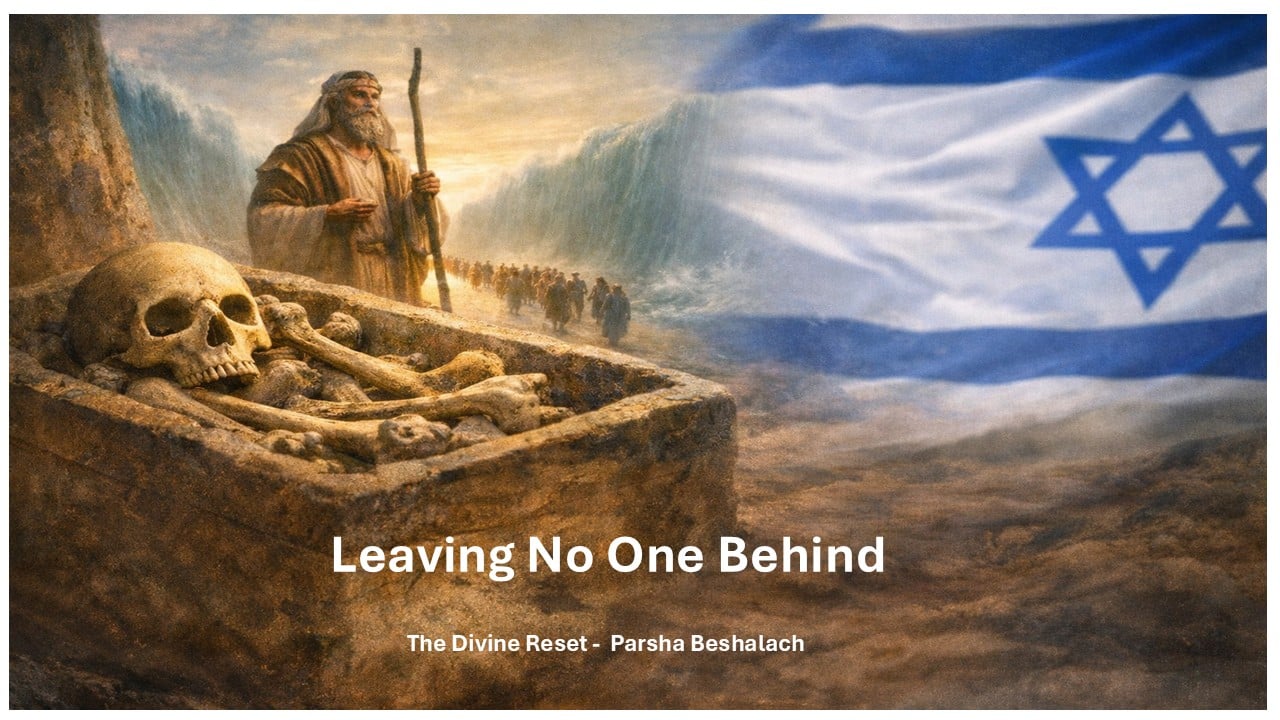
The Torah does not merely record history. It teaches patterns. The story of the Bible unfolds through survival, continuity, and moral endurance. That is why Parasha Beshalach feels so piercingly relevant today.
The parsha opens with a detail that is easy to miss but impossible to ignore:
“And Moses took the bones of Joseph with him, for he had made the children of Israel solemnly swear, saying: God will surely remember you, and you shall carry up my bones from here with you.” (Exodus 13:19)
Joseph’s bones are not symbolic. They are physical. Heavy. Inconvenient. Moses does not begin the journey to freedom with triumphalism, but with responsibility. Freedom is incomplete if it forgets its dead. Redemption begins with memory.
Joseph is eventually buried in Shechem—modern-day Nablus. The Torah is precise about geography. The Jewish people do not wander into history anonymously; they return to specific places, to land, to burial sites, to promises made generations earlier. This is not mythology. It is continuity.
From there, the parsha moves to the defining moment of the Exodus: the splitting of the sea. The Israelites have already left Egypt. Slavery is over. Pharaoh has lost. And yet Egypt chooses to pursue.
Why?
Not for strategy.
Not for defense.
But to destroy.
The Torah describes an irrational pursuit—an obsession that overrides logic. Egypt chases a people who are no longer a threat, no longer property, no longer economically useful. And that pursuit leads to Egypt’s destruction.
This is where the parsha becomes unbearably present.
Bones, Egypt, and Healing — Ran Gvili as the Bridge
This week, as we read Beshalach, the body of Ran Gvili—the last hostage—is brought back to Israel and returned to his parents.
“Last hostage” is not a statistic. It is a threshold. It marks the closing of a chapter that has held an entire nation suspended between prayer and dread, hope and helplessness. His return allows something essential to begin—not victory, but healing.
Joseph’s bones teach that redemption is not only about escaping slavery. It is about carrying responsibility. Moses does not say, “We’ll deal with the dead later.” He begins freedom by refusing to abandon someone who cannot walk out on his own.
Ran Gvili’s return is the same ethic in modern form.
In the ancient story, Joseph’s remains are proof that the Jewish people are not merely fleeing Egypt—they are moving toward covenant, land, and continuity. In our story, bringing Ran home is proof that we are not merely surviving the moment—we are insisting that our community still has a soul.
There is a deeper historical echo here. The Exodus is the birth of Am Yisrael, but it begins with a wound: centuries of oppression, broken bodies, and stolen dignity. Healing requires more than winning. It requires retrieval—bringing back what was taken, restoring what can be restored, and naming what cannot.
When a hostage is returned alive, there is relief. When a body is returned, there is a different kind of mercy: certainty. The torment of not knowing ends. Parents can mourn properly. A nation can stop holding its breath. Kaddish can be said. Shiva can be sat. Memory becomes truthful rather than suspended.
A grave is not closure—but it is the beginning of healing because it restores moral order to the world.
Bones are what remain when time strips away every illusion. They are the irreducible truth of a life that mattered. Carrying them says: you are not forgotten; you are not abandoned; you are still part of us.
From Joseph’s bones carried out of Egypt, to Ran Gvili brought back from near Egypt, the line is unbroken. Bodies. Memory. Responsibility.
For a people shaped by exile, pogroms, and genocide, this is not sentiment—it is spiritual resistance. It is how we refuse to let cruelty define the final word.
Ran’s return is therefore not only a national moment. It is a moral declaration:
we do not normalize absence,
we do not make peace with abandonment,
and we do not build a future on unresolved loss.
That is precisely how healing begins.
Egypt Then and Now — History, Myth, and Responsibility
This bridge matters because Egypt is not only the backdrop of the Exodus. It is a continuing actor in Jewish history—and in the present.
Egypt’s relationship with Israel has always been complex. In the late Ottoman and early Mandate periods, when railways were built and the land began to develop, Jews brought agriculture, industry, and economic initiative. Egyptian workers crossed borders to participate in that prosperity. Gaza itself was under Egyptian control until 1967, and many Gazans trace their roots directly to Egypt.
This is not ideology; it is documented history.
Serious academic research shows sustained migration from Egypt into Gaza, Jaffa, the coastal plain, and beyond. Egyptian laborers helped build railways, drain swamps, cultivate citrus, and work in construction and agriculture. Many settled permanently, forming families and communities later absorbed into what became known as the Palestinian population. Gaza functioned for decades as a gateway for Egyptian migration northward. [1]
This historical reality surfaced openly in 2012, when Hamas Interior Minister Fathi Hamad publicly rebuked Egypt during a fuel crisis and declared on Egyptian television that “half of the Palestinians are Egyptians and the other half are Saudis.”
The statement was politically motivated—but revealing.
Rather than engage this complexity, modern discourse increasingly turns to myth-making. Some narratives claim that Musa—Moses—did not lead the Israelites from Egypt, but instead guided Arab Muslims into the land, retroactively rewriting biblical history to erase Jewish continuity.
These myths do not arise from history. They arise from discomfort with history.
Beshalach warns where this leads. The Torah is not describing a military error or a tactical misjudgment. It is describing a psychological and moral collapse.
Egypt’s pursuit of Israel is not strategic—it is obsessive. Control has been lost, dignity wounded, and reality denied. Pharaoh cannot accept that the slaves have gone, that power has shifted, that history has moved on. What drives Egypt into the sea is not strength, but refusal—refusal to let go, refusal to accept limits, refusal to acknowledge that the world has changed.
When leaders and nations reject reality, obsession replaces judgment. And obsession, the Torah teaches, always ends in collapse.
Then and today, Egypt’s pursuit of hostility toward Israel—despite a formal peace agreement—may be strategic, but it is also obsessive. Control has been lost, dignity wounded, and reality denied. And obsession does not remain abstract; it carries a price. It corrodes judgment, hardens positions, and ultimately contributes to economic stagnation and decline.
Egypt today stands at a familiar crossroads. Gaza is not only Israel’s challenge. It is Egypt’s historical, demographic, and moral responsibility as well. Borders were drawn, but history did not disappear.
Beshalach teaches that redemption does not come from denial. It comes from restraint, truth, and the courage to carry what is heavy—whether bones, bodies, or responsibility itself. Egypt has a choice. It can continue to allow weapons, explosives, and materials for tunnels and rockets to pass through its territory—fueling destruction and prolonging misery. Or it can choose a different path.
A path of responsibility.
And Egypt is not alone in facing this choice. Regional actors such as Turkey and Qatar—who position themselves as sponsors, patrons, or mediators in Gaza—also carry responsibility. Financial backing, political cover, and ideological encouragement have consequences. Influence can be used to entrench conflict, or it can be used to dismantle it. There is no neutral ground when power, money, and legitimacy are involved.
While President Trump’s vision of a regional peace architecture—often described as a new board or framework for peace—may point in the right direction, the reality on the ground remains far more sobering. Egypt, Turkey, Qatar, and others have yet to truly turn the page on hostility toward Israel. Rhetoric has not softened; Hamas terrorist leaders are given a safe haven and a free pass, and mediation efforts have been showcased, but the deeper currents of incitement, tolerance of terror, and ideological hatred have not been uprooted.
Until that changes, declarations of peace risk becoming gestures rather than transformations. History warns us of this danger. In 1938, Neville Chamberlain declared “peace for our time,” believing that agreements and assurances could restrain forces that had no intention of being restrained. The result was catastrophe.
Beshalach teaches a harsher but more honest truth: peace built on denial does not hold. Only when hostility is confronted, responsibility accepted, and obsession replaced with restraint can a genuine turning of the page begin.
That path would mean actively stopping the flow of arms, concrete, and materials used for terror, and replacing them with genuine economic engagement: infrastructure projects, energy cooperation, reconstruction under real oversight, employment, and regional development. Not symbolic mediation, but sustained investment. Not rhetoric, but accountability.
Such an approach would not only change Gaza’s future—it could also become an economic and strategic opportunity for Egypt and the wider region. Beshalach reminds us that when nations choose restraint over obsession, and responsibility over denial, they do not drown in the sea. They step back from it.
The Divine Reset
The splitting of the sea is not only the climax of the Exodus. It is the foundational story of Judaism. We recite it every morning in our prayers—not as ancient poetry, but as living testimony. Judaism begins not with philosophy, but with intervention. With a moment when history breaks open and reveals that it is not closed, not random, and not abandoned by God.
The sea does not split to impress.
It splits to reset reality.
It teaches that when human cruelty reaches its limit, when oppression hardens into obsession, when escape seems impossible and the future sealed—God creates a path where none existed.
So the question presses on us today: Where is the miracle now?
Since October 7th, we have lived through devastation, shock, and profound sadness. We have buried too many. We have stood with families suspended between hope and despair. We have witnessed a surge of hatred that feels irrational, obsessive, and eerily familiar.
And yet—something else has been happening beneath the surface.
We are witnessing a reset.
Not one of spectacle, but of substance.
Across Israel and the Jewish world, resilience has hardened into clarity. Purpose has sharpened. Illusions have fallen away. We have relearned who we are, what binds us, and what cannot be outsourced or denied. Out of the darkness, identity has been reclaimed.
The miracle today is not that the sea split once.
The miracle is that, after centuries of exile, massacre, denial, and return, the Jewish people are still here—still insisting on life, responsibility, memory, and moral purpose. Hatred, instead of erasing us, has once again refined us.
Like the Israelites standing at the sea, we did not choose this moment. But we are choosing how to walk through it.
Beshalach reminds us that redemption is not instantaneous. The sea splits—but the journey continues. Healing does not erase pain; it transforms it into resolve.
And so we end where the parsha ends: with song.
Not a song of naïveté, but of defiance.
Not because the world is fixed, but because it can be repaired.
Not because suffering has vanished, but because despair does not get the final word.
This is the Divine Reset of our time.
And we are living through it.
Notes
[1] For historical research on Egyptian migration into Gaza and the Levant, see the Jerusalem Center for Security and Foreign Affairs (JCFA), Egyptian Émigrés in the Levant of the 19th and 20th Centuries, https://jcfa.org.
Related Topics
Related Posts