
Journalist, Commentator on Middle East Issues
Lebanon – Israel’s Chronic Problem: What Can Be Done to Solve It?
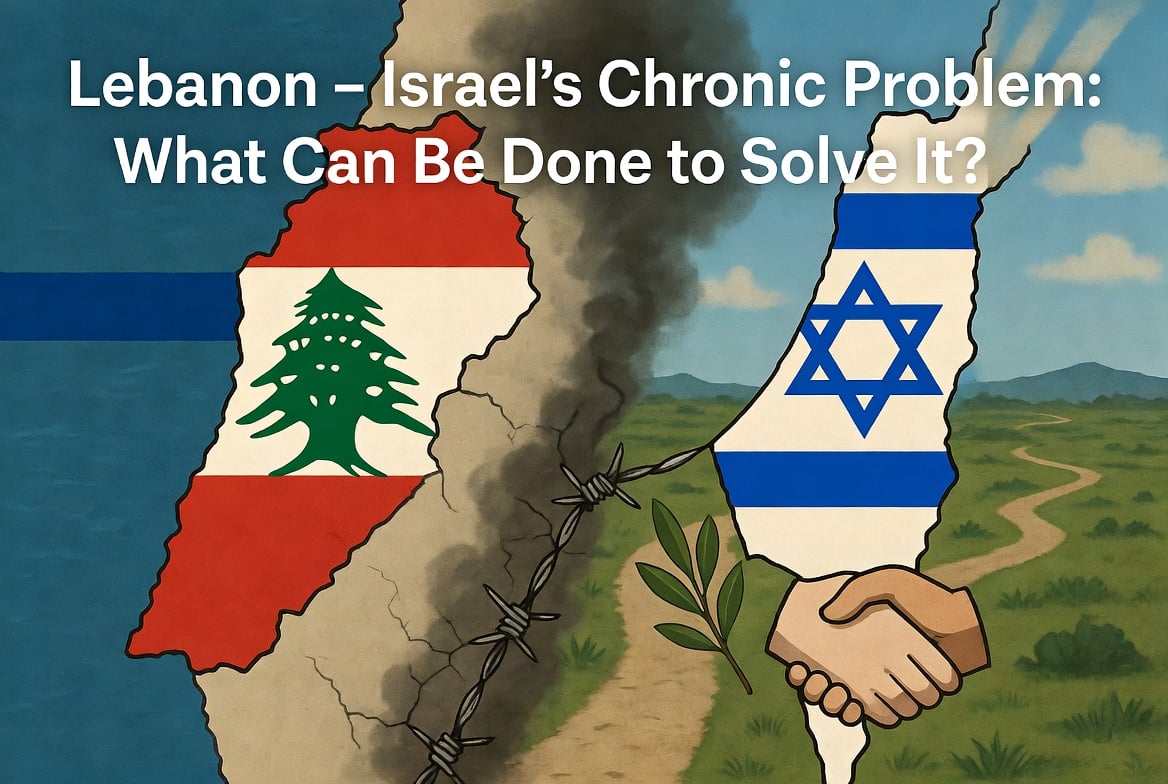
AI Illustration
The situation in Lebanon has, for decades, presented Israel with a complex strategic dilemma: How can Hezbollah be deterred and disarmed without being dragged into a broad, costly war that could destabilize the region and damage relations with other regional partners?
The Evolution of the Threat
Since the Second Lebanon War in 2006, Hezbollah has transformed from a guerrilla militia into a hybrid military force. It now possesses precision-guided missiles, drone systems, and a vast civilian infrastructure used as a human shield.
Meanwhile, the Lebanese government remains in a position of extreme weakness. It lacks real control over the state and depends politically and economically on external actors. This power vacuum has allowed Hezbollah to operate as a “state within a state,” systematically violating UN resolutions, most notably Resolution 1701. For Israel, this means there is no effective official sovereign to deter or coordinate with.
The Iranian Factor and International Positions
The central driver behind Hezbollah’s growth is Iran. Tehran views the organization as its primary forward arm on Israel’s northern border, part of its broader “Ring of Fire” strategy. This support includes funding, training, and the supply of advanced weaponry. Despite the harsh blows Iran has recently sustained, it continues to try to maintain regional influence through its proxies.
In contrast, the United States seeks to curb escalation. While Washington supports Israel’s right to self-defense, it exerts pressure to avoid an all-out war or an invasion extending beyond the Litani River. The recent decision by President Donald Trump to restrict Israeli strikes during the ceasefire period with Iran serves as a clear example of this policy. Europe follows a similar path: condemning Hezbollah while calling for Israeli restraint and attempting to bolster Lebanese state institutions.
Strategic Options for Israel
The war that broke out on October 8, 2023, significantly weakened Hezbollah, and recent strikes against Iran have choked its supply lines. While Hezbollah is at its weakest point since its inception, it remains a potent threat. Israel now faces three primary paths:
- Continuation of the “Campaign Between Wars” (MABAM):
Conducting limited, surgical strikes against assets in northern Lebanon to degrade capabilities without sliding into total war.
- Verdict: Effective in the short term, but fails to address the root Iranian role.
- A Decisive Large-Scale Military Operation:
A full-scale campaign to dismantle Hezbollah’s infrastructure.
- Pros: Could fundamentally change the reality on the ground.
- Cons: High cost to the Israeli home front and the risk of international intervention before objectives are met.
- The “Integrated Approach” (Military + Diplomacy):
Persistent, limited operations in Southern Lebanon combined with intense diplomatic pressure from the US and Europe to empower the Lebanese government to enforce UN resolutions.
- Verdict: A slow and complex process, but the most likely to produce long-term stability.
Bottom Line
The challenge facing Israel is not merely military; it is systemic. Success requires a delicate balance: curbing Iranian influence and strengthening Lebanese sovereignty while maintaining the freedom to act against security threats, all without falling into the trap of a prolonged occupation that would bleed the economy and damage Israel’s international standing.