The views expressed herein are solely mine.
Lebanon Must Crush Hezbollah for Peace
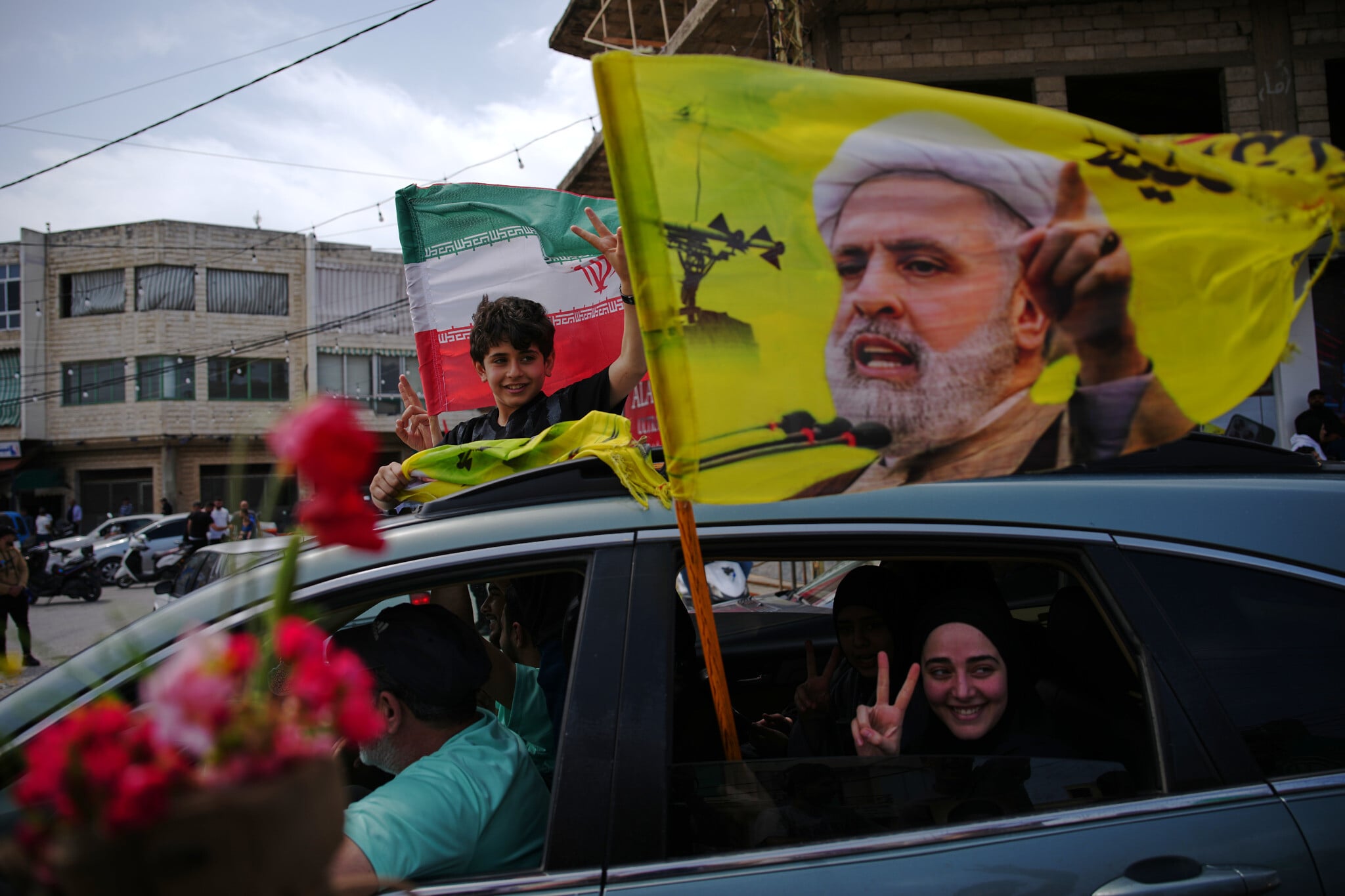
Displaced residents wave a flag with the image of Hezbollah leader Naim Qassem as they return to their villages following a ceasefire between Israel and Hezbollah, in Zefta, southern Lebanon, April 17, 2026. (AP Photo/Hassan Ammar).
Israeli Prime Minister Benjamin Netanyahu held urgent security consultations on April 27, 2026, after Hezbollah fired rockets and drones into the buffer zone south of the Litani River, once again shredding the United States-brokered ceasefire. But truces mean little when an Iranian proxy rearms and reloads by the day.
The only durable solution is a land-for-peace agreement between the Jewish state and the Lebanese government: Israel withdraws from the buffer zone, while Lebanon deploys its armed forces, asserts full sovereignty, and eliminates Hezbollah as a parallel terrorist army. This is the dormant logic of United Nations Security Council Resolution 1701 finally carried through to completion.
Hezbollah’s objections carry no sovereign weight. As a non-national Iranian proxy terrorist organization, it possesses no legitimate authority to veto state diplomacy. But for this formula to work, Beirut must do more than negotiate. It must stand up, and its military must engage Hezbollah to achieve what Lebanese leaders now publicly claim to want.
The buffer zone therefore decides everything. For the first time in decades, the Lebanese state has a strategic incentive to negotiate because economic collapse has stripped away every illusion.
Lebanon’s cumulative GDP decline since 2019 has approached 40 percent. The wider conflict and national destruction have generated roughly $14 billion in economic cost, while reconstruction and recovery needs now stand at $11 billion. More than 70 percent of the population has been pushed into multidimensional poverty, and unemployment remains structurally catastrophic as the post-2019 financial implosion -mainly due to Hezbollah’s linked Beirut Port explosion in 2020- continues to hollow out the country.
At the same time, Hezbollah continues operating its shadow empire of Captagon and hashish smuggling, draining state revenue while ordinary Lebanese sink deeper into deprivation.
Indeed, a formal treaty would destroy the occupation pretext that has kept Hezbollah politically alive for decades. Remove Israeli forces from the buffer zone in phased withdrawals -with clear and strong security measures- and Hezbollah’s last rhetorical justification evaporates with them. It loses the ability to masquerade as a “resistance movement” and stands exposed for what it is: an Iranian expeditionary instrument without an independent Lebanese national mandate.
Fears that Lebanese enforcement against Hezbollah would trigger civil war are increasingly detached from Lebanon’s present reality. Civil war requires a country split into armed communities willing to mobilize behind competing visions of power. That is not today’s Lebanon.
Lebanon has not conducted a national census since 1932. For nearly a century, successive governments froze the demographic record to preserve a confessional power-sharing order built around outdated Maronite and Sunni weight, even as the Shia population expanded. But raw sectarian arithmetic alone does not translate into revolutionary strength. Hezbollah’s influence was built less on demographic inevitability than on its ability to function as a parallel state financed by Tehran.
That financial pillar is now exposed for what it is. Hezbollah fighters receive roughly $700 a month, a figure that dwarfs the near-starvation wages of Lebanese Armed Forces soldiers, whose effective income has hovered near $150 per month. Iran has long sustained this imbalance by channeling more than $700 million annually into Hezbollah’s terror machine.
However, Washington recently approved a $230 million package in late 2025 specifically to strengthen the Lebanese security forces as Beirut moved toward confronting the group. Hezbollah’s coercive power, in other words, has depended more on collective Lebanese enthusiasm than on an externally subsidized patronage army. Ergo, Hezbollah now has a big problem.
That distinction matters because Lebanon’s other communities—and an increasing number of Shia within Hezbollah’s own exhausted social base—no longer see the organization as a shield. They see it as the internal cancer that helped bankrupt the economy, internationalize the war onto Lebanese soil, and suffocate any prospect of national recovery after Beirut’s collapse. Christians, Sunnis, Druze, and many Shia are not waiting to rise in Hezbollah’s defense. They are waiting for the state to finally do what it has refused to do for decades: cut out the parasite.
Thus, Lebanon must securitize Hezbollah as an existential threat to national sovereignty under the Copenhagen School framework. This lifts the so-called ‘militia’ above the level of routine politics and authorizes extraordinary state measures in the name of national survival.
The Lebanese Armed Forces must therefore step up: deploy south of the Litani River, strike Hezbollah infrastructure and terrorists, and join Israel in the field to secure the ongoing buffer zone before phased withdrawal. The armed forces already possess professional institutional capacity and prepared southern deployment plans. American, Emirati, Saudi, and Qatari financial backing, combined with Israeli operational coordination, would give them the decisive edge. This restores the state. It does not ignite civil war.
Unapologetically, implementation must be ruthless and verifiable. Israel should phase its withdrawal only after confirmed milestones are met. The Lebanese Armed Forces must take full control of the buffer zone. International monitors must verify Hezbollah’s heavy weapons removal. Alongside Syria and several Latin American countries, smuggling routes must be shut down. Reconstruction funds—already estimated by the World Bank at $11 billion-should go exclusively to Hezbollah-free zones.
In tandem, targeted sanctions must crush Hezbollah’s narcotics networks (which generate over $1 billion annually) and the establishment of a religion-neutral census must modernize power sharing to reflect 2026 realities and confer legitimacy on the post-Hezbollah political order that emerges from it. Together, these measures align Beirut’s incentives and sever Iran’s land bridge to the Mediterranean.
A formal Israel-Lebanon peace treaty delivers the ultimate geostrategic payoff. It cuts Tehran’s proxy axis, stabilizes the eastern Mediterranean energy corridor, and buries the “Greater Israel” hoax permanently. Hezbollah would retain no credible reason to function as a parallel paramilitary terrorist organization. Its funding, recruitment, and domestic rationale would begin to dry up as Lebanese sovereignty reasserts itself.
By contrast, perpetual unrealistic ceasefires simply allow Iran to reload at Lebanese expense. Lebanon therefore faces a stark choice: confront the internal threat, attack Hezbollah, and join Israel in the field, or remain a failed State held hostage by Tehran.
The numbers, the doctrine, and the moment all converge on one conclusion. Sovereignty demands force. Peace requires Lebanon to crush Hezbollah now.
Related Topics
Related Posts