
Narratives, Power, and the Middle East
Lebanon’s Summer Camps
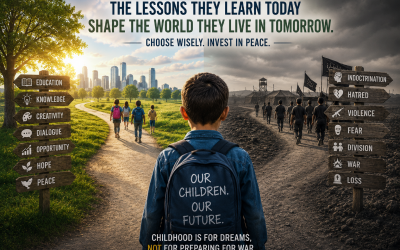
When Summer Camp Teaches War: Lebanon Cannot Build Peace by Preparing Children for the Next Conflict
By Imran Igra
A warning from history about youth militarization, armed movements and the future Lebanon’s children deserve
Every summer, parents send children to camp hoping they will come home a little more confident, a little more independent and perhaps with a few new friends. They expect sports, hikes, songs, lessons, service projects and the ordinary adventures that become childhood memories. They do not expect summer camp to become a place where war is romanticized or where young minds are introduced to the idea that armed struggle may be their destiny.
That is why the renewed attention surrounding Hezbollah-affiliated youth programs in Lebanon should alarm anyone who genuinely wants peace for the country — Lebanese first and foremost.
The issue is larger than uniforms, slogans or a few disturbing photographs. The deeper question is what happens when childhood, political identity and military culture begin to overlap. If a movement teaches young people that sacrifice in armed conflict is among the highest forms of service, what kind of future is it preparing them to inherit? And how can diplomats spend years trying to prevent another war while a new generation is being socialized around the imagery and language of the last one?
The Imam al-Mahdi Scouts, a youth organization associated with Hezbollah, has been described in recent reporting as combining conventional scouting and religious activities with ideological messaging, military symbolism and, for older participants, exposure to weapons-related instruction. The New York Post article that prompted this discussion cited claims of roughly 74,000 to 75,000 participants or members; that figure should be treated as an organization-linked or reported estimate rather than an independently verified census.
That distinction matters. Facts matter, particularly in a region where propaganda travels in every direction. But even without exaggeration, the underlying concern is serious enough: children should not be treated as a strategic reserve for tomorrow’s conflict.
This is not an argument against Islam, Shiism, Lebanese patriotism, religious education or scouting. Nor is it an argument that every child who attends such a program becomes a fighter. That would be irresponsible. The argument is narrower and more important: when a youth movement linked to an armed political organization normalizes martial imagery, martyrdom narratives or preparation for armed struggle, it risks making the next conflict feel inevitable before children are old enough to question whether it is necessary.
Lebanon can hardly afford that.
The country is still trying to climb out of an extraordinary economic and political crisis. The World Bank estimated that real GDP contracted 7.1 percent in 2024 and that the cumulative decline since 2019 approached 40 percent. Its assessment of the recent conflict put recovery and reconstruction needs at about $11 billion. An earlier damage assessment estimated $8.5 billion in physical damage and economic losses, nearly 100,000 housing units partially or fully damaged, and more than 875,000 people internally displaced at the height of the conflict.
Those numbers are not abstract. They represent businesses that did not open, homes families could not return to, classrooms interrupted, savings destroyed and young people wondering whether their future lies in Lebanon at all.
Against that background, what is the strategic value of teaching another generation to see armed confrontation as a permanent feature of national life? Lebanon needs engineers to rebuild infrastructure, entrepreneurs to create jobs, teachers to repair interrupted education, doctors, scientists, programmers, investors and public servants. It needs young people who believe the future can be larger than the conflicts of their parents.
There is also a wider international concern about children and armed groups. The United Nations’ Children and Armed Conflict office reports that, in Lebanon during 2025, 294 grave violations were verified against 281 children and 132 boys were recruited and used by armed actors. The UN page does not attribute all of those cases to Hezbollah, and it would be wrong to do so. But the statistic shows that child recruitment in Lebanon is not a theoretical issue. It is a present danger.
International standards are clear about the direction societies should be moving. The Optional Protocol to the Convention on the Rights of the Child on the involvement of children in armed conflict establishes strong protections against the recruitment and use of children in hostilities, particularly by non-state armed groups. The principle behind those rules is uncomplicated: childhood should be protected from war, not organized around it.
History gives us plenty of warnings about what happens when political or military movements decide that children are an investment in the next struggle.
Consider Nazi Germany. The comparison is not meant to suggest that Hezbollah and the Nazi regime are identical; they plainly are not. The relevant lesson is about the method of molding youth around ideology and militarism. Hitler Youth membership grew from roughly 108,000 at the end of 1932 to about 8.7 million by 1939 as competing youth organizations were absorbed or eliminated and the Nazi state tightened its control over German childhood. By the closing stages of World War II, teenagers were being drawn directly into Germany’s desperate defense.
What did all that ideological discipline ultimately accomplish for German children? Not security. Not national greatness. They inherited ruined cities, dead relatives, occupation and the moral catastrophe of a regime that had taught loyalty more effectively than judgment. Germany’s eventual success came after militarized totalitarian education was dismantled and the country rebuilt around democratic institutions, economic reconstruction and civic life.
That is the first warning: a movement can become very good at producing loyal young followers while becoming catastrophically bad at producing a safe future for them.
Sri Lanka offers another example. The Liberation Tigers of Tamil Eelam, or LTTE, fought a long separatist war and became notorious for recruiting children. International organizations documented thousands of cases. During peace efforts, ending underage recruitment became part of the struggle to protect children from a conflict they had not created.
The LTTE was ultimately defeated militarily in 2009. Decades of recruitment, sacrifice and discipline did not produce the independent state the movement promised. What remained were grieving families, traumatized communities and former child recruits who had to find their way back into civilian life.
The lesson is not that every insurgency follows the same path. It is that turning children into instruments of a political project can sustain a conflict without solving the political problem underneath it.
Colombia provides a different but equally important lesson. The FARC insurgency lasted for decades and recruited minors during its conflict with the state. By 2015 and 2016, as peace negotiations advanced, the United Nations was publicly welcoming FARC commitments to stop recruiting and using children under 18.
Think about the symbolism of that. When serious peace finally became possible, removing children from the machinery of war was not an obstacle to peace. It was part of peace.
That should matter enormously in Lebanon. If a practice will eventually have to be dismantled for reconciliation to succeed, why deepen it now?
ISIS took the logic of youth militarization to an even darker extreme with the so-called “Cubs of the Caliphate.” UN investigators documented children being treated as future fighters and subjected to recruitment and training. The organization invested heavily in the idea that its ideology could be made permanent by shaping children early.
Its territorial caliphate nevertheless collapsed.
What survived was not the promised utopia. It was a humanitarian and security nightmare involving displaced families, traumatized children, detention camps, broken education and years of difficult reintegration. Indoctrination can manufacture obedience. It cannot manufacture legitimacy, prosperity or durable peace.
Cambodia carries another painful memory. Children were used as soldiers during years of civil war, including under the Khmer Rouge period. The country’s experience demonstrates something often forgotten in the romance of revolutionary movements: when violence becomes the language through which young people understand politics, ending the shooting does not automatically end the damage. Societies then spend decades recovering memory, trust and normal civic life.
These historical cases are different. Their ideologies, crimes, political objectives and circumstances cannot simply be collapsed into one category. But across those differences runs a stubborn pattern: adults begin a struggle, children are taught to inherit it, and years later society is left trying to teach those children how to live without it.
That is precisely why Lebanon should be having this conversation now — before another generation is lost to the assumption that war is unavoidable.
Hezbollah and its supporters have long argued that armed “resistance” is necessary for Lebanon’s defense. Many Lebanese, especially in communities that have experienced invasion, occupation or bombardment, have their own historical reasons for viewing security through that lens. Those experiences cannot simply be dismissed. Any serious peace argument must acknowledge them.
But acknowledging fear is not the same as accepting permanent militarization. In fact, the more painful the history, the greater the responsibility to keep children from becoming prisoners of it.
A ten-year-old does not need to inherit every grievance of a forty-year-old. A teenager should be allowed to question the assumptions of the generation before him. That is how societies change. It is how enemies eventually become negotiating partners, how borders become quieter and how old narratives lose their power to send young people to die.
There is another contradiction that deserves attention. Lebanon’s political leaders and international partners repeatedly speak about sovereignty, state institutions and the need for the Lebanese state to exercise authority over security. UN Security Council Resolution 1701, adopted in 2006, called for the implementation of earlier provisions concerning the disarmament of armed groups and envisioned an area between the Blue Line and the Litani River free of armed personnel and weapons other than those of the Lebanese state and UNIFIL.
Peacebuilding cannot be confined to negotiations between officials. It has to reach culture, education and the stories societies tell their children. A ceasefire can stop rockets for a period of time. It cannot by itself stop the next war if young people continue to be raised believing that armed conflict is noble, permanent and unavoidable.
That is why youth militarization is not a side issue. It is a peace issue.
Imagine the alternative.
Imagine a Lebanese summer program with tens of thousands of children competing in robotics, coding, medicine, environmental science, entrepreneurship and public service. Imagine Christian, Sunni, Shiite, Druze and other Lebanese teenagers working together on emergency preparedness, rebuilding villages, preserving Lebanon’s extraordinary cultural heritage and learning how democratic institutions are supposed to function.
Imagine if the prestige associated with carrying a weapon were transferred to building a company, inventing a medical device, restoring a school or negotiating an agreement that prevents people from dying.
That would not make Lebanon weaker. It would make Lebanon harder to destroy.
A country’s real strength is not measured only by missiles, fighters or the ability to mobilize quickly. It is measured by whether talented young people want to stay, whether families believe tomorrow will be better, whether institutions can resolve disputes without gunfire, and whether children can imagine identities larger than the conflicts surrounding them.
This is where the summer-camp question becomes so urgent. Childhood does not last long. The ideas planted during those years can last a lifetime. Teach a child that another community is permanently an enemy and peace becomes harder. Teach that martyrdom is the highest achievement and ordinary life can begin to look small. Teach that political disagreements are ultimately settled by force and democratic compromise starts to resemble weakness.
Once those ideas become cultural habits, diplomats are negotiating not only borders and weapons. They are negotiating against an identity built around conflict.
Lebanon deserves better than that. So do Israeli children. So do Palestinian children. So do children in every society trapped inside a conflict older than they are.
The standard should be universal: no political movement, government, militia, religious organization or armed group should use childhood as a runway toward war. If we condemn it when our adversaries do it, we should condemn it when our allies do it. The principle means little otherwise.
And this is not a call to erase history. Children should learn history — all of it. They should understand occupation, terrorism, displacement, discrimination, war and the failures of political leaders. But teaching history is different from recruiting children into its unfinished battles. Education should give young people the tools to examine the past, not orders to repeat it.
There will always be people who argue that this is naïve. They will say the Middle East is dangerous, that enemies are real and that children must be prepared for the world as it exists.
But preparing children for reality does not require preparing them for combat.
The most powerful countries in the twenty-first century compete through technology, universities, capital, diplomacy, intelligence, trade and innovation. Lebanon cannot rebuild by treating human potential as ammunition. Its young people are already leaving in search of opportunity. The answer cannot be to give those who remain another reason to believe their future will be defined by war.
History has delivered the warning often enough. The Hitler Youth did not save Germany. Child recruitment did not deliver the LTTE’s promised state. FARC’s path toward peace required abandoning underage recruitment. ISIS could indoctrinate children but could not build a durable country. Cambodia’s children inherited wounds that took generations to confront.
Why repeat a model whose human cost is so well documented?
Lebanon’s greatest strategic resource is not an arsenal. It is the imagination of its children.
If peace is truly the objective, then every institution that influences those children should be moving them away from the battlefield — intellectually, culturally and physically. Give them history without hatred. Faith without militarization. Patriotism without perpetual war. Discipline without blind obedience. Courage without a weapon.
Because the most dangerous thing about teaching children to prepare for the next war is that, eventually, someone may decide they are ready to fight it.
And then everyone will ask why peace failed again.
Related Posts