Let’s Fight Candace Owens, Not Each Other
It always saddens me when I have to write yet another blog about a scandal — especially one that feels entirely avoidable.
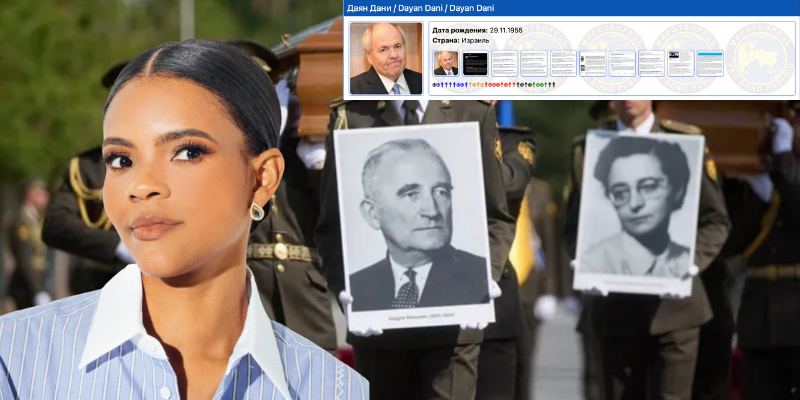
This time, it is about the tensions that arose following the reburial of Andriy Melnyk, the leader of the Organization of Ukrainian Nationalists (OUN), and the reaction it provoked not only in Israel but also in Poland — Ukraine’s essential partner, which shares a border with the country and serves as a key hub for transporting military aid to the embattled state.
The history here is, at the very least, complicated. Much of it has been distorted by Soviet and Russian propaganda, which has done an outstanding job demonizing Ukraine’s role during World War II, despite the fact that it was the Soviet Union that signed the Molotov-Ribbentrop Pact and helped divide Europe — and Poland in particular — before some of the worst crimes of the Holocaust took place.
But it is also true that not every action carried out by Ukrainian nationalists in the name of Ukraine can be, or should be, morally justified.
The concerns surrounding Melnyk’s reburial are therefore understandable. OUN factions did collaborate with Nazi Germany, and attempts to deny that, or downplay it by bringing up different historical “whataboutisms” , quite frankly puzzle me.
It remains true even if other nations, including Israel, have figures in their own histories who used morally questionable methods in pursuit of political goals. And it remains true even if Ukraine has the right to shape its own historical narrative as it sees fit.
Yad Vashem, meanwhile, is doing precisely what it is supposed to do: researching and documenting the Holocaust, its perpetrators, and its accomplices. I see very little reason for rejecting its concerns, even if the faction in question also fought for Ukraine’s freedom from Moscow’s rule.
Which is why the decision by some Ukrainian activists to add the head of Yad Vashem to the Myrotvorets database — effectively a list of alleged enemies and wrongdoers — strikes me as unnecessarily hostile. Especially when the accusation is that he is somehow deliberately undermining relations between Ukraine and Israel.
What exactly is the purpose of that?
Other than descending once again into the familiar “you’re stupid — no, you’re stupid” dynamic, particularly in the aftermath of the recent grain scandal that has already strained emotions on both sides, with Kyiv’s conduct also turning out to be also questionable in the end.
And it feels even more unnecessary at a time when Ukraine and Israel face no shortage of common challenges and common detractors. Just look at Candace Owens — a podcaster whose increasingly bizarre claims have made her a darling of anti-Ukraine and anti-Israel audiences alike — traveling to St. Petersburg to attend Russia’s flagship economic forum alongside Vladimir Putin.
She’s currently boasting of her travels extensively and giving interviews to the Russian propaganda machine, including the religious channel Spas.
History is painful. History is messy.
And yes, it deserves to be revisited.
But it should be revisited through new forms of dialogue that shed greater light on what actually happened — not through the lens of Kremlin propaganda, but through the experiences of real people and an honest effort to understand why events unfolded the way they did, without excusing anyone. That requires serious work: historians, working groups, ideologically neutral researchers, and a willingness to engage with uncomfortable facts.
After all, it is very easy to point fingers retrospectively when you already know how the story ends.
For now, all I see is someone in the Kremlin smiling.
Because what could be better than another scandal involving Ukraine, Israel, and the word “Nazi”?