
Let’s talk about genocide(s)!
We’ve all – at some point in our lives – heard the saying “The road to hell is paved with good intentions.” But have we stopped to think why that should be so? Why would good intentions produce bad outcomes? I suggest the answer is “because those good intentions are taken to extremes”. We tend to fall in love with those intentions, to the extent of suspending our critical thinking.
Take the biblical injunction “justice, justice thou shalt pursue”: what can be wrong with bringing more justice to the world?
Quite a lot, potentially. Because the blind pursuit of justice can actually produce injustice. When justice becomes an ideological project – something to be maximized at all costs – rather than a principle to be applied with reason and restraint, it can ultimately undermine both the rule of law it is supposed to serve and the peace it is meant to bring.
We are beginning to see precisely this problem in the almost fanatical drive to criminalize conflict and expand the role of international courts.
More than eight decades ago, as the Holocaust was unfolding (around 63% of Europe’s Jews would eventually be murdered), a Polish Jew called Rafał Lemkin coined the term ‘genocide’. Linguistically, it derived from the Greek ‘genos’ (people or ‘race’) and the Latin ‘cidium’ (killing). Lemkin’s moral sensitivity had identified that what the Nazis were doing was worse even than mass murder: what they intended to kill was not just ‘a very large number of people,’ but a people as such: they were attempting to erase a particular flavor of humanity. No wonder that this was soon labelled “the crime of crimes”.
The term resonated. By 1948, in response to the Holocaust, the governments of UN member states formulated and adopted an international treaty meant to criminalize it and prevent it from recurring: the Convention on the Prevention and Punishment of the Crime of Genocide.
At the heart of its definition were the words:
acts committed with intent to destroy, in whole or in part, a national, ethnical, racial or religious group
As we have seen, the essential idea behind ‘genocide’ is the intention to destroy a people. So why “in whole or in part”?
That phrase was proposed by the Norwegian delegate, Finn Moe Wikborg. His explanation could hardly have been simpler:
it was not necessary to kill all the members of a group in order to commit genocide.
Of course not. Otherwise, Hitler could theoretically have argued that the Holocaust was not genocide because he talked only about exterminating European Jewry: Jews in America might have survived. Or a genocidaire intent on exterminating an entire people could claim that no genocide had occurred if he were stopped after murdering ‘just’ half of them.
In other words, “in part” appears to address the extent of the destruction, not to change the object of the intention. The intended target remains a people as such.
Though in many ways different from the Holocaust, Rwanda provides another unequivocal example of genocide. In 1994, Hutu extremists set out to destroy the Tutsi population of Rwanda. The methods were different from those of the Nazis and the killing was compressed into little more than three months, but the essential intention was the same: the target was not ‘simply’ a large number of Tutsis because they were Tutsis, but the Tutsi as a people. Hundreds of thousands were murdered as the perpetrators sought a Rwanda in which that particular flavor of humanity no longer existed. This was genocide according to the Convention, but also in the original, intuitive sense of the word. The International Criminal Tribunal for Rwanda (ICTR), a UN criminal tribunal created by the Security Council, had no problem ruling this was a genocide.
Then came Srebrenica. In July 1995, towards the end of the Bosnian war, Bosnian Serb forces under General Ratko Mladić captured Srebrenica, a predominantly Muslim enclave that had been declared a UN ‘safe area’. They forcibly removed some 30,000 women, children and elderly people. Over the following days, Bosnian Serb forces systematically killed between 7,000 and 8,000 Muslim men and boys, the overwhelming majority executed in cold blood after capture rather than in combat.
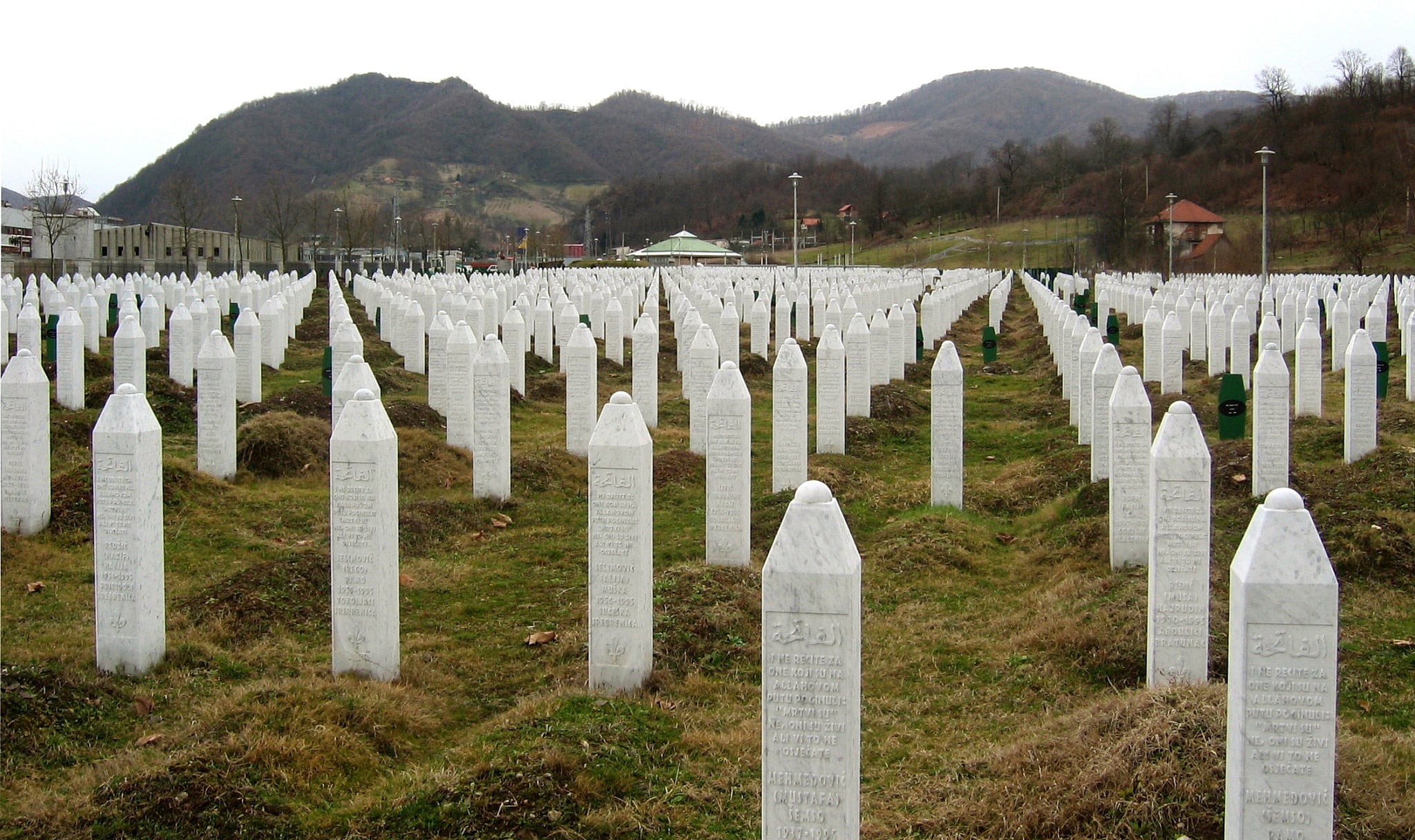
{By Michael Büker – Own work, CC BY-SA 3.0, https://commons.wikimedia.org/w/index.php?curid=6405619}
There is no question that this was a horrendous war crime. But was this an attempt to exterminate the Bosnian Muslim people as such? The murders were horrific, but they were localized; even within Srebrenica, the women, children and elderly were expelled rather than killed.
Yet the International Criminal Tribunal for the former Yugoslavia (ICTY) eventually ruled that the Srebrenica massacre was genocide, even though Srebrenica’s Muslims represented a relatively small proportion of Bosnia’s entire Muslim population. With the world shocked by the enormity of the crime and demanding justice, the judges must surely have felt considerable pressure not to appear timid by withholding the label of genocide.
To get there, the judges interpreted “in part” literally: the intention did not have to be to destroy the Bosnian Muslim people as such; it could be to destroy a part of that people – in this case, the Muslim community of Srebrenica, through the killing of its men and boys.
However, the literal interpretation creates an obvious problem: every community is “part” of a larger “whole”. What if antisemites attempted to murder all five Jewish families living in a particular village? This would be a horrific pogrom; but is every pogrom a genocide? Taken to its extreme, “in part” could make any racially motivated murder a genocide.
The judges recognized the problem. Their solution was to introduce a term that does not appear anywhere in the Convention: in order to qualify as genocide, the targeted “part” had to be “substantial”.
But what is “substantial”? The judges established no numerical threshold. Instead, they created an ad hoc test: numbers were the necessary starting point, but they could also consider the prominence of the “part” within the larger group, whether it was “emblematic” of that group or “essential to its survival”, and even the geographical reach of the perpetrators. None of these considerations was decisive; they were merely “useful guidelines”, to be considered according to the circumstances of each case.
So what’s wrong with that? Well, for starters, the judges may have misinterpreted the original intention behind the Convention’s “in whole or in part”: that phrase may have referred to how much of the group was actually destroyed, rather than how much of it the perpetrators intended to destroy.
There is a wider problem with the overly ‘literal’ interpretation of law. Laws are made of words, and words cannot anticipate every circumstance. Take theft. Most of us have a pretty clear idea of what theft means: taking something that belongs to somebody else with the intention of keeping it. But suppose I find a wallet containing £100 in a park. I look around for its owner and ask the people nearby, but nobody can identify it. Eventually I pocket the money.
Have I “appropriated property belonging to another”? Literally, yes. Does that make me a thief? Most people would instinctively say no. Yet an excessively literal reading of the law could produce precisely that result. The definition would have perverted the concept it was intended to define.
Words are important, but the meaning of law cannot be reduced to textual dissection. Definitions must be interpreted in the light of the thing they were intended to describe and the purpose for which they were enacted. The common law must not replace common sense.
By interpreting the genocide definition literally rather than logically, the Srebrenica ruling created a legal concept of ‘genocide’ that was different from – and arguably at odds with – the common understanding of the term.
Remember that ‘genocide’ fundamentally means the attempt to erase a people, an entire flavor of humanity. In other words, the ultimate victim is not just the people targeted, but humanity itself. Genocide is a ‘crime against humanity’ in common understanding, not merely in legal terminology.
Ironically, the judges themselves understood this perfectly well. In the appeal judgment, they explained that genocidaires “identify entire human groups for extinction” and attempt to “deprive humanity of the richness” provided by its different peoples.
That profound description aligns both with the common meaning of the term and with the original intention of the Convention. But it sits uneasily with the legal test they had constructed and with the Srebrenica ruling itself. If humanity is the ultimate victim because one of its constituent peoples is marked for extinction, how can the destruction of a relatively small local community – let alone one whose women, children and elderly were deliberately allowed to survive – be construed as the same crime?
Srebrenica was far from the end of this process. On the contrary, it established a precedent: genocide no longer necessarily meant an attempt to erase a people as such. Once the concept had been detached from that intuitive meaning, the door was open to applying the “crime of crimes” label to conflicts that looked very different from either the Holocaust or Rwanda.
Which brings us to Gaza. According to the Hamas-controlled Gaza Ministry of Health, more than 73,000 Palestinians (civilians and combatants) were killed during nearly three years of war with Israel. This represents circa 3.3% of Gaza’s population and 0.5% of the global Palestinian population.
But it didn’t take three years for the ‘genocide’ accusations to surface – they did so already in October 2023. By 29 December, when the reported death toll stood at around 21,500 – approximately 1% of Gaza’s population and 0.14% of Palestinians worldwide – South Africa had already applied to the International Court of Justice, alleging that Israel was committing genocide and demanding that the Court make it stop.
Ultimately, the Court did not satisfy South Africa’s demands – but nor did it throw out the case. It found that the Palestinians in Gaza had a “plausible” right to be protected from acts of genocide and that there was a real and imminent risk of irreparable harm to that right. It therefore ordered a series of “provisional measures”.
Crucially, however, it did not rule that genocide was taking place. Deciding on the actual merits of South Africa’s claim – in other words, whether Israel had indeed committed genocide – will take years. Meanwhile, South Africa has requested – and received – another 18 months to prepare its next submission. As a result, the written proceedings alone will now stretch at least into 2029.
But court proceedings are one thing and political activism quite another: for many, that the Jewish state is guilty of genocide has already become an article of faith and an incontrovertible ‘social media truth’.
Nor is Gaza unique. Russia’s brutal war against Ukraine has likewise generated widespread accusations that Russia itself is committing genocide against Ukrainians – although the existence of Ukrainians as a people does not appear to be at risk; not even at ‘plausible’ risk.
One can imagine a future – and not a remote one – in which every military conflict will be accompanied by accusations of genocide, with one or both sides being dragged before an international court to litigate the matter for years.
A certain category of political activists would like nothing better: they see this as strengthening international institutions and an end to impunity. Many may even believe that this would eventually make war itself a much more costly – and therefore much less appealing – proposition.
But they are wrong: moral value, like monetary value, is subject to inflation. Printing more of the highest-denomination notes does not make us richer; it merely devalues that currency. Calling ever more conflicts ‘genocides’ does not make war less likely – it makes genocide less exceptional. It trivializes ‘the crime of crimes’ into the crime of many.
Worse, the relentless criminalization of conflict may actually make disputes more difficult to resolve. Why would Armenia and Azerbaijan negotiate in good faith and seek to resolve their differences through accommodation when they can both take the other to the ICJ, seeking legal vindication from above? And how could any Palestinian leader make peace with the Jewish state – a peace that necessarily involves mutual concessions – when it’s become an article of faith that Israel committed genocide against his people?
And it’s not ‘just’ about war and genocide. Since the ICJ ruled that Israel’s occupation of the West Bank is unlawful and must unconditionally end – why would Palestinians offer Israel any concessions merely for fulfilling what they now see as a legal obligation?
“The road to hell is paved with good intentions.” Even when pursued with the best of intentions, the relentless drive to expand the reach and power of international institutions (especially the courts) may lead to very bad outcomes.
But what is the alternative? Restraining that drive may sound suspiciously like granting impunity. If international courts cannot hold dictators, generals and governments to account, who will? Should we simply accept that terrible crimes will go unpunished because the international machinery capable of punishing them is imperfect?
No. The way forward is neither impunity nor ‘international’ moral inflation; it is enhanced national justice. After all, why do dictators so often escape justice – as in the case of Omar al-Bashir? Not because they’re not prosecuted internationally (they often are); but because they’re never held accountable at home.
And why is that? Because dictatorships, almost by definition, start by emasculating the very institutions that might hold tyrants accountable.
Now imagine a world in which every national court is independent; the press is free, the public debate unfettered; rulers are all accountable to law and to the voter. Why would we even need international courts?
You want a fairer world? Fight for power to the people, not power over peoples. Independent national institutions, not politicized international courts. Democracy in every nation, not international judicial oversight. Just and judicious politics, not politics by judicial means.
Justice, justice thou shalt pursue!