
The views expressed herein are solely mine.
Liberman’s Moscow Pivot: Surviving U.S. Aid Cuts
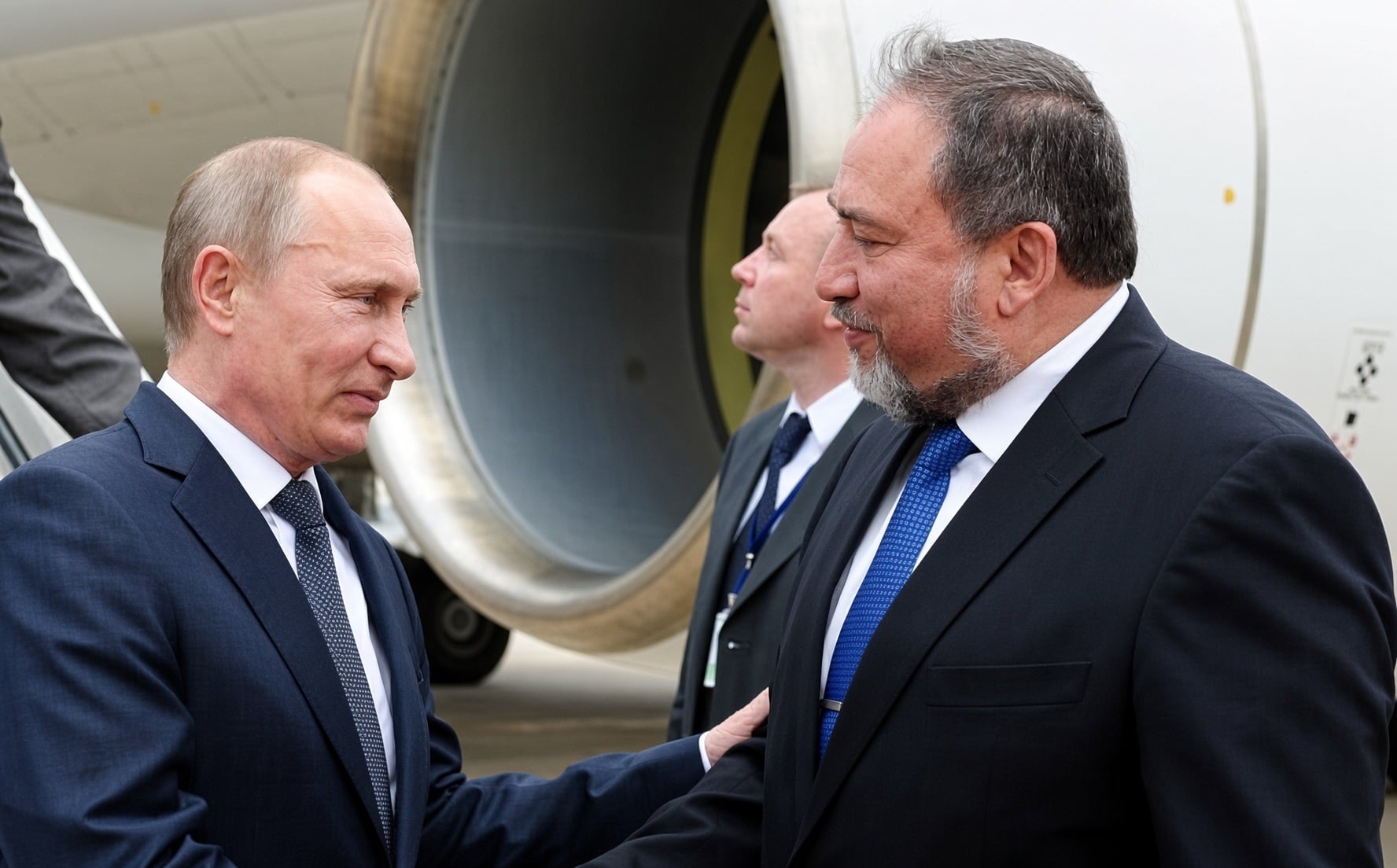
Then-Foreign Minister Avigdor Liberman greets Russian President Vladimir Putin at Ben Gurion Airport, June 25, 2012. (Kobi Gideon/GPO).
President Donald Trump’s Election Day declaration that Washington will terminate roughly $4 billion in annual military assistance to Israel by year’s end—citing an earlier understanding with Prime Minister Benjamin Netanyahu—collides directly with a congressionally appropriated memorandum running through fiscal 2028. Compounding this structural rupture, Vice President JD Vance’s subsequent post blaming Republican midterm losses on the Iran war and demanding that the United States “change our relationship to Israel” signals a permanent ideological realignment. This isolationist rhetoric confirms that America First calculations now treat Jerusalem as a volatile domestic liability rather than an indispensable strategic partner. Consequently, any incoming Israeli government—whether formed by the opposition alongside Arab parties, by opposition factions backed by Likud defectors as Avigdor Liberman envisions, or after a second national election—must treat restoring an operational Moscow channel as an existential priority, not a diplomatic luxury.
Strategic precedent proves that this type of pragmatic diversification yields decisive results. Czechoslovakia’s 1948 arms shipments, authorized under direct Soviet pressure, supplied the fledgling IDF with more than 34,000 rifles, 5,500 machine guns, 86 combat aircraft (including Avia S-199 fighters and Spitfires), and over 100 million rounds of ammunition. Prime Minister David Ben-Gurion subsequently acknowledged that these vital deliveries “saved the country” during the catastrophic opening month of the War of Independence. This pivotal episode demonstrates that Soviet-bloc hardware, rather than Western sympathy alone, averted an otherwise fatal military defeat against five invading Arab armies. Decades later, Russia’s current defense pact with Tehran—evidenced by active Caspian Sea transfers of drone technologies and heavy munitions—places identical geopolitical leverage back in the Kremlin’s hands. Furthermore, Israeli deconfliction protocols with Russian air assets over Syria have already prevented regional conflagrations that American air defense cannot unilaterally deter.
On the domestic front, Israel retains a unique political vehicle to execute this realist maneuver. Approximately 15 percent of Israel’s voting public comprises Russian-speakers, a disciplined constituency Liberman’s Yisrael Beiteinu has long commanded and one that neither Netanyahu’s allegations of Russian bot subversion nor broad domestic revulsion toward Vladimir Putin has fractured. Liberman himself, born in Soviet Moldova and having previously directed both the Foreign and Defense Ministries, conducted frequent high-stakes negotiations in Moscow, repeatedly elevated bilateral stability with Russia above symbolic Western solidarity, and pointedly refused to join NATO-aligned expulsions following the Salisbury incident. His unmatched institutional history makes him the only Israeli statesman capable of speaking the Kremlin’s language, mobilizing the relevant domestic base, and negotiating free of the paralyzing personal friction that plagues Netanyahu’s current diplomacy.
Admittedly, most Israeli defense strategists—including this writer—harbor no romantic illusions about Russian benevolence. Hardheaded realism nevertheless mandates an immediate hedge against superpower withdrawal. American military assistance historically provided a predictable, multi-decade procurement lifeline whose abrupt political revocation forces rapid supplier diversification precisely as Iranian ballistic and proxy capabilities surge. Any administration that recklessly discounts Moscow willingly hands Russia an unchallenged veto over the Levant’s airspace alongside unchecked authority over Iranian military modernization.
Exacerbating this exposure, Washington exhibits a chronic deficit of strategic follow-through. While another destructive confrontation with Iran remains inevitable, Trump has signaled no appetite for the decisive regime dismantling necessary to neutralize the Islamic Republic as a multi-generational menace. This hesitation mirrors the exact half-measure doctrine Washington deployed against Saddam Hussein’s Iraq, leaving behind an intact adversary that inevitably triggered a costlier second war. Because the Kremlin preserves direct technical, defense, and intelligence channels into Tehran, any realistic Israeli campaign to throttle Iranian enrichment, drone exports, or proxy missile stockpiles fundamentally requires Russian compliance or calculated neutrality. Without that leverage, Jerusalem faces a grinding, endless multi-front war of attrition against an entrenched regional axis backed by sovereign Eurasian patrons.
To execute this recalibration immediately, the incoming governing coalition must designate Liberman as special envoy for Eurasian security, endowed with plenipotentiary authority to negotiate a binding “Caspian Transparency Protocol.” Under this bilateral framework, Israel will provide actionable intelligence on Iranian dual-use cargo traversing the Caspian basin in direct exchange for Russian restrictions on high-end air-defense suites and drone guidance kits bound for Hezbollah. Simultaneously, the Prime Minister’s Office should establish a classified “Periphery Energy Corridor” initiative under Liberman’s direct chairmanship, tying Eastern Mediterranean gas development to Moscow’s urgent imperative to circumvent Turkish maritime bottlenecks. Such an agreement would guarantee the Kremlin long-term offtake rights and shared transit security in return for strict Russian guarantees barring Iranian naval bases across the Levant and Red Sea. Finally, the Foreign Ministry must establish an operational, Russian-speaking “Deconfliction Cell” within the Moscow embassy—staffed by bilingual Yisrael Beiteinu veterans, Mossad attachés, and senior regional specialized IDF officers—tasked with daily technical coordination with the Russian General Staff on Syrian and Lebanese flight corridors, and Iranian geostrategic and military challenges. This institutional structure will permanently replace vulnerable leader-to-leader telephone exchanges with an enduring, hardened military channel.
True security is forged through hard power and cold calculation, not the fickle winds of American domestic politics. For an Israel facing an unmoored Washington, the path through Moscow is not a betrayal of the past, but the only realistic blueprint for the future.
Related Topics
Related Posts