
What Jeffries and Schumer See When Israel Excludes Its Arab Citizens
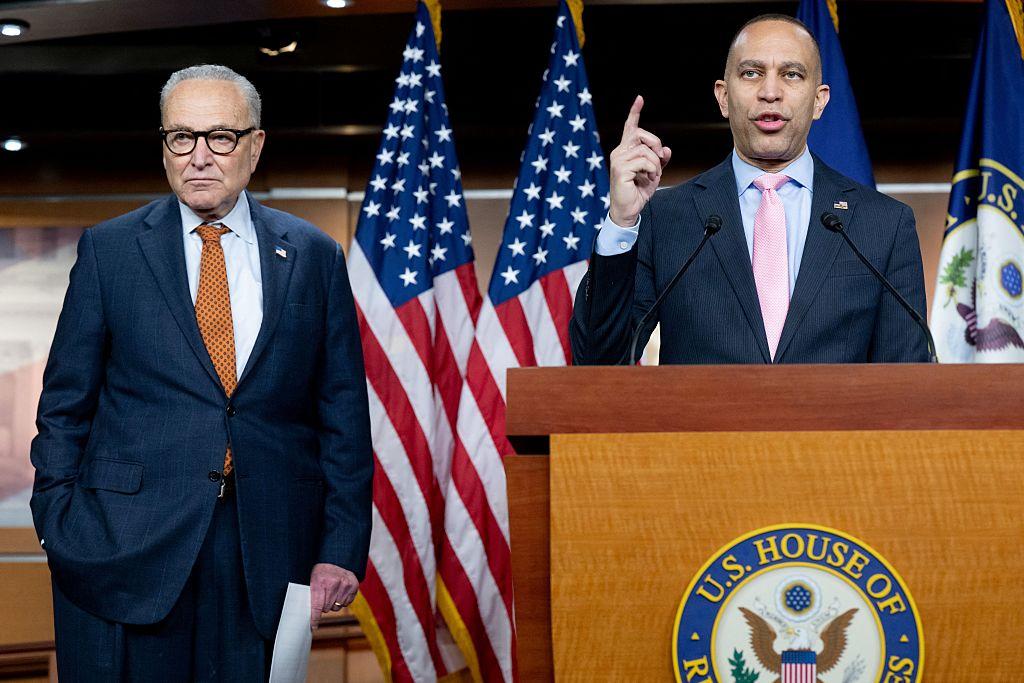
20 years separate Hakeem Jeffries, the 56-year-old Democratic leader in the House of Representatives, from Chuck Schumer, the 76-year-old Democratic leader in the Senate. They both seemingly come from different backgrounds; Jeffries is an African American whose paternal grandfather immigrated to America from Cape Verde in the Atlantic Ocean, 500 kilometers from the African coast, while Schumer is a Jew of Ukrainian-Polish descent.
But Jefferies and Schumer are also very similar; both were born and raised in Brooklyn, Jefferies in Crown Heights, and Schumer in Midwood, and they attended public schools in a borough that has long been a diverse community of minorities from all over the world.
If there is one thing that characterizes every African American and Jewish person who grew up in Brooklyn, it is a minority consciousness – the understanding that they represent a group of people who will always have to fight for their place.
But in their lives and achievements as politicians who have reached the highest positions in American politics, they also represent the possibility that America offers to every girl and boy to develop and become anything they dream of – to fulfill the American dream that is not limited by origin or skin color, even if there is and always will be an influence on it.
Those who grew up in Brooklyn in a society that is a mosaic of minorities and who dreamed and fulfilled their dreams will find it hard to understand the mindset of many Israelis who reject cooperation with the Arab parties and thus with the Arab public that voted for them in droves. They will never understand why an Arab girl cannot dream of representing the community she grew up in as a minister in the government or why the future of an Arab child is limited by hatred, exclusion, and fear.
Jeffries and Schumer are just examples of the current composition of the Democratic caucuses in the House and Senate – in one, minority representatives make up the majority of the caucus, and in the other, they are nearly half of it. The Democratic Party is not only the party of voters from various minority groups in the U.S., but also of their elected representatives –all of whom are minorities who have managed to break through the various “glass ceilings” that were placed before them.
These people who will lead the next Congress will not accept the marginalization and limitation of a citizen just because of their origin. These people will never understand the arguments of right-wing Israeli opposition leaders like Avigdor Lieberman, Naftali Bennett, and their ilk against a government in partnership with an Arab party like Ra’am, which has proven its commitment to the state and its advancement on countless occasions and whose main concern is promoting the civil equality of the voters it represents.
Much has been said about the “international safety net” that a government in partnership with an Arab party or parties would create for Israel, but the American context is different – for Jeffries and Schumer, both from the moderate wing of the Democratic Party, they care deeply about what is happening in Gaza and the West Bank.
However, they, like any minority member in Congress, have a different, much more personal perspective – that of a minority member who has managed to rise and who will fight against any attempt to impose restrictions on minorities, both in the U.S. and in Israel.
In their eyes, Bennett and Lieberman’s demands for a government without Arabs are not legitimate. They hear the Arab public representatives, the condemnations of the October 7 massacre and Hamas terrorism, and understand that the demand to exclude them from the coalition and the government is not “security-related,” but rather racist.
The future of cooperation between the next Israeli government and the Democratic-controlled Congress will be primarily determined by its actions in promoting political compromises with the Palestinians, stopping the rampant violence in the West Bank, and more. However, if this government begins its journey by marginalizing the Arab minority, it will find it much harder to reach the hearts of many U.S. lawmakers – Jews, African Americans, Hispanics, and others – who are minorities themselves.