The views expressed herein are solely mine.
Libya: The War Obama Started and Never Owned
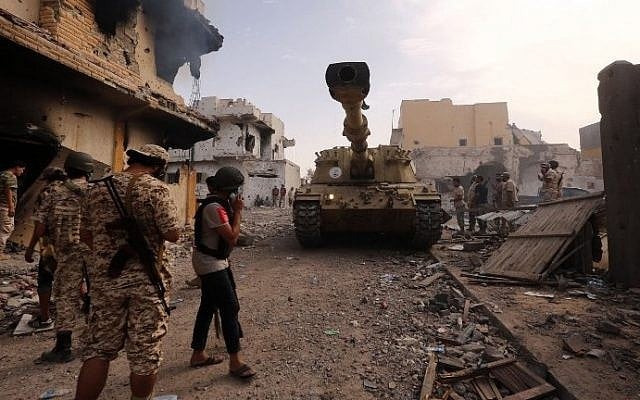
Forces loyal to Libya's UN-backed Government of National Accord (GNA) gather in the coastal city of Sirte, east of the capital Tripoli, during their military operation to clear IS jihadists from the city, on October 14, 2016. (AFP/Mahmud Turkia)
Washington’s constitutional outrage has always been selective. In 2011, former President Barack Obama launched a major war in Libya without congressional authorization, leaning on the legal fiction that sustained air warfare somehow did not constitute “hostilities.”
That decision—one of the most aggressive assertions of executive war power in modern U.S. history—has since been quietly erased from polite memory.
In parallel, the same political class that looked away then now performs ritualized outrage when later presidents assert executive authority against far clearer threats—from Iran’s regional war machine to authoritarian strongmen like Nicolás Maduro, a narco-state ruler accused internationally of mass repression and criminal violence.
That double standard was not accidental. It was normalized in Libya—where precedent was set and accountability quietly died.
Strategically, the war was sold as “humanitarian.” In reality, it was a failed regime-change operation conducted by airpower.
Under a UN mandate authorizing civilian protection—not state destruction—the United States and NATO carried out roughly 26,000 air sorties, including more than 7,700 strike missions, firing hundreds of precision munitions, including Tomahawk cruise missiles. This was not a “limited operation.” It was one of the most intense bombing campaigns of the post-Cold War era—launched without Congress and concluded without accountability.
What followed exposed the central lie of liberal interventionism. Libya was never a civic nation waiting for democracy. It was and still is a tribal society of more than 140 tribes and clans, with roughly 30–40 holding real political and military power. Authority historically flowed through centralized coercion, oil patronage, and tribal arbitration.
Undeniably, Muammar Gaddafi was a dictator—but he was also the system. Remove the arbiter, and the structure collapses; and that is what happened. Elections failed. Militias replaced ministries. Rival governments -literally dividing the country in two- claimed legitimacy while lacking sovereignty. Inevitably, Libya fractured into armed city-states funded by oil theft and foreign sponsorship.
Meanwhile, the United Nations recognized rogue governments it could not defend and brokered processes that no faction respected.
Predictably, foreign powers moved in fast. Turkey entrenched itself militarily to secure Mediterranean leverage and shield Islamist-aligned factions. As this unfolded, Russia embedded mercenary forces to gain influence over energy assets, ports, and migration routes into Europe. The UAE backed anti-Islamist troops as part of a wider regional struggle. Egypt focused on containment. Europe hedged. Without a doubt, Libya became a geopolitical asset rather than a country.
In this wreckage, the reemergence of Muammar Gaddafi’s son, Saif al-Islam Gaddafi, in 2021 was not nostalgia—it was structural reality. He had survived war, imprisonment, and attempted erasure, and his name still resonated among tribes alienated by militia rule and foreign domination. Even his personal history—including reported emotional ties to an Israeli citizen, once unthinkable in Arab nationalist politics—signaled how completely ideology had collapsed in favor of stability.
That this figure has now been reported killed today only underscores the point: Libya’s post-2011 order does not eliminate symbols of authority through political competition, but through attrition. The system devours anyone who threatens to reconstitute a center of gravity—no matter how damaged, compromised, or anachronistic that center may be.
This is the truth Western capitals refuse to confront: Libya did not fail because it rejected democracy. Like in post-intervention Iraq, it failed because the state was destroyed before anyone understood the society. In tribal systems, authority precedes representation. Libya was denied that sequence.
In my opinion, this Northern African country was not liberated. It was unmade—by a war launched without Congress, executed at massive scale, and abandoned without accountability. Until that failure is owned, Libya will remain what it is today: a strategic battlefield controlled by everyone except Libyans themselves.
Related Topics
Related Posts