Shaarey Tphiloh's rabbi, sharing views from Israel
Featured Post
The King was in the field. So was my wife. And a lion
A lion in the Kenyan grass brought an Elul metaphor startlingly to life — but the Jewish community in Nairobi gave it deeper meaning
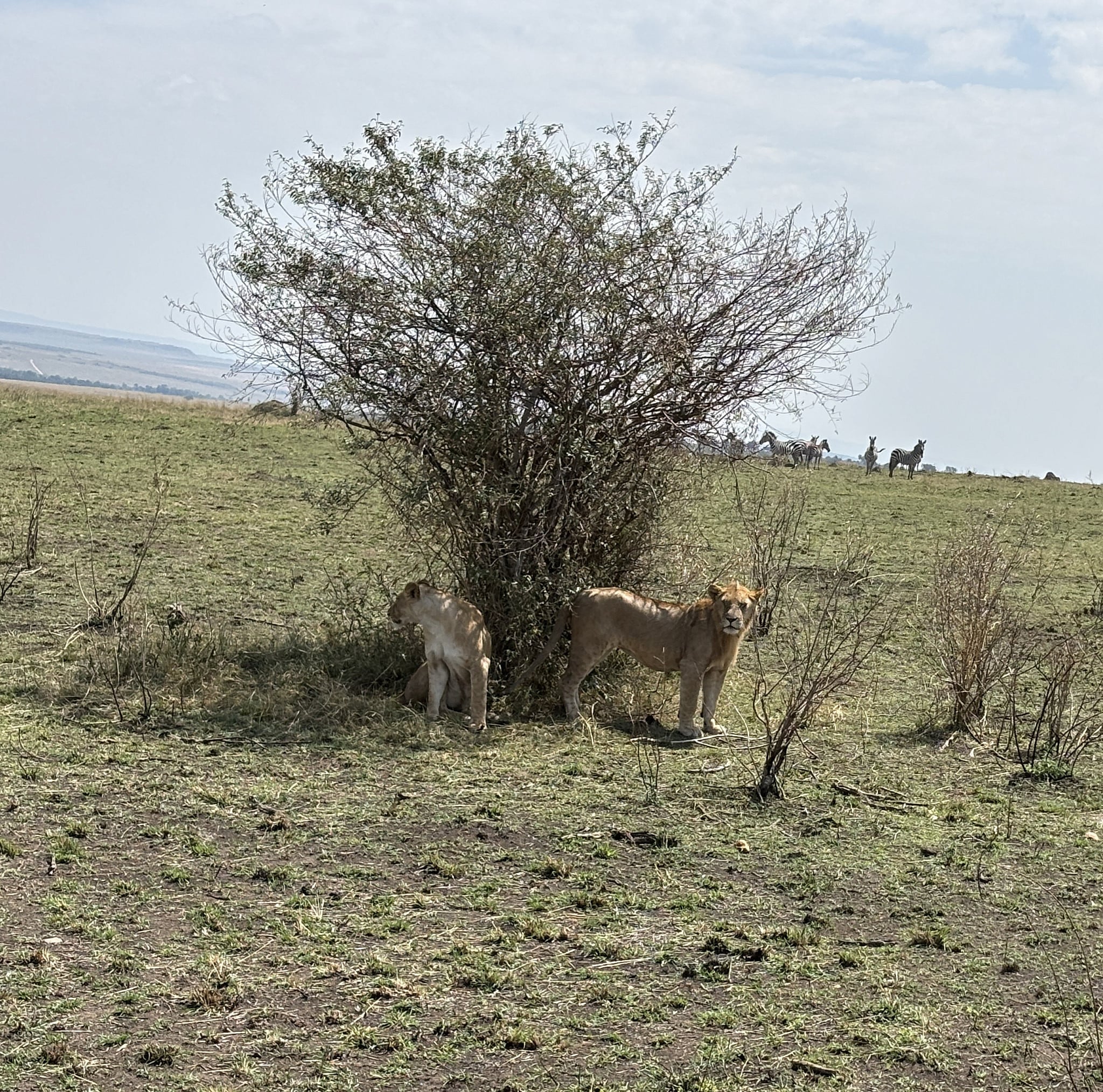
Lions in Maasai Mara. Elul, 5786 (Courtesy)
“Do NOT under any circumstances exit the vehicle when you are on safari.”
I read this warning printed in bold letters and nodded in obvious agreement. Our Toyota 4×4 Land Cruiser bumped along through the dusty tracks of the Maasai Mara as elephants rumbled by close enough to touch and hyenas bared their teeth at us from the tall grass. We marveled at a leopard in a tree, spotted a black rhinoceros running in the distance (a rhinoceros runs fast!), saw Cape buffalo, and watched endless herds of wildebeest and zebras move across the plain. Inside the vehicle, it felt safe.
Then a small emergency developed: my wife announced that she was over-hydrated and needed an urgent stop.
Our safari driver, a polite older man, initially explained that it was forbidden to stop. But my wife made a convincing argument. Looking around carefully, he finally agreed, and drove off the road a bit into a grassy patch, and said, “Go quickly.”
The moment my wife stepped out of the Land Cruiser, my teenage son called out: “Ima, come back, there is a lion very close to you over there.”
I didn’t believe him, but, still, I poked my head out to check. You know how in the movies when someone’s face turns to sheer shock? Remember how in the first Jurassic Park when Sam Neill takes off his sunglasses and his eyes widen as he looks at a giant brachiosaurus for the first time? That was how I looked and felt just then.
Oh. My. God. I pointed and stuttered, “Honey, it’s… it’s a lion!” My wife was used to us making mischief and playing jokes, so she just told us to mind our own business and stop annoying her. Meanwhile, the lion, the king of all beasts, looked up at me, at our jeep, and at my sweet wife in the grass. The lion yawned and didn’t eat any of us, thankfully.
The King in the field
Returning from that safari, I reflected on the metaphor of the lion in Jewish tradition. In the Hebrew Bible, the lion is a symbol for God: “The lion has roared; who will not fear?” The biblical prophets describe how God roars like a lion as He protects Zion and Jerusalem.
In Hasidic thought, we are taught that in the month before Rosh Hashanah, “the King is in the field.” The King, metaphorically, leaves His royal palace to greet us where we are, making Himself accessible to anyone who seeks Him. Encountering God as King through prayer and introspection during the month of Elul can be an inspiring experience. Imagine an encounter with God in the field, as the encounter with a roaring lion in the African wild. Who could not be inspired before Rosh Hashanah with awe in the face of that image?
But it is not only God who is compared to a lion. The Jewish people themselves are given this title. In Jacob’s final blessing, he declares: Gur Aryeh Yehuda — “Judah is a lion’s whelp… like a lioness, who dares rouse him?” (Genesis 49:9). The scepter and staff of authority, the Torah tells us, will remain within Judah. This means the strength and conviction of Torah law will guide us through history.
During my visit to Kenya, I was inspired not only by the king of the savanna, but even more so by the lion-hearted spirit of the Jewish people enduring and thriving in far-flung corners of the globe.
Zionism and tradition at a crossroads
In Nairobi, we visited the local synagogue, a community established in 1904. Kenya as a whole has had important moments in modern Jewish history. At the beginning of the 20th century, the “Uganda Scheme” discussions were actually centered on the possibility of founding a Jewish state in western Kenya, and in 1948, a Jewish figure named “Wilson” secretly helped Irgun and Lehi detainees to escape from detention in Gilgil, Kenya.
During Operation Entebbe in 1976, President Jomo Kenyatta provided vital support to the Israeli Air Force as they landed in Kenya on their way to rescue hostages in Uganda. In fact, while we were in Kenya, local newspapers ran feature stories commemorating the anniversary of Entebbe, celebrating the nation’s historical partnership with Israel. We met many Kenyans who expressed warm feelings about Israel and the Jewish people.
Kenya’s small Jewish community continues to keep Jewish ritual traditions alive. At the Orthodox synagogue in Nairobi, I met Dr. David Silverstein, the long-time community lay leader and author of Heartbeat: An American Cardiologist in Kenya, and also the community spiritual leaders, Tal and Yosef Zimerman, who were trained at Amiel-Strauss. It was a vivid reminder of how the Torah goes forth from Zion to flourish worldwide.
On Shabbat, I joined Reb Yosef’s Torah study class, where local observant Jews gathered to delve into the weekly portion, Parshat Shoftim. We discussed the law of the Eglah Arufah, the ritual performed when a slain body is discovered in a field between two towns, requiring the city elders to break a calf’s neck at a flowing stream to publicly proclaim their moral accountability for the stranger’s life.
In a country like Kenya, where livestock walk openly along the roads alongside passing vehicles, the rituals in the agrarian society of the Torah felt extraordinarily immediate. The debate around the Shabbat table over ancient ritual slaughter and responsibility, and how they compared to local tribal customs, was dynamic and deeply engaged.
Listening to that Torah discussion in Nairobi, I sat in quiet awe. I reflected on the indomitable spirit of our people. Like brave lions, the Jewish people have navigated difficult terrains and historical storms for centuries with unwavering courage. Like lions guarding their pride, we carefully safeguard our Torah and its laws in synagogues and small communities across the earth.
In the month of Elul, we seek out moments of awe and reflection. As we advance to the High Holidays, it is a time for repentance as we seek our lion-hearted spirit, our pure neshama. I am not saying that we need to go on a safari in Elul. In fact, I think the best place to connect to God is through prayer and Torah study in our local synagogues. In this way, we can be inspired by the great, glorious texts and tradition. Also, there is one great advantage to finding God in a local synagogue rather than on safari. Usually, a shul has a restroom nearby so that you or your spouse can take a break during the services without coming face to face with a hungry lion.
Related Topics
Related Posts