Lithuania Commemorates the Genocide It Refuses to Name
Lithuania’s public broadcaster has produced a near-perfect specimen of Holocaust distortion. It does not deny that Lithuania’s Jews were murdered. It arranges its words so the victims stay visible while their Lithuanian killers vanish.
The LRT/BNS article, “Lithuania to mark Occupation and Genocide Day,” opens by honoring those who died for the country’s independence, then summarizes the occupations of 1940 to 1944. Read the grammar.
On June 15, 1940, the article says, Soviet soldiers “attacked” a Lithuanian border post and “killed” Aleksandras Barauskas. The Soviets then “used over 150,000 troops to occupy Lithuania.” They “imprisoned, killed, or deported” more than 23,000 people. The perpetrators are named. The verbs are active. The acts are attributed.
Then the article reaches the Holocaust: “During the subsequent Nazi occupation in 1941 and 1944, over 29,000 people were imprisoned or sent to concentration camps, and approximately 240,000 were killed, including almost the entire Jewish population.”
Suddenly nobody kills anyone. The Jews “were killed.” By whom? The sentence does not say.
Then the article returns to Soviet rule, and agency returns with it. Once the Soviets reoccupied Lithuania, people “were arrested” and “deported.”
This is not careless writing. It is exact. The murders sit “during” the Nazi occupation, close enough to make the reader assign them to Germany, but the sentence never identifies who carried out the killing on Lithuanian soil. It names the occupation. It gives a death toll. It concedes that almost the entire Jewish population was destroyed. It withholds the perpetrators. That is Holocaust distortion.
A genocide without a subject
Holocaust denial says the Jews were not murdered. Holocaust distortion admits they were murdered and then manipulates who is responsible.
The record is not uncertain. The United States Holocaust Memorial Museum states that Lithuanians carried out violent anti-Jewish riots before and immediately after German forces arrived, that German Einsatzgruppen and Lithuanian auxiliaries began murdering Lithuania’s Jews together in June and July 1941, and that German forces and their collaborators killed the overwhelming majority of Lithuanian Jews, most within the first six months of the occupation. The Museum is explicit that the Einsatzgruppen acted “together with Lithuanian auxiliaries.” In one village it describes, armed Lithuanian collaborators rounded up Jews, forced them to dig trenches and undress, and delivered them to the killing site.
LRT could have written one accurate sentence: “During the German occupation, Nazi German forces, assisted by Lithuanian auxiliaries and local collaborators, murdered almost the entire Jewish population of Lithuania.” That assigns direction to Nazi Germany while acknowledging the indispensable Lithuanian role.
Instead LRT wrote that the Jews “were killed.” The passive voice is doing political work. It lets Lithuania count the Jewish dead without accounting for Lithuanian participation in their deaths. The Nazis receive contextual association. The Soviets receive direct attribution. Lithuanian perpetrators receive grammatical immunity.
The definition has a name for this
Holocaust distortion is not an insult. It is a defined category. The International Holocaust Remembrance Alliance adopted its Working Definition of Holocaust Denial and Distortion by consensus in Toronto on October 10, 2013. The first enumerated form of distortion is the effort to “excuse or minimize the impact of the Holocaust or its principal elements, including collaborators” of Nazi Germany.
Lithuania is an IHRA member country. It adopted that definition. It is bound by the standard it helped write.
LRT’s sentence meets the first clause directly. The participation of Lithuanian auxiliaries, police, and local administrations in the murder of Lithuania’s Jews is a principal element of the Holocaust as it happened in Lithuania. The article removes it. That is minimization of a principal element by the cleanest method available: omission.
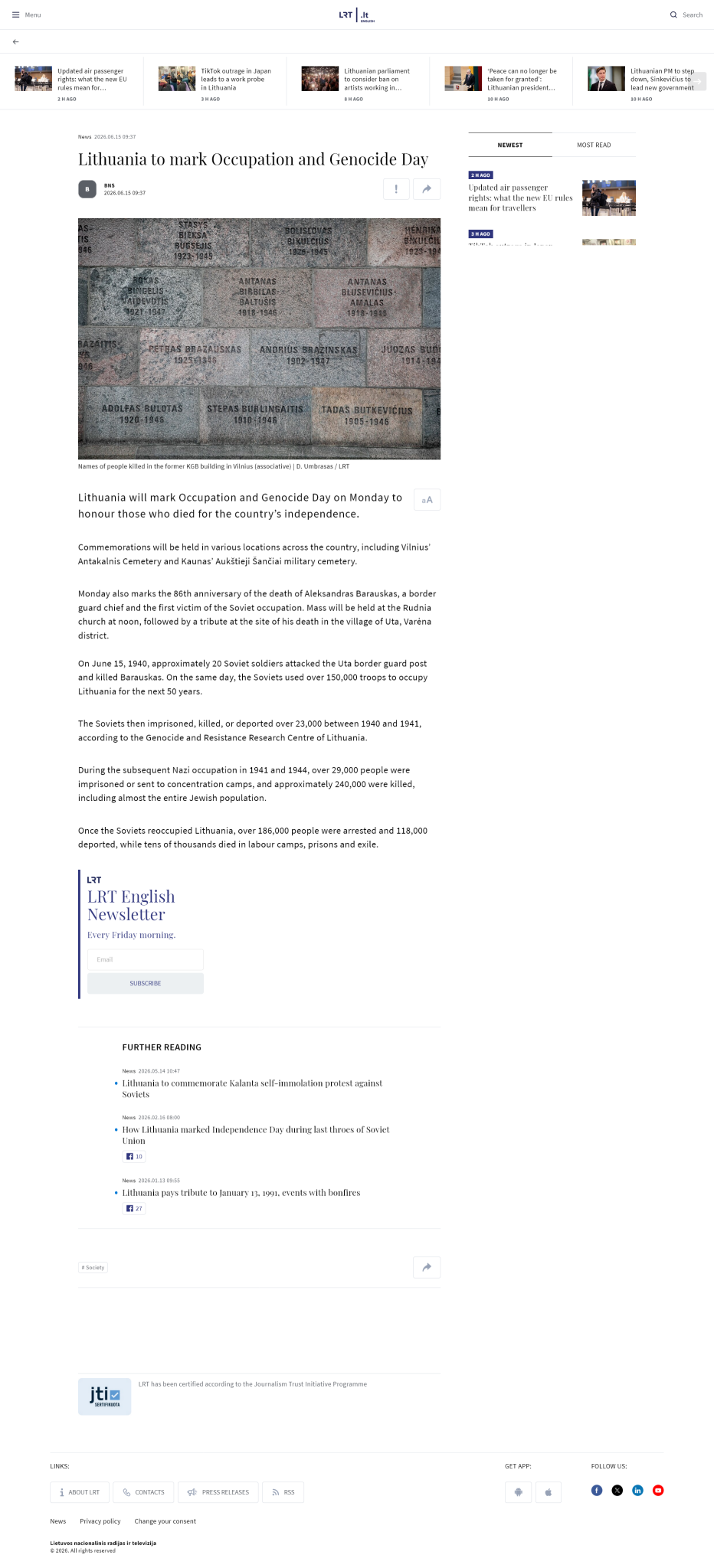
The photograph engages a second clause. IHRA’s expanded guidance names the downplaying or honoring of people complicit in Holocaust crimes as a form of distortion. LRT’s chosen image is a memorial wall that LRT itself reported might bear the names of people connected to the killing of Jews. The broadcaster honored the wall anyway.
The source aggravates both. This is not a fringe blog. It is the Lithuanian state’s own public broadcaster. The distortion is institutional, and it carries the state’s voice.
Whose genocide is being remembered
The title is revealing: “Lithuania to mark Occupation and Genocide Day.” But which genocide? The day honors those who died for Lithuanian independence. The commemorations are built around Soviet occupation, Soviet repression, Lithuanian military cemeteries, and the first Lithuanian border guard killed by Soviet soldiers. The Holocaust appears almost incidentally, wedged between two fuller accounts of Soviet crimes.
The destruction of Lithuanian Jewry becomes one more chapter of generalized national suffering. Jews become a population that “was killed” during one of Lithuania’s occupations. But Lithuanian Jews were not murdered as combatants for Lithuanian independence. They were murdered because they were Jews, targeted in a racial genocide carried out by Nazi Germany with extensive local assistance. There is a moral difference between commemorating genocide and accepting responsibility for participation in it. Lithuania does the first and avoids the second.
The photograph completes the distortion
The accompanying photograph shows names carved into the former KGB building in Vilnius, captioned as people killed there. Lithuania’s victims have names. They are cut into stone. They are individual national martyrs. The Jews receive a statistic: “approximately 240,000 were killed.” No names. No towns. No pits. No shooters.
The image is worse than decorative, because LRT itself previously reported that the wall was historically compromised. In 2019, LRT reported that some inscriptions might have to be removed because those memorialized had tenuous links to anti-Soviet resistance or may have been involved in the Holocaust, and that names on the wall might belong to people connected to the killing of Jews or collaboration with Nazi authorities. The director of the Genocide and Resistance Research Centre conceded the original verification had been “somewhat rushed.”
In 2026, LRT reused the same wall, without qualification, as the visual symbol of its day of occupation and genocide remembrance. I cannot prove that a specific visible name belongs to a documented perpetrator, and I do not need to. LRT knew the memorial’s integrity had been questioned and that Holocaust perpetrators might be among the names. It used the wall anyway as an uncomplicated emblem of Lithuanian innocence. The text anonymizes Jews; the photograph individualizes Lithuanians. Both perform the same operation.
This is not an accusation against every Lithuanian
Acknowledging Lithuanian participation is not a charge of collective guilt. Some Lithuanians murdered Jews. Others informed on them, guarded them, transported them, or took their property. Some stayed passive. Others risked their lives and their families’ lives to rescue Jews. Accuracy distinguishes among them. Distortion melts them into one national category of victims and heroes.
The rescuers deserve better. Their courage meant something precisely because other Lithuanians were carrying out the persecution around them. Erase the perpetrators and you empty the rescuers’ choices of their meaning. The demand is not that Lithuania call itself a nation of murderers. The demand is that it stop describing the Holocaust as a weather event that happened “during” the Nazi occupation. People did this. German people did it and German institutions organized it. Lithuanian people did it and Lithuanian institutions assisted. The Jewish population did not simply disappear.
Remembrance without accountability is public relations
Lithuania demands exact attribution for Soviet crimes. Soviet soldiers attacked. Soviet forces occupied. Soviet authorities arrested, deported, and killed. That precision is proper. But when the victims are Jews and the perpetrators include Lithuanians, precision becomes unavailable. The Jews “were killed.”
This is how a country commemorates the Holocaust while protecting its preferred self-image. It concedes the number of dead, because denial would be discrediting. It files the murders under Nazi occupation, because that hands the crime to a foreign regime. It omits local agency, because local agency disrupts the national story. That is not remembrance. It is reputational management conducted with the dead.
Nazi Germany originated the Holocaust. But Lithuanian auxiliaries, officials, and local collaborators helped perpetrate the genocide of Lithuanian Jewry. Today’s Republic of Lithuania did not commit those murders. It is nonetheless responsible for telling the truth about the people and institutions it commemorates and folds into its national narrative. A state cannot draw moral authority from remembering genocide while editing its own participation out of the sentence.
LRT should correct the article. It should replace the passive formulation with an honest one: “During the Nazi German occupation of Lithuania from 1941 to 1944, German killing units, assisted by Lithuanian auxiliaries and local collaborators, murdered almost the entire Jewish population of Lithuania.” It should also disclose that the memorial wall in its photograph was reviewed after LRT reported that some of its names might be tied to the killing of Jews or to Nazi collaboration.
None of this diminishes Soviet crimes. Truth is not a limited resource. Lithuania can condemn Soviet occupation, deportation, and murder without laundering Lithuanian participation in Nazi crimes. The problem is that it wants both the moral authority of Holocaust commemoration and the comfort of innocence. It wants the Jewish dead, but not the Lithuanian responsibility.
And so, once again, the Jews “were killed.”
Lithuania commemorates.
Nobody accounts.