Lithuania’s Jedwabne Moment
In “The Impossibility of Ignorance” and “The Company He Kept,” I argued that Lithuania elevated Adolfas Ramanauskas-Vanagas into its head-of-state canon without producing the Holocaust-era due-diligence file that such elevation required, and that it did so from within a hero class already contaminated by exposed perpetrators, facilitators, and state laundering. This article addresses the consequence. What does a democratic state do when a protected national myth collides with a morally devastating historical record?
Poland faced that question at Jedwabne. The reckoning was incomplete, contested, and politically painful. But the state still moved through investigation and presidential remorse. Jan Tomasz Gross’s Neighbors forced the issue into public view. The Institute of National Remembrance investigated. President Aleksander Kwaśniewski stood at the site in July 2001, expressed “deepest remorse,” and said the truth could not be denied. Poland did not silence the questioner. It investigated the question.
Lithuania has chosen the opposite order. It canonized first, insulated second, and prosecuted the question third.
That is why Artur Fridman is Lithuania’s Jedwabne moment. Not because the facts are identical, but because the institutional test is the same. A democracy confronted with a protected national story and a morally charged archive has two choices. It can investigate, publish, correct, and absorb the consequences. Or it can defend the myth and punish the person who tests it. Poland investigated. Lithuania prosecuted.
The Soviet Union was a criminal regime. Its occupation, deportations, executions, imprisonments, and repression are matters of record. There can be no redemption or forgiveness for those crimes. Nothing here softens that judgment. I fully support those Lithuanians who resisted Soviet rule as a force of evil. But that fact does not cleanse the record of those who also participated in the persecution and murder of Jews. Lithuanian participation in Holocaust crimes was so widespread that figures of military age from that milieu cannot responsibly be treated as morally unexamined patriots by default. The burden must run the other way: absent a serious and documented investigation, anti-Soviet biography is not exculpation. Fighting Soviet crimes did not absolve genocide against Jewish neighbors.
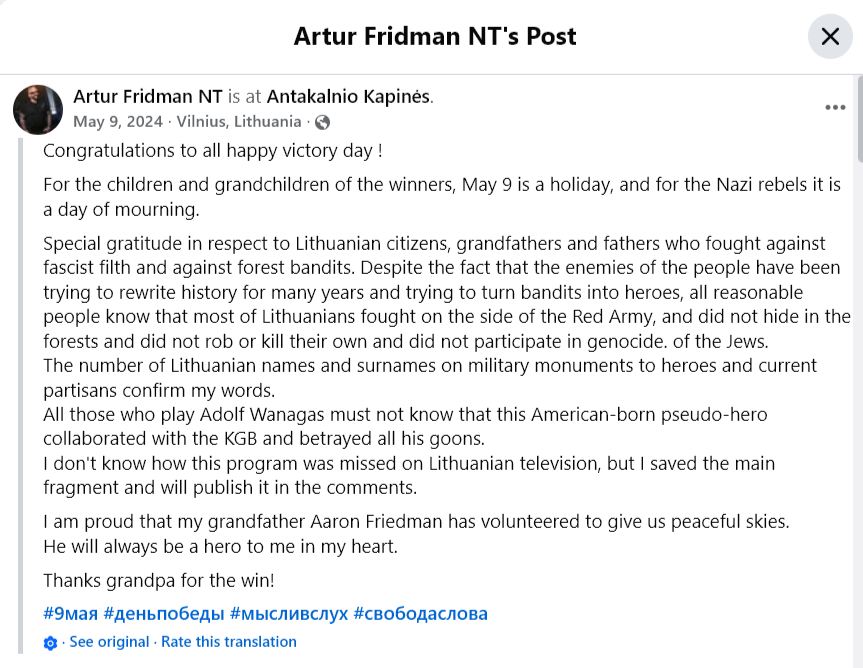
The Fridman case makes that comparison concrete. According to the published indictment record, Fridman posted a Facebook message on May 9, 2024 (screenshot attached). On January 8, 2025, Lithuanian authorities imposed a written pledge preventing him from leaving the country. On October 30, 2025, prosecutors filed charges under Articles 170-2 §1 and 313 §2. This is not a seminar-room dispute. It is criminal process directed at a Jewish citizen for Holocaust-related speech.
Lithuania’s defenders can no longer claim this is merely a disagreement among historians. The state has been on notice for years, and its response to notice has not been correction but persistence. The Brazaitis file proves that. Congressman Brad Sherman wrote in September 2019 objecting that Lithuanian institutions were misusing U.S. documents to claim Juozas Ambrazevičius-Brazaitis had been “completely exonerated.” He demanded either credible references or a public correction. He wrote again in May 2021 after receiving no official response and after the Genocide Center dismissed his first letter as merely “the opinion of a politician.” That is not confusion. It is state persistence in a false claim after notice.
That point matters beyond Brazaitis because it establishes the governing presumption for the entire Lithuanian memory system. Lithuania’s record in this field is now so demonstrably compromised by false exculpation, selective omission, and refusal to correct after notice that no claim advanced by its state memory institutions should be accepted at face value. The default position should be skepticism unless a proposition is independently validated by credible external scholarship and documentary evidence. Lithuania has forfeited the right to automatic deference.
The scholarship that does exist points in the opposite direction from the state’s mythology. Saulius Sužiedėlis writes that Lithuanian police and administrative structures followed the German lead and at times acted on their own, and that Lithuanian police units supplied the “majority of the killers” in the destruction of provincial Jewry and at major killing sites. He also rejects one of the most durable moral evasions in Lithuanian public memory: the perpetrators were “not a tiny rabble of misfits and lowlifes” but came from different strata of society. That matters because it destroys the fantasy that the Holocaust in Lithuania can be assigned to a small, socially alien fringe while the national hero structure remains morally intact.
Sužiedėlis also strips away another refuge: coercion. Those collaborating in the killing process generally were not punished for refusing to kill, and officials who left their posts rather than continue in their duties generally were not punished either. Choice remained. Agency remained. The historical record does not support the comforting myth of universal compulsion.
Christoph Dieckmann reaches the same conclusion from another direction. His reconstruction of occupation policy in Lithuania shows that ghettoization, robbery, labor exploitation, and murder were not simply distant German commands imposed on passive locals. They drew in local administrators, police, auxiliaries, and beneficiaries. The destruction of Lithuanian Jewry was not only an extermination process. It was also a system of seizure, advantage, and participation. That matters here because it makes the central Lithuanian defense — anti-Soviet heroism on one side, Holocaust conduct on the other — morally and historically unusable unless the state can show the investigation by which it separated the two before conferring honor. It has never shown that file.
The institution whose conclusions help police that mythology is itself now under public domestic impeachment. On March 22, 2026, Lithuania’s national broadcaster reported that the Seimas-created external expert council for the Genocide Center said it could not effectively communicate with the institution’s leadership, that recommendations were ignored, that documents were delivered too late or not at all, that the strategic plan lacked scholarly quality criteria, and that the Center functioned “de jure” as a research center but “de facto” as a bureaucratic institution. The same report stated that only about 30 of 152 positions directly conduct historical research. At that point the issue is no longer merely poor scholarship. It is institutional illegitimacy. In a 2024 LRT report, director Arūnas Bubnys acknowledged that the Center could not become a scientific institution under current law and existing capacities. And in a 2023 LRT opinion piece recounting remarks by senior LGGRTC historian Alfredas Rukšėnas on LRT’s “Radijo ringas,” the Center was described as no longer functioning as a true research institution, but as one that takes political constituencies into account when judging Holocaust-linked figures. Lithuania is therefore asking courts and the public to defer to a body that does not even seriously maintain the standards of an independent scholarly authority.
This is why Fridman is not a side case. He is the test. A state that commemorates murdered Jews while prosecuting a living Jew for discussing how they were murdered and by whom is not engaged in remembrance. It is engaged in management. Wreaths and prosecution are not reconciliation. They are perception control.
Jedwabne remains the right comparison because it isolates the institutional choice. When the archive collides with the myth, does the state investigate the archive or prosecute the challenge? Poland, for all its later evasions and incompleteness, at least attempted an answer through investigation and presidential remorse. Lithuania has chosen canonization, insulation, and criminal process.
The remedy threshold is therefore not another ceremony, another recommendation, or another speech about values. Lithuania should dismiss the charges against Fridman; rescind and publicly acknowledge the wrongful coercive measures already imposed on him; publish the pre-elevation review files for Ramanauskas-Vanagas and every other state-honored figure with a disputed Holocaust-era record; identify the reviewing officials; state the evidentiary standard applied; disclose any dissent; and explain why criminal process was used to defend a canon the state itself never properly vetted.
For external consumption, Lithuanian diplomats tell Americans and Israelis how much Lithuania values its Jewish history and how deeply it mourns the Jews murdered by Nazis, Soviets, and collaborators — always in that order, always with “collaborators” last, always without specifying that the collaborators were Lithuanian. For Lithuanians, the state elevates Holocaust perpetrators into its national pantheon.
To the world, Lithuania commemorates rescuers as though they represented Lithuanian society. They represented 0.04% of it. Lithuanian diplomats remain silent about the other 99.96% or blame it on Nazis and Soviets. The Soviets did not commit genocide against Jews. Lithuanians did. But facts are not a component of the Lithuanian discourse.
Lithuania asks foreigners to see remorse. It asks Lithuanians to live inside a managed narrative where heroes are unvetted, archives are unreleased, and questions are prosecuted. A state that speaks the language of democratic memory abroad while enforcing selective truth at home is not engaged in reckoning. It is practicing the same habits of managed memory and moral inversion that defined the regimes it claims to have overcome.
In Lithuania, no one was punished for murdering Jews. A Jew is being prosecuted for posting about it. What does that say about Lithuania today? It says the system is not broken. It is functioning exactly as intended.