Living between headlines
Israelis are no strangers to living with uncertainty. But there is a particular kind of exhaustion that comes from repeatedly preparing for futures that never arrive.
I don’t think it is the fear that is exhausting us. I think it is the constant pivoting.
For weeks now, most Israelis have been living two lives at once. On the surface, life continues. Children go to school. Parents go to work. Weddings take place. People stand in line at the supermarket, complain about traffic, and try to make summer plans. Outside the north, much of life has looked remarkably normal.
And yet every normal moment has been accompanied by an asterisk. Every plan has had a silent “unless.” Every routine has existed against the backdrop of not knowing what tomorrow might bring.
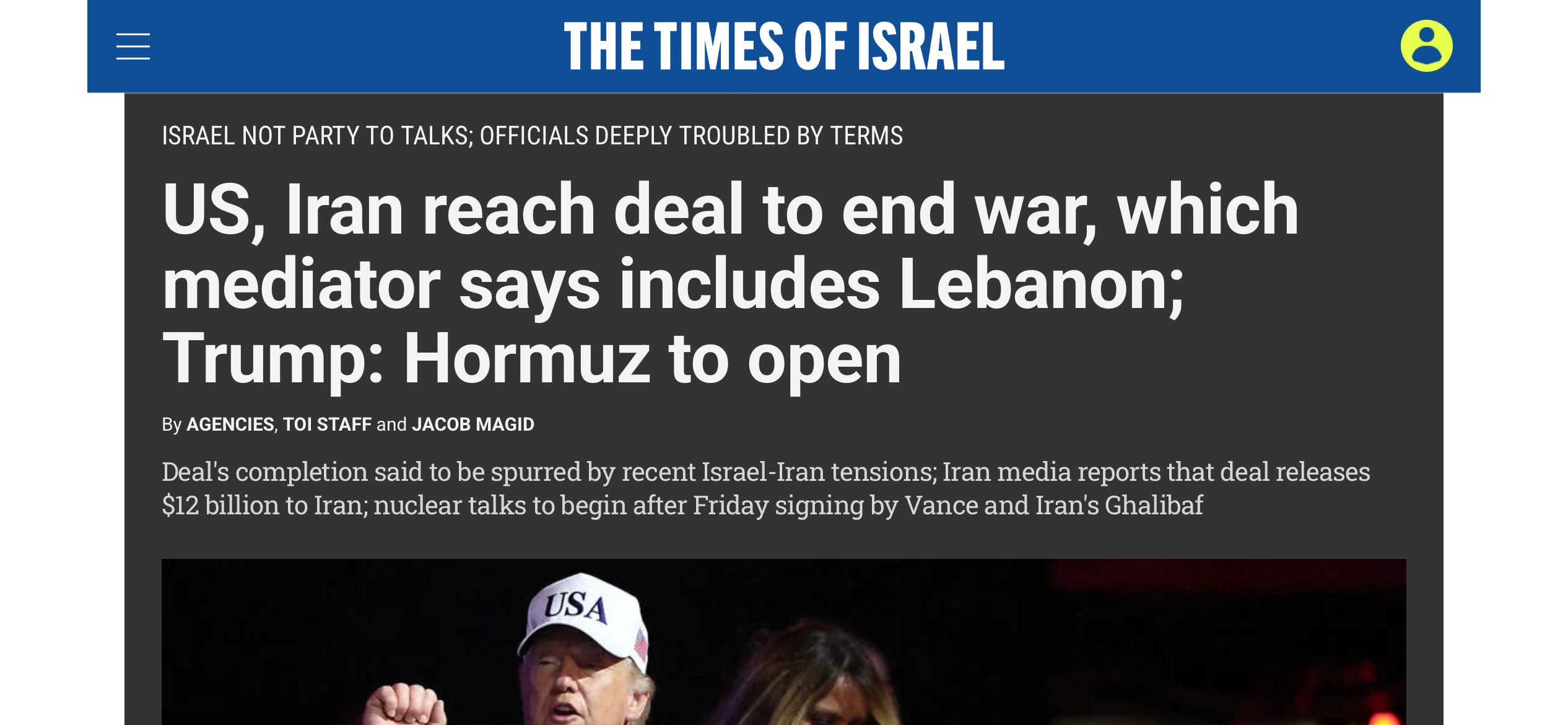
A deal is coming. No, an attack is coming. No, a deal is coming. No, rockets are coming.
Last Sunday, we were told to prepare. Schools were cancelled. Parents scrambled. Some children worried and cried. Others celebrated. On Monday, there was a one-day war. Then it was announced that there would also be no school on Tuesday. Then yes school. At a certain point, it becomes difficult to know what is reality and what is possibility.
Yesterday, I had a video call with a couple in America. Before we began, I mentioned casually that I might have to leave in the middle because it seemed possible that an attack was imminent.
In truth, there is nothing casual about impending missiles.
The meeting ended. I checked the news. Reports suggested that the United States was pressuring Iran not to attack. I went to sleep expecting a siren. I woke up and read that there was a deal. An hour later, I read that Iran was threatening not to uphold the deal unless Israel fully withdrew from Lebanon.
I found myself feeling something that I suspect many Israelis are feeling right now: I simply don’t have the emotional energy to keep rearranging my expectations.
There is a particular exhaustion that comes not from what happens, but from repeatedly preparing for what might happen. You brace. You relax. You brace again. You exhale. You tighten up once more. Eventually the emotional muscles begin to ache.
Today is Rosh Chodesh Tammuz. I arrived early at the midrasha where I work so I could join the communal Hallel. Usually, Hallel feels like a welcome interruption — a chance to sing, to pause, to focus on gratitude and praise. This morning, however, I found myself drawn less to the triumphant verses and more to those born of uncertainty and vulnerability.
ה’ לי לא אירא מה יעשה לי אדם. ה’ לי בעזרי ואני אראה בשנאי. טוב לחסות בה’ מבטח באדם. טוב לחסות בה’ מבטח בנדיבים
The Lord is with me; I will not be afraid. What can man do to me? The Lord is with me; He is my helper. It is better to take refuge in the Lord than to trust in man. It is better to take refuge in the Lord than to trust in princes.
I realized that perhaps what has been so exhausting these past few weeks is that we keep trying to anchor ourselves — in predictions, intelligence assessments, analysts, reports, unnamed officials, leaks, rumors, and headlines.
And then reality shifts. The headlines change. The experts revise their assessments. The certainty dissolves. And once again we are left adrift.
The psalm we recited this morning offers a different possibility. Instead of seeking certainty, it tells us to trust.
We have no way of knowing what will happen tomorrow. But we can have confidence that even if we don’t know what tomorrow will bring, we are not facing it alone.
That distinction feels particularly relevant as we enter the month of Tammuz.
Tammuz is the month when things begin to crack. It is the month when the walls of Jerusalem were breached. The month that begins our annual journey toward remembering destruction. The month when we are forced to confront what happens when a society becomes fractured from within.
It is easy to look at the tragedies of this season and focus on the enemies outside our walls. But our tradition insists that the more important story was the one unfolding inside them.
The Romans may have destroyed the Temple. But sinat chinam, baseless hatred, made us vulnerable to losing it. That lesson feels particularly relevant right now. Because there is so much that we cannot control.
We cannot control Iran or Hezbollah. We cannot control what American officials say in public and negotiate in private. We cannot control intelligence assessments, military timetables, diplomatic initiatives, ceasefires, threats, or ultimatums.
But while we cannot control the headlines, we can control how we live between them.
We can choose how we speak to one another and how we treat the people around us. We can choose whether uncertainty makes us more suspicious or more compassionate and whether fear defines us or empowers us.
Perhaps that is the challenge of this moment.
Not to pretend we are not afraid. Not to pretend that we know what tomorrow will bring. But to stop looking for certainty in places where certainty does not exist.
To stop imagining that the next report, the next leak, the next statement from Washington, Tehran, or Jerusalem will finally allow us to relax. Because there will always be another headline. Another rumor. Another maybe.
The question is not whether uncertainty will disappear. The question is how we will live while it remains.
This morning, I felt that the words of Hallel were speaking directly to us – our fears and our exhaustion. Not because they promise that tomorrow’s news will be good. But because they remind us where stability is meant to come from.
Not from princes. Not from politicians. Not from predictions. But from faith.
As Tammuz begins, we do not know what tomorrow will bring. But we can choose how we meet it.
We can anchor ourselves in faith, in kindness, in responsibility toward one another. In the determination not to allow fear to become division. In the choices we make. In the way we live each day.
And in the quiet conviction that while the future remains uncertain, we are not facing it alone.