
Could Trump’s Iran Rhetoric Ever Turn Explicitly Nuclear?
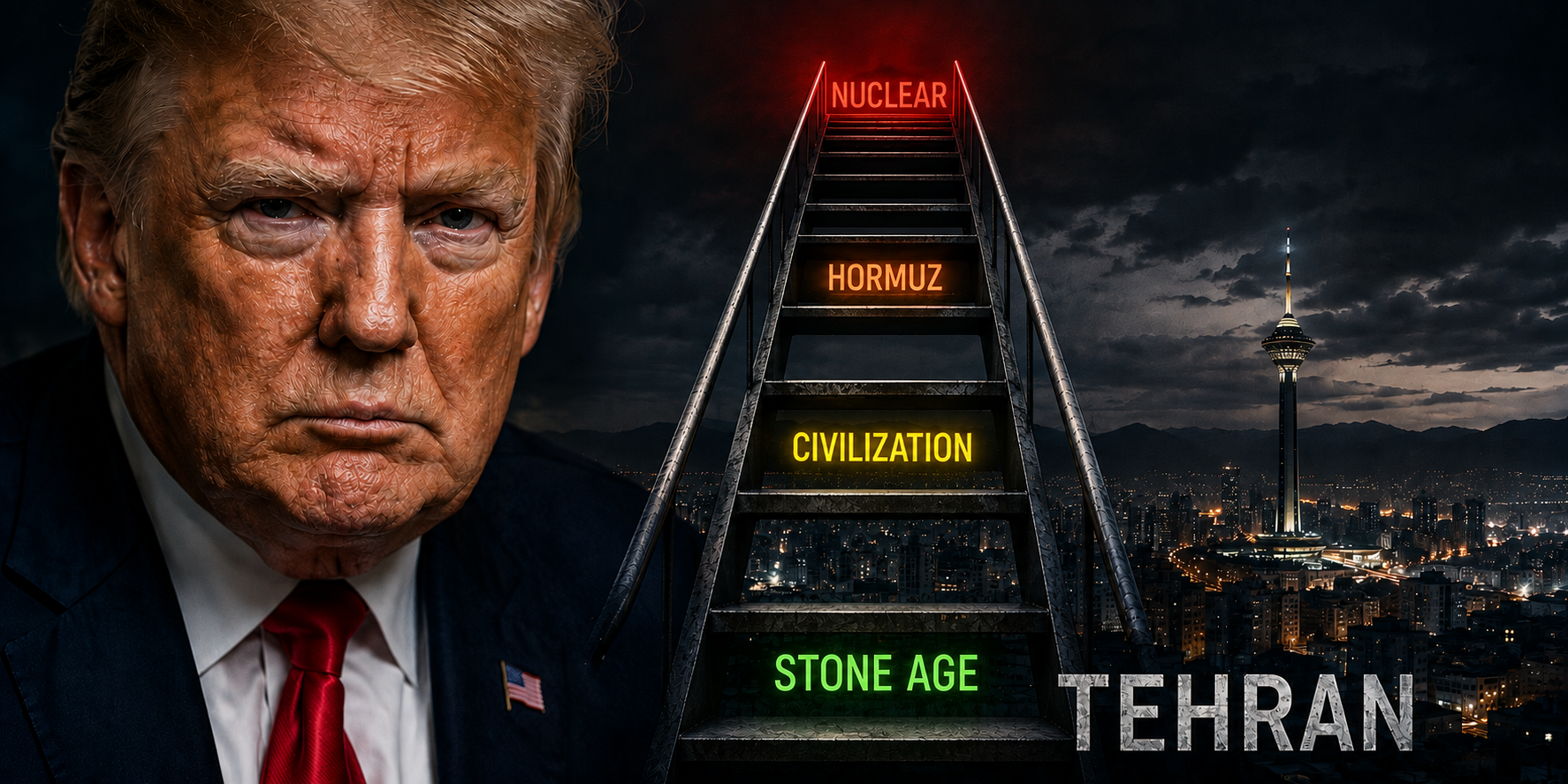
Trump’s threats against Iran already run near the ceiling of what a president can say out loud. In April, hours before a deadline he had set for Tehran to reopen the Strait of Hormuz, he wrote that a whole civilization would die that night, never to be brought back again, and that he did not want it to happen but that it probably would.
The day before, he had promised to bomb Iran back to the Stone Ages and to strike every power plant and bridge the country runs on. Legal scholars called the language genocidal, the Pope called it unacceptable, and a French foreign minister warned it could constitute a war crime.
Then a ceasefire arrived ninety minutes before the deadline, and the civilization survived the night. On Friday the pattern repeated in miniature: he would soon declare the Strait of Hormuz a US territory, he said, and hit Tehran economically.
Iran has stopped flinching. Its answer on Friday was contempt: a deputy foreign minister posted that the strait opens and closes under Iranian authority alone. The scorn is not new, and it is not empty. Through this year the regime has met each round of threats with a fixed message.
President Masoud Pezeshkian told naval officers at Bandar Abbas that Iran does not seek war and favors dialogue, but is not afraid of threats and will not retreat from its rights. Weeks later he drew the line that has held since: dialogue does not mean surrender. After the earlier fighting, an emergency-headquarters spokesman dismissed the warnings as the crude, arrogant, baseless threats of a delusional American president.
The contempt rests on something concrete. Tehran has said openly that a serious attack, even a conventional one, brings a response against American bases across the region and against the energy infrastructure of the Gulf. When the war opened this year, Iranian officials claimed their forces had carried out scores of counterstrikes against US and Israeli assets over the weeks that followed.
That promised retaliation is why the conventional threats stay cheap talk. Everyone can price them. Everyone can see that carrying them out invites a bill Washington, and the Gulf states whose refineries sit within Iranian reach, would rather not pay.
This is where a nuclear register would behave differently, and the difference is worth setting out plainly, as a scenario rather than a recommendation. If current rhetoric yields nothing in Tehran and the administration’s patience finally wears thin, a shift toward explicitly nuclear threats marks one branch of a wide fan of rhetorical options open to a president in a war he is far from winning. Putting it in relief is not the same as arguing for it.
The first difference is the response. Conventional destruction invites a conventional answer, and Iran has spelled out what that answer would be. A nuclear threat does not invite the same reply, because Iran has nothing symmetric to answer it with. The retaliation that disciplines the conventional threat is missing. That absence cuts against intuition: the graver register may be the one Iran is least able to make expensive.
The second difference is the cost of following through. A conventional campaign against Iranian infrastructure guarantees the counterstrike on the Gulf, which is why it has stayed a threat. Fulfilling a limited nuclear threat, however monstrous, does not summon that same symmetric response, which is what makes it harder to wave off as a bluff. The cheaper a threat is to execute, the more it is believed.
Set against that logic is what Iran does under any of it, and here the scenario turns on itself. The regime has proven it does not fold. It absorbed the assassination of its leadership in the opening strikes of this war and answered with conditions rather than concessions. A nuclear register would not shake that. It would feed the story the government has told for forty-seven years, that the outside means to erase it, and bind the population to the state rather than prying them apart.
The one form that tempts, an order to the city’s residents to leave, dressed as mercy, would seize a population of nearly ten million as a logistical body while leaving the regime untouched as a political one. People driven onto the roads by a foreign ultimatum turn on the power that forced them out, not on their own rulers. A century of air campaigns records no exception.
One more feature separates the two registers, and it constrains the escalation it describes. Conventional threats can be repeated weekly until they fade into noise, which is roughly what has happened to the Stone-Age talk. Nuclear rhetoric cannot be spent that way. Its whole force depends on being rare, and a president who reached for it often would hollow it into just another deadline nobody keeps. Even as an instrument, it is a card that can be played once or twice, not a posture that can be held.
None of this predicts that Trump will cross into nuclear language, and none of it weighs whether he should. It marks the edge of the fan. He can escalate there; nothing legal or material stops him, only an eighty-year habit that one sentence would end. What the scenario shows is narrower and stranger than the fear behind the question.
The nuclear register is the one Iran can least answer and the one Trump could most cheaply carry out, and it is still aimed at a regime that every threat so far has only hardened. Pezeshkian has already given the reply in five words. Dialogue does not mean surrender. A war far from won does not get closer by climbing to the last rung. It only runs out of rungs.