
Living between never and again
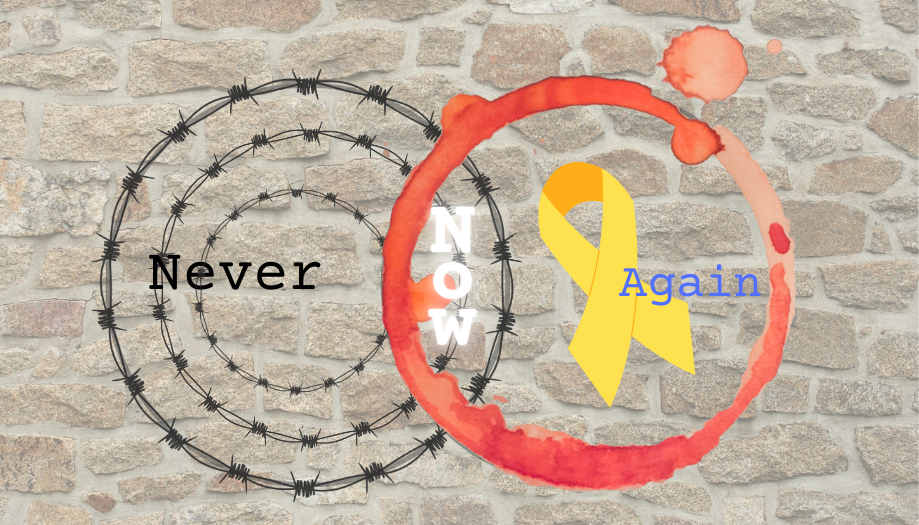
For me, these past two months have been whiplash. In June, Israel struck Iranian nuclear facilities in an operation that was the pinnacle of decades of strategy — precision, cooperation at the highest levels, and flawless execution. It was a historic moment, a pinnacle of Jewish power, and proof that “Never Again” wasn’t just a slogan but action, backed by the president of the United States, who declared to the nation that America would not permit the annihilation of Israel. As a Jew in America, I felt more at home and protected than ever before.
A mere seven weeks later, I saw the images of Rom and Evyatar — hostages held for more than 650 days, underground in dungeons of terror just 10 minutes from the IDF. I look at them and see my grandparents in 1943 Auschwitz. How could this reality skip just one generation of my family? We are watching Jewish bodies waste away on our own soil, and we have not brought them home. Never Again has collapsed into Again, and no number of victories in our other battles can drown out that truth.
This contrast is relentless. One moment Israel demonstrates extraordinary reach and capability; the next, we are staring at the faces of our brothers — abused, starved, still in captivity. These moments aren’t spread over decades; they come days or weeks apart, crashing into each other without resolution. What is the meaning of sovereignty if our people are held underground on our own promised soil? What is the value of strength if it doesn’t bring them home?
It’s not just my own lived experience — it’s also what the world is watching and believing. A different version of reality is being broadcast globally, one in which Israel is seen not as a nation defending itself, but as an oppressor. Our enemies murdered our children, burned our people alive, and yet we are the ones painted as monsters. We are condemned for carrying out the most critical and difficult work imaginable: confronting a threat that endangers not only us but the foundations of Western civilization, and doing it from the most vulnerable position possible — on the front lines of its fire. We are dismantling jihadist extremism, an ideology that has pledged religious war against anyone who refuses to conform to its beliefs or way of life. And still, the story the world chooses to believe is the one told by those who would destroy us.
I am frayed — torn between disbelief at how easily false narratives have spread throughout the United States and frustration at how little we’ve done to stop them. One of the most effective has been the claim of calculated, systemic starvation in Gaza — a narrative baked into Hamas’s long-term strategy, spearheaded by October 7. While there is now a real logistical crisis in food distribution, with genuine hunger in Gaza, the early imagery and accusations were part of a deliberate PR campaign designed to erode Israel’s legitimacy from day one. More than that, it was crafted to ignite the caring hearts of the West, to set them ablaze and let them burn. Hamas understands that caring does not require critical thinking, and they have weaponized that truth.
Yet there is also pride in how we have compartmentalized, focusing on the tactical war — the one fought in real life with all-too-real consequences. Maybe that is the war that matters most. Maybe. But I swing back again into the darker space, realizing that our ongoing loss in the PR war — the information war — erodes our standing, weakens alliances, and emboldens those who wish us harm. That cost isn’t abstract. Two days ago, an Israeli community center minutes from my home was vandalized with Nazi symbols and threats. This is the tension I live with: the battle between legitimacy and acceptance, and the strength required to survive.
I live within the space between Never and Again.
It is where pride and grief, victory and failure coexist — and where the weight of hate bears me down, yet the birthright I refuse to surrender carries me on.