
Founder & Principal, Line of State
A Settlement-Made Part Can Put a Billion-Dollar Israeli Arms Deal at Risk
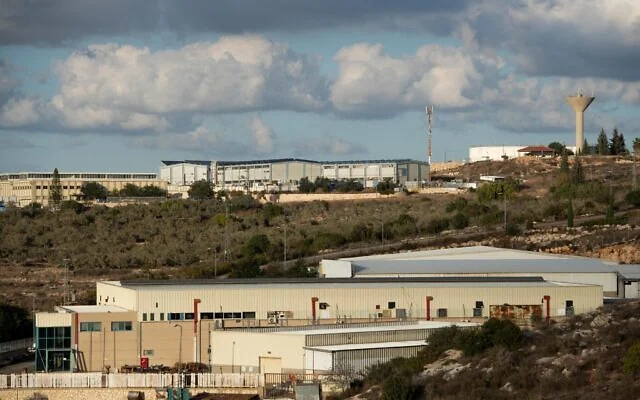
The Barkan Industrial Park near Ariel in the West Bank. What Jerusalem defends as a political principle, foreign buyers may treat as a compliance risk. Ministers make the choice; defense companies bear the consequences. (Sraya Diamant/Flash90/File)
West Bank sourcing is not merely a compliance problem for Israeli defense exporters. It is an ownership problem for the state that controls them. Shay Gal, former IAI Vice President and Chief of Staff to its Chairman, examines the risks reaching foreign buyers, capital markets and corporate boards – and the political decisions that never reach a vote.
In 2004, a single address helped cost Israel Aerospace Industries (IAI) $8 million. Its military helicopter plant in Atarot, north of Jerusalem, lost that sum; among the causes was the United States’ refusal to award work for the US Air Force to a facility beyond the Green Line, the pre-1967 armistice boundary. IAI management sought to relocate the operation to Lod, inside Israel. The government and Jerusalem Municipality blocked the move, fearing a political precedent. Neither technology, price nor quality determined the American refusal. An address did. The company saw a loss; the state saw a precedent. [1]
A component worth a few hundred shekels can jeopardize a contract worth billions. Manufacturing a part beyond the Green Line does not turn an entire Israeli defense system into a settlement product. But its origin can be scrutinized under procurement conditions, compliance requirements, financing and insurance. Disqualification requires a replacement supplier and requalification; the deal may be delayed, reopened or cancelled. Even without disqualification, a bank, insurer, prime contractor or compliance officer may refuse to bear the political risk.
Almost all of Israel’s core defense industry operates inside Israel. Its supply chains extend beyond the Green Line. In Barkan, a West Bank settlement industrial zone, Supergum identifies IAI, Rafael Advanced Defense Systems, Elbit Systems and the Israel Defense Forces among its customers. It manufactures seals, rubber and plastic products, and aerospace components. Barkan also housed Technopah, an authorised Ministry of Defense supplier that produced housings and enclosures for unmanned aerial vehicles, missile systems and launchers before closing in 2019. At Mishor Adumim, another West Bank industrial zone, aluminium manufacturer Extal reports longstanding cooperation with leading defence companies. [2]
The West Bank is not Jerusalem, and it is not the Golan Heights. Israel has never extended its law, jurisdiction and administration territorially to the West Bank as a whole. It did so in the areas incorporated into Jerusalem after 1967 and in the Golan Heights in 1981. Since February 2005, under an EU-Israel technical arrangement, proofs of preferential origin for Israeli exports to the European Union must identify the production location and postcode. European customs authorities use that information to distinguish eligible Israeli goods from settlement products. Israel itself supplies the information. [3]
In 2019, the United States recognized Israeli sovereignty over the Golan Heights. It now holds an active $2,141,020 defense contract with IAI’s Golan Industries division in Bnei Yehuda. In Jerusalem and the Golan Heights, Israel can manage the political and commercial price of its position. [4]
In the West Bank, obscuring production origin is already priced into the contracting risk. Blurring the distinction does not eliminate the exposure. It moves it to a more dangerous stage: tender evaluation, financing, signature or renewal. There, the cost may be not merely a delay, but the contract itself.
At IAI and Rafael, the State of Israel is simultaneously shareholder through the Government Companies Authority, major customer, regulator through the Ministry of Defense, and sovereign authority responsible for foreign and security policy.
Under Section 4 of Israel’s Government Companies Law, a state-owned company ordinarily operates on commercial considerations unless the government, with the Knesset Finance Committee’s approval, prescribes otherwise. The law permits a departure from commercial judgment. The state must then define the national interest, make the decision and bear its cost. Management presents the risks and alternatives. The board does not determine the territory’s status; it determines the commercial cost of state policy and must decide explicitly how that cost is to be borne. [5]
Yet the decision lies within a political structure. Ministers appoint directors, while the election of a chairman and appointment of a chief executive require their approval. Political interference in appointments and board affairs has already been publicly documented.
At IAI, the workers’ union is more than a labour-relations force. Company employees constitute a substantial bloc of registered Likud members. During the party’s August 2026 primaries, workers were documented arriving at polling stations with prepared voting lists. The union therefore wields power inside the company and political weight with the ministers who approve its leadership. [6]
No written instruction is necessary. Senior executives need only know which decision ministers do not want to see and which would provoke a confrontation with an organized force inside the governing party.
The CEO does not raise it. The chairman does not press. The board does not decide. And the company pays a price no one decided to pay.
Winning a tender does not end the exposure. A losing bidder can turn a component manufactured beyond the Green Line from a procurement issue into a political controversy in the purchasing country. Once the dispute moves from the product to the government and parliament, political concern alone may delay signature, reopen a decision or derail an otherwise settled contract. Before an award, or immediately afterwards, the matter can reach ministers, parliamentary committees or the media.
The exposure extends beyond the contract. Ahead of an initial public offering, especially in the United States, underwriters and lawyers will examine which revenues, contracts and supply chains face boycotts, trade restrictions or supplier replacement. Material exposure may require prospectus disclosure, depress valuation and deter investors. After listing, it can recur in periodic reporting and capital raising.
Elbit Systems already warns the US Securities and Exchange Commission that boycotts, divestment campaigns and trade restrictions may materially harm its business and financial condition. Production beyond the Green Line must be addressed before an IPO, not explained afterwards. [7]
A boycott, restriction or lost contract resulting from military operations necessary to defend Israel is a price the country must pay. So is retaining a production line needed in war, knowledge that cannot safely depend on foreign suppliers, or a critical capability that must not be transferred abroad.
What serves no military necessity must justify itself commercially.
If production can move from Barkan, Ariel or Ma’ale Adumim – all in the West Bank – into Israel without compromising expertise, capacity, supply to the IDF or operational freedom, national and commercial interests coincide: remove that production from export supply chains exposed to the territorial distinction.
Israel and its defense industries already relocate production when strategic interests require it: to the United States as American military assistance shifts towards US procurement, and to Europe to meet local-content requirements, export restrictions and capacity needs. [8]
Those willing to move production from Israel abroad to protect financing and markets cannot portray the relocation of a component from Barkan to Lod as a surrender of sovereignty.
Whoever blurs the distinction between Israel and the West Bank invites the world to do likewise – and to extend the territory’s risks to Israel itself.
Keeping production beyond the Green Line without military necessity is a political choice whose cost the state imposes on its defence companies. Executives and directors allow those companies to pay it in contracts, valuation and freedom of action.
–
This English version, adapted and expanded by the author, is based on an article originally published in Hebrew in Walla Money on November 11, 2026, under the title “רכיבים מההתנחלויות מסכנים חוזי נשק של מיליארדים”.
–
Related by the Same Author
- July 20, 2026 – Nasdaq Can Value IAI and Rafael. It Must Not Price Israel’s Freedom of Action – The Times of Israel.
- August 12, 2026 – Israel Must Stop Competing Against Itself Before It Lists IAI and Rafael – The Times of Israel.
- September 9, 2026 – Israel Owns the Factory. It Still Does Not Own the Next Interceptor. – The Times of Israel.
- September 15, 2026 – Being Pro-Israel Means Knowing the Settlements Are Not Israel – The Times of Israel.
- October 12, 2026 – Europe Buys Israel’s Weapons. Israel Still Builds Its Strategy Around America. – The Times of Israel.
- October 18, 2026 – October 7 Exposed the Security Cost of Israel’s Settlements in the West Bank – The Times of Israel.
- October 22, 2026 – The West Bank Must Not Hold Israel’s European Security Ties Hostage – The Jerusalem Post.
–
[1] Atarot, 2004. A report published on April 6, 2005 recorded an $8 million loss at IAI’s Atarot military helicopter plant in 2004. It identified the American refusal to place work at the facility as one cause, not necessarily the sole cause, of the loss. It also documented management’s request to relocate the operation to Lod and the government’s and Jerusalem Municipality’s refusal on political grounds.
[2] Defence suppliers beyond the Green Line. Supergum’s aerospace division identifies IAI, Rafael, Elbit and the IDF among its customers and describes its aviation and space products. Globes, June 2018, identified Supergum’s location in Barkan. Calcalist, February 19, 2019, documented Technopah’s military production, Ministry of Defense supplier authorisation and closure. Extal identifies its Mishor Adumim manufacturing facility and defence-industry relationships. These records establish reported industrial links, not the presence of any particular component in a specific exported weapons system.
[3] European rules of origin. European Commission, Directorate-General for Taxation and Customs Union, EU-Israel Technical Arrangement. Agreed in 2004 and implemented on February 1, 2005, the arrangement requires the name and postcode of the place where production conferring origin occurred. Settlement-origin materials are treated as non-originating under the relevant preferential-origin rules; their inclusion does not automatically change the origin of the entire finished product. Eligibility depends on the applicable rules and the production involved. EU treatment of products from East Jerusalem and the Golan Heights likewise differs from Israel’s domestic legal position.
[4] Golan Heights and American procurement. US Presidential Proclamation 9852, March 25, 2019, recognised Israeli sovereignty over the Golan Heights. Federal procurement records identify Defense Logistics Agency delivery order SPE4A726F7485, awarded on June 1, 2026, to Israel Aerospace Industries Military Aircraft Division, Golan Industries, in Bnei Yehuda. Its current obligated value is $2,141,020, with an end date of October 25, 2027. American recognition does not bind the European Union, which maintains a different territorial position concerning both the Golan Heights and East Jerusalem.
[5] State ownership and corporate authority. Israel’s Government Companies Law, 5735-1975, particularly Sections 4, 18, 24 and 37. Section 4 establishes commercial considerations as the ordinary standard for government companies unless the government, with the approval of the Knesset Finance Committee, prescribes other considerations. The law also governs ministerial participation in appointments and corporate oversight. The argument that government must define and bear the commercial cost of its political decisions is the author’s governance conclusion, not a quotation from the statute.
[6] Political appointments and organised voting. Calcalist, November 11, 2025, documented the dispute over IAI’s chairmanship and its consequences for corporate reporting. N12, August 17, 2026, reported that IAI employees were brought from their offices to a nearby Likud primary polling station and received prepared voting lists. These records document political connections and organised voting; they do not independently establish that the union or a minister blocked a particular supplier-relocation decision.
[7] Financial disclosure and material exposure. Elbit Systems, 2025 Annual Report on Form 20-F, filed with the SEC in March 2026. The report addresses boycotts, divestment campaigns, political pressure and trade restrictions, including potential material effects on Elbit’s business and financial condition. It does not establish that settlement-origin components caused a particular loss. The disclosure consequences of any specific supply-chain exposure depend on the applicable facts, contracts, jurisdictions and materiality standards.
[8] Industrial relocation and procurement. The 2016 US-Israel Memorandum of Understanding on Security Assistance, covering fiscal years 2019–2028, phases out the Offshore Procurement exception that allowed some US military assistance to be spent on production in Israel. The European Union’s SAFE framework, established in 2025, further reinforces regional manufacturing and supply-chain eligibility requirements, generally limiting non-qualifying component costs to 35 per cent of the end product’s estimated component cost. For the broader industrial argument, see the author’s October 12, 2026 essay, “Europe Buys Israel’s Weapons. Israel Still Builds Its Strategy Around America.”
Related Topics
Related Posts