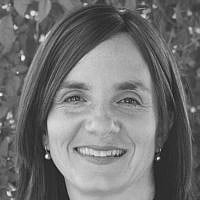
Liz Gunn Randolph Interview | Alexandre Gilbert #302
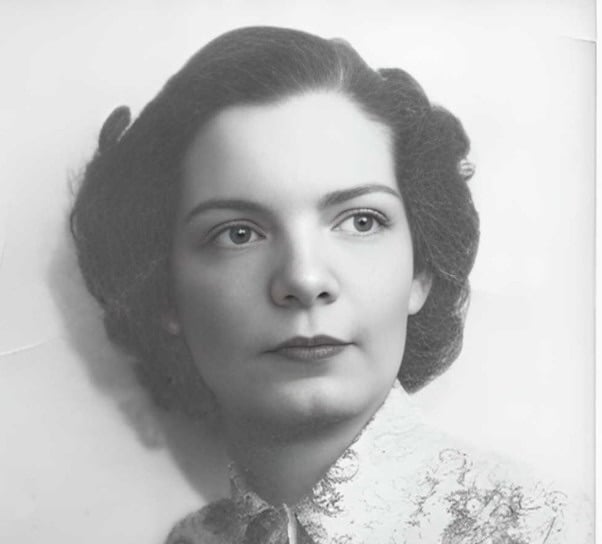
Liz Gunn Randolph, a Ball State literature graduate, recalls her grandmother Mary Goodman-Gunn — cousin of Hollywood actor Don Castle and niece of producer Burton George — like William Wyler (Ben-Hur), the Marx Brothers, and Marcel Marceau, of Alsatian-Jewish descent.
If I close my eyes in a quiet room, I can recall my grandmother, Mary Bendel (Goodman) Gunn. Raised in Texas, she spoke not with a twang but in a softer, cultured southern voice. The queen bee of our family, she held court everywhere, with her own way of setting a table, cooking, or ordering in restaurants. She had opinions on everyone, never shy about offering advice. The only time I saw her despondent was after my grandfather’s death in 1999, just short of their 60th anniversary.
Mary’s mother was from Louisiana, and as a girl Mary often took the train from Beaumont to Lake Charles to visit her grandparents, Sam and Rosa Bendel. Her mother tipped the conductor to watch over her. Born at her grandparents’ home in February 1918, two months premature and weighing just two pounds, she was kept alive by a nurse who placed her before a woodburning stove with the oven door open.
Her parents, Adrian B. Goodman of Navasota, Texas, and Elyse Bendel of Lake Charles, were born to Jewish merchant families. The Goodmans, from Exin, Prussia (now Poznań, Poland), settled in the American South in the 1840s, while the Bendels arrived from Austria in 1865. Sam’s wife, Rosa, was from New Orleans; her father, David Reims, immigrated from Ringendorf, Alsace, in 1871 to avoid conscription in the Franco-Prussian War.
After marrying Julia Raas, from nearby Niedernai in Alsace, David settled in Lake Charles and became a butcher. They had six children: Rosa, Bella (who died young), Mira, Armand, Caroline, and Blanche. The daughters all married local Jewish merchants. Armand, however, abandoned his wife and child to pursue an acting career in New York, a scandal that led his father to cut him off. Known professionally as Burton George, he became a moderately successful silent film director and writer. My grandmother met him only once, at his mother’s funeral, and remembered him as very handsome.
Burton George’s silent film career ended in 1925 when the Selznick Picture Corporation went bankrupt. Its founder, Lewis J. Selznick, was father to Myron, David, and Howard Selznick, later of RKO (which became Universal). Burton’s final film, Morgenröte, was shot in Germany in 1929, where he served as artistic director. After that, records vanish until his death from tuberculosis in Chicago in 1935, where he was buried in a pauper’s grave.
While working as treasurer for the Louisiana Grain Company, Adrian rented a room at Sam Bendel’s house, where he quickly fell for Sam’s daughter Elyse—a beautiful young woman, high school salutatorian, and niece of famed New York designer Henri Bendel who often sent her stylish clothes to wear. They married at her father’s house in Lake Charles in March of 1917.
Newspaper accounts described the reception as lavish, with flowers, music, and guests from Texas and Louisiana. Elyse’s gown, a custom Bendel design, was a gift from her uncle Henri. My aunt still has her gold wedding band, inscribed with the date.
By 1920, the Goodmans were living in Beaumont, Texas, where Adrian worked in the oil industry during a time of prosperity. Mary now had a younger brother, also named Adrian, distinguished only by the middle initial “B” rather than “Jr.” Elyse, who had no middle name, later adopted “Bendel,” just as her mother had added “Odette.” Adrian Sr., ever the entrepreneur, was always on the lookout for opportunity.
During the downturn of the oil boom, Adrian began selling fishing hooks, sinkers, and cork bobbers for the Brown Metal and Cork Company. A born storyteller, he traveled as far as Oregon and Kentucky, according to his son Adrian Jr. The family moved to Houston for better opportunities and schools, and just before the 1929 crash, Adrian invested most of their savings in the stock market.
In 1930, after losing most of their savings, Adrian suffered a heart attack at 45 and left the struggling tackle business, which had declined after the owner’s 1927 death. Around the same time, Elyse’s parents, Sam and Rosa Bendel, faced financial difficulties and split their time between Houston with Elyse and Adrian and Monroe, Louisiana, with her brother Dr. Bill Bendel. Mary and her brother Adrian Jr., who spent summers with their grandparents and Uncle Bill, called them “Mommee” and “Poppee,” and Adrian Jr. decided to pursue a medical career.
Elyse and Adrian moved west to California for better work and educational opportunities. Before leaving, they told Mary and her brother that the family would no longer identify as Jewish—a decision Mary accepted, as they had rarely attended Temple, kept Kosher, or had Bar Mitzvahs. Later, it was suggested that this choice was to improve Adrian’s chances of admission to medical schools, which limited the number of Jewish students.
Adrian Jr. recalls the family drove to California in their old Chevrolet. Initially planning to settle in Los Angeles, Adrian B. chose San Francisco instead, favoring its look and seeing an opportunity to launch a snack he had discovered in Dallas called Toastos, similar to Fritos.
The family moved into a one-bedroom apartment in San Francisco’s Marina district. Mary finished her senior year at Galileo High School in 1935, across from the Ghirardelli Chocolate Factory, where she enjoyed the daily chocolate aroma. That March, her grandfather Sam Bendel died of a heart attack at 70 at his son’s home.
The family struggled to launch Toastos, a snack marketed with beer, but many confused it with cereal, and San Francisco wasn’t a big beer market. They stayed just long enough for Mary to graduate high school.
By September, the family moved to Los Angeles with limited funds, enough for Adrian to start a tire recapping business—the first in the area—which quickly took off. That year, Mary began studying merchandising at USC, where tuition was just $20 per semester.
In 1936 Mary met my grand-father on a blind date set up by one of her Zeta Tau Alpha sorority sisters. Richard J. Gunn was from Great Bend, Kansas and in the past had spent many winters in California with his family who owned several hundred acres of wheat farmland and the Barton County Flour Mill. He was an older college student at age 25 and his entrance into USC had been delayed by a car accident in 1932 when he had broken his right-arm. After the accident, he was never able to fully extend it, which denied him the opportunity to serve in World War II. In 1938, he proposed to Mary by telling her of his plans to return to Great Bend to open a clothing store with his father. Mary said she didn’t know where the direction of this conversation was going, so when he asked her if she would come to Great Bend and be his wife, she was so stunned she just nodded yes.
She wasn’t able to complete her degree at USC, not because she was getting married, but because once again her father’s business failed, and her parents couldn’t afford both her tuition and her brother’s. The business had failed because there was a lawsuit for infringement of a patent for the method of recapping the tires. Adrian decided not to pursue the lawsuit and to just close his business. In 1940 with the uptick of military manufacturing boom in the US prior to American involvement in World War II, both Adrian and Elyse got jobs working as clerks in the office at the Douglas Aircraft Company in Long Beach, California, which built military planes.
It was during this time period that Mary’s cousin Marion Goodman Jr. moved in with their family so he could pursue his career in Hollywood as an actor. Marion was born in Beaumont, TX in 1917 to Marion and Lucille (Viterbo) Goodman. He was a B movie Hollywood actor under the stage name Don Castle who acted in movies like Love Finds Andy Hardy and Young Dr. Kildare and later he was a TV producer of the show Lassie. World War II interrupted his acting career, and he was drafted into the Army Air Force and served during the war making training films with the First Motion Picture Unit. After the war he continued his film career and his final role was a drunken cowboy in the movie Gunfight at the O.K. Corral in 1957.
Mary and Richard married in October 1939 in Los Angeles, moved to Great Bend, and immediately opened the Gunn Clothing Store. Their first $4,000 house had only a hand-pump kitchen faucet until Richard’s father installed running water and a bathroom as a wedding gift. Mary entered marriage with little household experience, as her mother had employed a housekeeper. In Kansas, her mother-in-law Beulah taught her household chores and simple cooking, while Mary also learned to manage the budget—once spending $5 on a cookbook when the monthly budget was only $40.