
Looking Past ‘Silenced No More’

A newspaper does not need to lie to reposition reality. Sometimes it can do so through something far quieter: the placement of uncertainty.
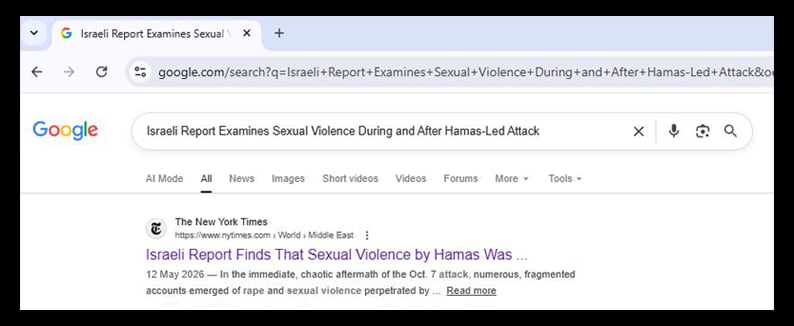
On May 12, the New York Times gradually transformed the headline on its coverage of a two-year investigation into the sexual crimes Hamas and its collaborators committed against Israeli civilians on October 7 and against the hostages taken into Gaza. What first appeared as Israeli Report Finds That Sexual Violence by Hamas Was… became, by publication, Israeli Report Examines Sexual Violence During and After Hamas-Led Attack. The earlier wording still survives in Google’s cached listing.
The difference between those formulations is not stylistic. The subheadline beneath it was blunter. But it is rarely the subheadline that readers carry away.
Another major newspaper approached the same material differently. Le Monde’s headline read: October 7: New report documents extent of sexual violence committed by Hamas. Both newspapers worked from the same body of evidence. Yet unlike Le Monde’s plain wording, the New York Times embedded the violence within the diffuse chronology of “during and after Hamas-led attack.” The wording replaces the grammar of action with the grammar of temporal association: violence no longer appears as something perpetrators did to victims, but as something that somehow existed around a larger event. Even the event itself is flattened into the generic language of an “attack,” a term that absorbs massacre, abduction, captivity, and prolonged abuse into a single indistinct frame.
Headlines do more than summarize articles. They quietly assign epistemic status. They tell readers whether something belongs to the category of established reality, contested allegation, political claim, or unresolved dispute.
Most readers will never examine the underlying evidence for themselves. They absorb instead the moral and epistemic cues embedded in a headline’s grammar. Research has shown that headlines shape interpretation, prime cognitive associations, and influence memory in ways that are difficult to correct even after readers see the full article. That is why wording matters so much in cases of mass violence. Not because language replaces facts, but because language shapes how facts are socially permitted to appear.
The document handled with such caution by the New York Times was not a rumor circulating online or a political press release. The Civil Commission on the October 7 Crimes by Hamas Against Women and Children spent two years assembling it from more than four hundred testimonies, over ten thousand photographs and videos, and more than eighteen hundred hours of analysis, using methods designed to make every conclusion traceable and reviewable. It documents thirteen recurring patterns of sexual violence, including rape, sexual torture, and mutilation, and concludes that the violence was systematic and deliberate, an integral part of the attack rather than incidental to it.
The report was endorsed by Hillary Clinton and by David Crane, the former chief prosecutor of the Special Court for Sierra Leone, with a foreword by Irwin Cotler and Aharon Barak, the former president of Israel’s Supreme Court. Whatever one thinks about Israeli politics, this was not fringe material treated cautiously because its credibility was inherently uncertain.
The day before, on May 11, the New York Times had published Nicholas Kristof’s column The Silence That Meets the Rape of Palestinians. There, the language of violation appeared without hesitation. The victims were named. The crime was named.
The issue is not that Palestinian allegations should be dismissed or ignored. Serious journalism should investigate such claims rigorously. The issue is that certainty and hesitation appeared unevenly distributed. Imagine the same register turned toward the other victims: The Silence That Meets the Rape of Israelis. The Times did not write that sentence. It wrote that a report examines sexual violence during and after Hamas-led attack.
The larger question is what changed. Why did the New York Times, faced with a heavily documented investigation into crimes committed against Israeli civilians, retreat into a language of abstraction and epistemic distance that another major Western newspaper did not adopt?
One possible explanation lies in how certain foreign newsrooms have come to read Israel. Benjamin Netanyahu and his government, along with figures like Itamar Ben-Gvir within it, may be read less as political actors than as an interpretive filter through which material emerging from the country must pass. But this grants those figures a disproportionate power: the power to collapse distinctions that democratic societies ordinarily insist on preserving. Israel is not reducible to its current government. It remains a society with independent courts, universities, journalists, civil commissions, opposition movements, and researchers engaged in their own struggles over truth, responsibility, and political authority.
The people involved in assembling the commission’s findings were not emissaries of Benjamin Netanyahu. They included survivors, witnesses, forensic investigators, legal experts, and researchers, drawing on testimony and on evidence gathered from the scenes of massacre, abduction, and captivity themselves. Treating such work as politically contaminated from the outset does not hold power accountable. It simply places certain victims at a greater distance from public recognition.
Journalism depends on skepticism. But skepticism loses its moral seriousness once it becomes unevenly distributed. No extraordinary act of courage was required here, only the willingness to say plainly in the headline what the investigation concluded about what was done to Israeli civilians on October 7 and to the hostages held in Gaza. Another major paper, working from the same evidence, managed exactly that. The caution was never required; it was chosen.
A profession that can name one people’s suffering without hesitation, and reach for the grammar of caution when another’s is documented, has not been more rigorous. The question is not whether to take Israel’s side. It is whether the language used to report findings treats them as findings. That is among the most basic responsibilities of journalism: to use language in good faith.