Grammy and Emmy nominated singer-songwriter, author, essayist
Retying The Knot: On Prophets, Pogroms and McDonald’s
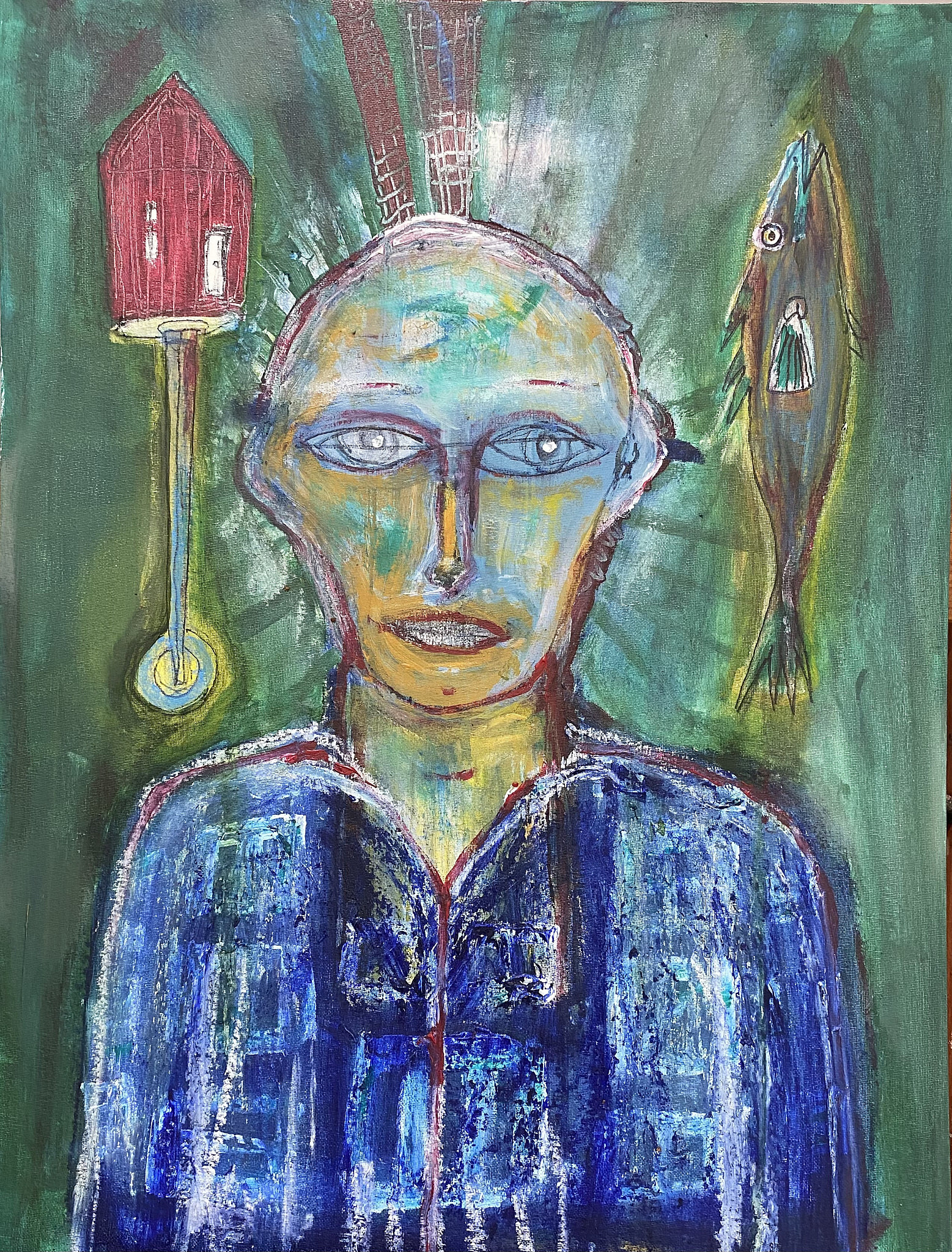
Illustration by the author (Acrylic on canvas, 18 x 24 inches)
Retying The Knot: On Prophets, Pogroms and McDonald’s
My wife and I fly regularly to visit our grandchildren. I use a computer. I have just successfully used modern medicine to address a hearing issue. I mention these things not to establish my credentials as a modern person, but because I’ve been acculturated—as perhaps you have—to lead with them. To signal that I am not a person left behind. That I am forward-facing, reasonable, unencumbered by the past.
But lately I’ve been wondering about the cost of leaving that impression.
Last week my son Isaac and I spoke about his wife’s family. She comes from a world quite different from most of the Jewish people I’ve known across my lifetime. Her lineage is unbroken. Grandparents, great-grandparents, great-great-grandparents—known, named, and present in their commitment to Judaism. Those who survived the Shoah continued to practice Jewishly, remaining faithful to commandments going back some four thousand years. The chain of tradition was tested, at times severely, and it held.
That conversation stayed with me. What it subtly illuminated was the nature of my own chain—where it had broken and how, in retrospect, I have come to see its repair as an aspiration, a practice, and a responsibility.
I want to be careful here about the word secular. I don’t find it useful, and not only because it compresses something complicated. I don’t believe most of us are steadfastly secular, any more than I believe most of us are steadfastly devout. We have our moments in both directions. There are times of great need, and in those times, almost all of us look somewhere beyond ourselves. The sacred and the mundane are always coexisting, always in some proportion or another. The question is less whether we reach toward something larger, and more what we reach toward, and why.
In that sense, I think everyone is, in their own way, religious. Everyone is devoted to something, some means of transcending the momentary, whether through the accumulation of things, through relationships, through full immersion in whatever a mercurial popular culture declares essential this season. There is nothing wrong with any of that. But I’ve grown increasingly interested in the alternative: a growing countercultural awareness in me, which argues that the majority is not necessarily right. That the accumulation of four thousand years of scholarship, philosophy, and moral intelligence might be as urgently needed now as at any point in history.
The breaks in my family of origin’s chain were not simply the result of assimilation, of families eager to fit in, of children wanting to be American. That is part of it—my parents were first-generation Americans, and their task was survival through belonging, and I largely inherited that task. But the breaks also came from something darker. It can be said, I think, with some confidence, that nearly all of the Jewish people I grew up with, and have known into adulthood, had grandparents who arrived in America carrying the memory of escape—from pogroms, from violence, from the particular kind of hatred that doesn’t require a reason but always seems to proffer one, tailor-made for the times.
No different from October of 2023, when that history announced itself again in the massacre of Jews in Israel at the hands of Hamas. As seems to happen for the Jews at every inflection point when societies fall into dismemberment, the awful past and the sanguine sense of the present collapse into each other.
What I understood with ever more clarity in the aftermath of that is that the rupture in my family’s chain was not a failure of faith. It was, in part, a wound. And wounds, if they go unexamined, get passed down. The question of what comes next matters. Not only what we think, but what we do. What thread, practically and spiritually, can be drawn from such scrutiny and woven back into a life?
In the Jewish families I knew growing up, the thread never fully disappeared. Shabbat candles were still lit, if not with complete regularity. Matzo was eaten at Passover, even if a bowl of Cheerios may have sometimes appeared alongside it. A devotion to the past, however expressed, however imperfect, was still apparent. Today, I watch the children of my friends becoming more and more disconnected, not because they are indifferent, but because the thread has grown too thin to see.
And yet. I don’t think the hunger goes away. I’ve never met someone who didn’t, at some point, reach for something beyond the momentary. The question is whether there is something there to meet them when they do.
I recall the one time my father drove me to school and took a detour.
“Let’s go to synagogue. I think there’s still time.”
It was the first and only morning service we ever attended together. We both put on tefillin and, because we were largely unfamiliar with the prayers, spent most of our time looking around at the handful of older men who had come to pray.
Afterward, my father took me to McDonald’s for breakfast. I ordered an English muffin with pork sausage and cheese.
“We should do that more, Pete,” he said.
We never did. But unlike so many other moments from my childhood that have faded with time, that one remains vivid. Looking back, I think what stayed with me was not the service itself, nor even the conversation afterward. It was the sense that something had briefly reconnected—a thread neither of us fully understood, but one we both somehow felt.
For me, as long as I can remember, there has been a yearning—not fully formed, certainly not a rational understanding, but something innate—that I must mend a tear in the fabric that holds together the past and present. That I must endeavor to retie a knot in a rope that had been severed, not simply from choice, but also from circumstances that had been foisted on our people.
I am aware of how that sounds. There is an earnestness to it that our culture tends to greet with suspicion. We are trained to look ahead, to treat the past as something to be synthesized and moved beyond, to regard deep tradition as belonging to simpler folks, unlike us.
But what if the tear is in your fabric too and you’ve simply grown accustomed to the draft blowing on your skin?
Not to live in the past. To reconnect it to the present.
“He shall turn the heart of the fathers to the children, and the heart of the children to their fathers.”
— Malachi 3:24
Related Topics
Related Posts