
Lost Herrings
A short companion to “What Lithuania Means When It Says ‘Vanished,’ ‘Lost,’ or ‘Perished’”
Full article: https://grantgochin.substack.com/p/what-lithuania-means-when-it-says
Survivors of the Seventh Fort in Kaunas said the Jews imprisoned there felt like herrings in a barrel.
The phrase was not metaphor enough. Jewish men were forced to lie motionless on open ground under the sky. Jewish women were forced into the fort’s dark casemates — vaulted chambers built into the structure of a military fort, often dark, enclosed, and semi-underground. There was alcohol for the Lithuanian guards. They partied, drank and celebrated.
Jewish men who wore glasses were called out under the pretext of being registered for lighter work, because doctors, lawyers, and engineers were supposedly needed by the Lithuanians. The Jewish men did not return. They were murdered on the other side of the wall.
Testimony records that thirty to forty Jewish women brought into the casemates were raped and murdered by drunken Lithuanian guards.
Then came the pit.
Records of interrogations of TDA members describe Jews brought to the pits in groups and shot ten at a time. One day, 463 were shot. The next day, 2,514 people were brought to one huge pit. Germans brought machine guns. Germans and Lithuanians walked around the pit and fired randomly down into the trapped crowd for about an hour and a half, until nobody in the pit showed signs of life. Then Lithuanians went down into the pit to search for gold rings and extract gold teeth from the mouths of the murdered Jews.
Did these Jews get lost?
Did these Jews vanish?
Did these Jews perish?
Were the Lithuanian men who guarded them, raped the women, shot into the trapped crowd, climbed into the pit, searched for rings, and pulled gold teeth from corpses merely “collaborators”?
Those questions are the reason I wrote the longer article, “What Lithuania Means When It Says ‘Vanished,’ ‘Lost,’ or ‘Perished’”: https://grantgochin.substack.com/p/what-lithuania-means-when-it-says
Lithuanian state and diplomatic language often turns murdered Jews into “vanished Jews”, “lost Jews”, or “perished Jews”. Soviet and Nazi criminals are named, Lithuanians are referred to only as “collaborators”; they are never identified. The words are very deliberate. They remove the Lithuanian murderer from the sentence. They make murder sound like mist. They convert a pit into an absence. They allow a state to mourn what its own society destroyed while hiding the Lithuanian men who perpetrated the destruction.
The Seventh Fort alone is enough to expose the fraud. A person does not “vanish” while lying under machine-gun fire in a pit. A woman does not “perish” when Lithuanian guards rape and murder her in a fort chamber. A corpse does not become “lost” while Lithuanian soldiers climb down to pull gold from its mouth.
The same language collapses at Skuodas.
After liberation, a Red Army medical commission opened the pits at Alka Hill. The record states that of 510 women, babies, and children killed there and below the hill, 289 had been buried alive. In one grave, a woman shot in the back of the head was found holding a one-year-old child who had no injury marks. The child had been buried alive. Another certified pit held 149 people with no bullet wounds or blunt-force injuries; the committee concluded that all 149 had been buried alive.
What threat could a suckling infant possibly have represented to anyone?
What military purpose was served by burying a nursing child alive in its mother’s arms, leaving it to suffocate beneath the earth?
What “complexity” explains that grave?
The answer is none. The infant did not “vanish”. The infant was not “lost”. The infant did not “perish” in a tragedy. The infant was buried alive because a society had been taught that Jewish life no longer deserved protection, pity, law, or even language.
That is why these words are offensive. “Vanished” is not memory. It is laundering. “Lost” is not mourning. It is evasion. “Perished” is not reverence. It is an insult when the record shows rape, pits, rifles, stones, gold teeth, buried infants, and Lithuanian hands.
The Jews of Lithuania were herrings trapped in a barrel. They did not get lost in that barrel. They did not vanish in that barrel. They did not perish in that barrel.
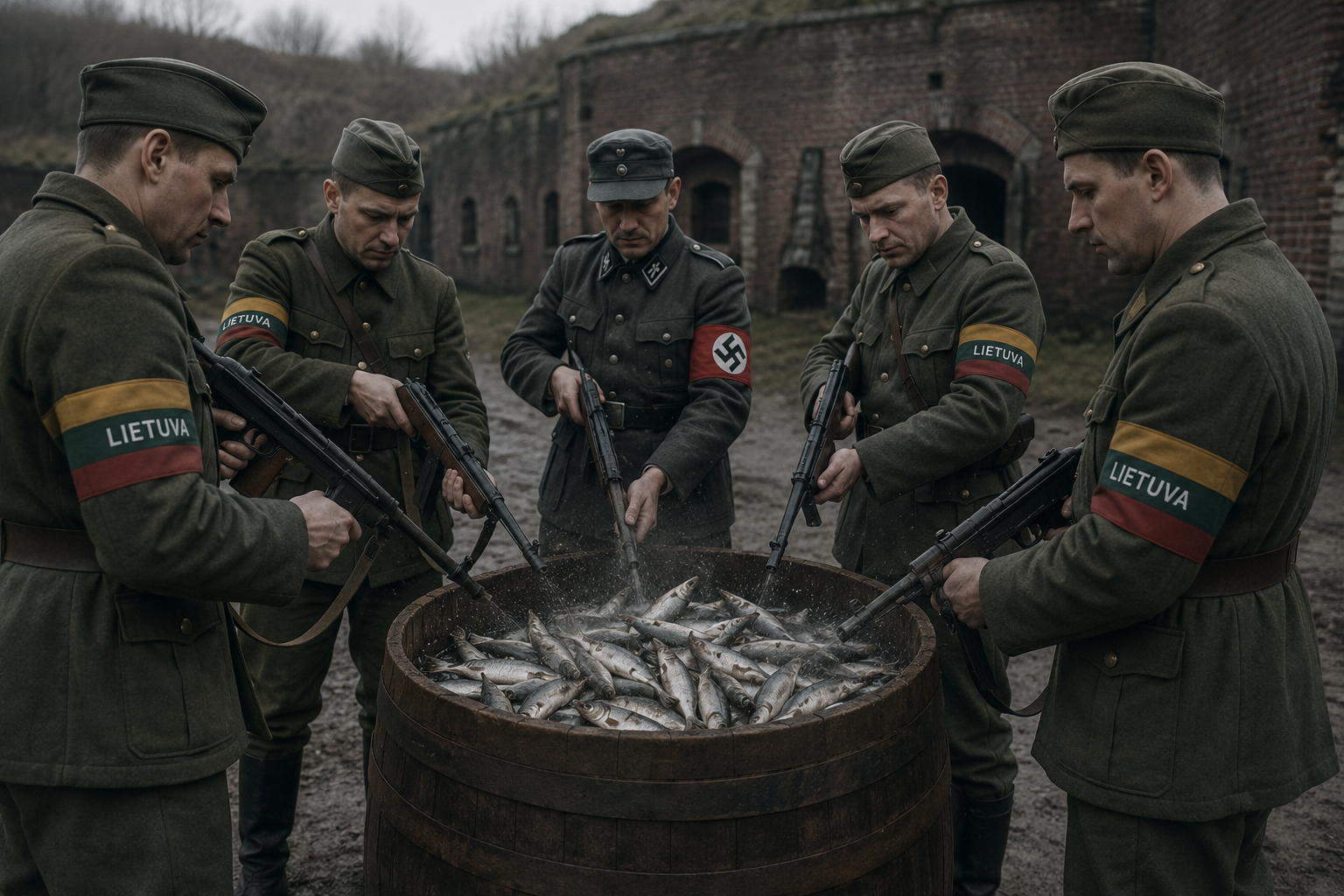
The words must say what happened.
They were murdered. Savagely, brutally, enthusiastically.
And many of their murderers are named heroes of the Lithuanian nation today.
Lithuania says it is a nation of values. National heroes embody those values. That is why Lithuania cannot name the crimes or name the criminals. To do so would explain to the world what those values were and are.
Sources
USHMM on Kovno/Seventh Fort: https://encyclopedia.ushmm.org/content/en/article/kovno
Skuodas testimony, JewishGen/Yizkor Book Project: https://www.jewishgen.org/yizkor/skuodas1/sku001.html
Skuodas testimony, trial-record section: https://www.jewishgen.org/Yizkor/Skuodas1/sku106.html
Full companion article: https://grantgochin.substack.com/p/what-lithuania-means-when-it-says