
Rabbi, Special Operations Police Officer, Award Winning Filmmaker
Loving Jews Is Not Politics. It Is a Moral Act
In a world that increasingly asks Jews to justify their existence, their history, and even their grief, one truth must be stated plainly and without apology:
Loving Jews is not a political position. It is a moral one.
This distinction matters—because when love, dignity, and basic human concern are reframed as “politics,” they become conditional. Negotiable. Optional. And history has shown, again and again, that when Jewish humanity becomes conditional, catastrophe follows.
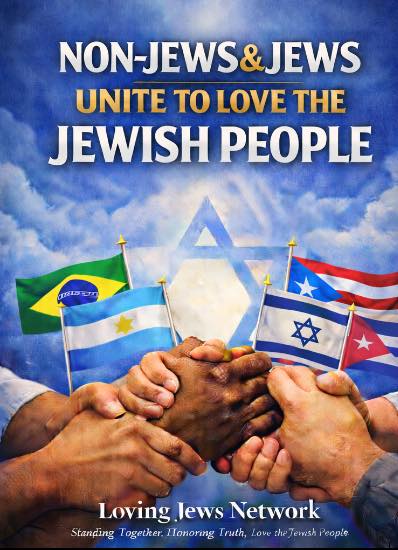
I created the Loving Jews Network out of a growing moral urgency. It emerged from countless conversations—with Jews who felt increasingly isolated, and with non-Jews who felt disturbed by what they were seeing but unsure where they were “allowed” to stand. The purpose was simple: to give voice and visibility to people—Jewish and non-Jewish alike—who believe that the Jewish people deserve dignity, safety, and truth.
This was not conceived as a counter-movement.
It was not designed as a campaign of anger.
And it was never meant to be an argument about borders, governments, or ballots.
It was meant to be something far more basic:
a declaration of humanity.
When Existence Becomes Debatable
There is something uniquely unsettling about being asked to justify one’s right to exist.
Jews today are not merely criticized for policies or governments—as all nations are—but are increasingly asked to explain their history, their legitimacy, their grief, and even their deaths. Mourning Jewish victims is scrutinized. Jewish fear is questioned. Jewish pain is weighed, contextualized, and often dismissed.
This is not political disagreement.
It is moral erosion.
When people feel entitled to interrogate whether Jewish suffering is “appropriate,” “proportionate,” or worthy of empathy, something fundamental has broken. The issue is no longer geopolitics. It is the loss of a moral reflex—the instinct that once told societies when something had gone too far.
The Loneliness of the Jewish People
Across history, Jews have learned a painful lesson, often too late: when hatred rises, silence often rises with it.
Antisemitism rarely announces itself as hatred. It disguises itself as reason, ideology, justice, or moral concern. And while it spreads, neighbors grow quiet. Institutions hesitate. Allies begin to whisper instead of speak.
Today, antisemitism is once again being normalized—on university campuses, in cultural institutions, across digital platforms, and within social movements that claim moral superiority while excusing or minimizing violence against Jews.
The result is not only fear.
It is isolation.
Many Jews feel they are standing alone—not because there are no allies, but because allies are increasingly afraid to be visible. Support has become “complicated.” Sympathy has become “contextual.” Silence has become fashionable.
The Loving Jews Network exists to say clearly and publicly: you are not alone. And more importantly, you should never have been made to feel that you are.
Why This Is Not About Politics
Politics is about power, policy, and competing interests. Morality is about human worth.
The moment loving Jews is framed as “taking a side,” something dangerous happens. Decency becomes conditional. Jewish safety becomes negotiable. Jewish humanity becomes dependent on ideological alignment.
This framing must be rejected.
One does not need to support a particular government, endorse a policy, or agree with every action taken by Jews anywhere in the world in order to affirm a basic moral truth: Jews deserve to live without fear, erasure, or justification for their suffering.
That is not politics.
That is ethics.
And when ethics are sacrificed on the altar of ideology, everyone eventually pays the price.
Why Non-Jews Matter in This Conversation
Some of the most powerful voices in the Loving Jews Network are not Jewish.
They are Christians, Muslims, Druze, Hindus, atheists—people of conscience who understand a truth history has demonstrated repeatedly: hatred of Jews never remains confined to Jews alone.
Antisemitism is not merely another prejudice. It is a civilizational warning sign.
When Jews are targeted, it is not because of what they have done, but because of what they represent: memory, moral continuity, resistance to totalitarian thinking, and the uncomfortable presence of an ancient people who refuse to disappear.
When Jews are attacked, civilization itself is being tested.
To stand with Jews is not to “take sides.”
It is to take a stand—for truth, for history, and for the moral boundaries that protect everyone.
Love as Resistance
In an age saturated with outrage, love has become a radical act.
Loving Jews today does not mean blind agreement or uncritical loyalty. It means something far more demanding—and far more human.
It means:
-
Refusing to dehumanize
-
Refusing to justify terror or violence against civilians
-
Refusing to remain silent when lies replace truth
-
Refusing to treat Jewish pain as a bargaining chip
This kind of love does not scream.
It does not threaten.
It does not cancel.
It insists.
The Loving Jews Network does not demand unanimity. It does not ask its members to agree on every political question. It asks for something far more basic: decency.
You do not need to be Jewish to love Jews.
You only need to recognize humanity when it is under threat.
The Cost of Moral Confusion
One of the great dangers of our time is moral confusion masquerading as sophistication.
We are told that everything is “complex,” that every act must be endlessly contextualized, that moral clarity itself is naïve. But moral clarity is not extremism. It is the foundation of civilization.
It is not “complex” to condemn antisemitism.
It is not “nuanced” to excuse violence against civilians.
It is not “progressive” to demand explanations from the dead.
The Loving Jews Network exists to push back against this confusion—not with rage, but with resolve.
Because when a society loses the ability to say “this is wrong” without hesitation, it loses its moral compass altogether.
A Call to the Quiet Majority
There is a quiet majority in this world—people who feel that something is deeply wrong, but are unsure where to stand or how to speak without being misrepresented or attacked.
They do not want to shout.
They do not want to insult.
They do not want to be weaponized by politics.
They simply want to do what is right.
This is their place.
Not to shout.
Not to attack.
But to affirm something the world desperately needs to hear again:
The Jewish people matter.
Their lives matter.
Their safety matters.
Their grief matters.
Their dignity is not up for debate.
And loving them—openly, unapologetically, humanely—is not a political act.
It is an act of moral clarity.
Loving Jews Network
Standing Together. Honoring Truth. Loving the Jewish People.
Related Topics
Related Posts