Founder & Principal, Line of State
Macron’s Diplomacy of Distraction
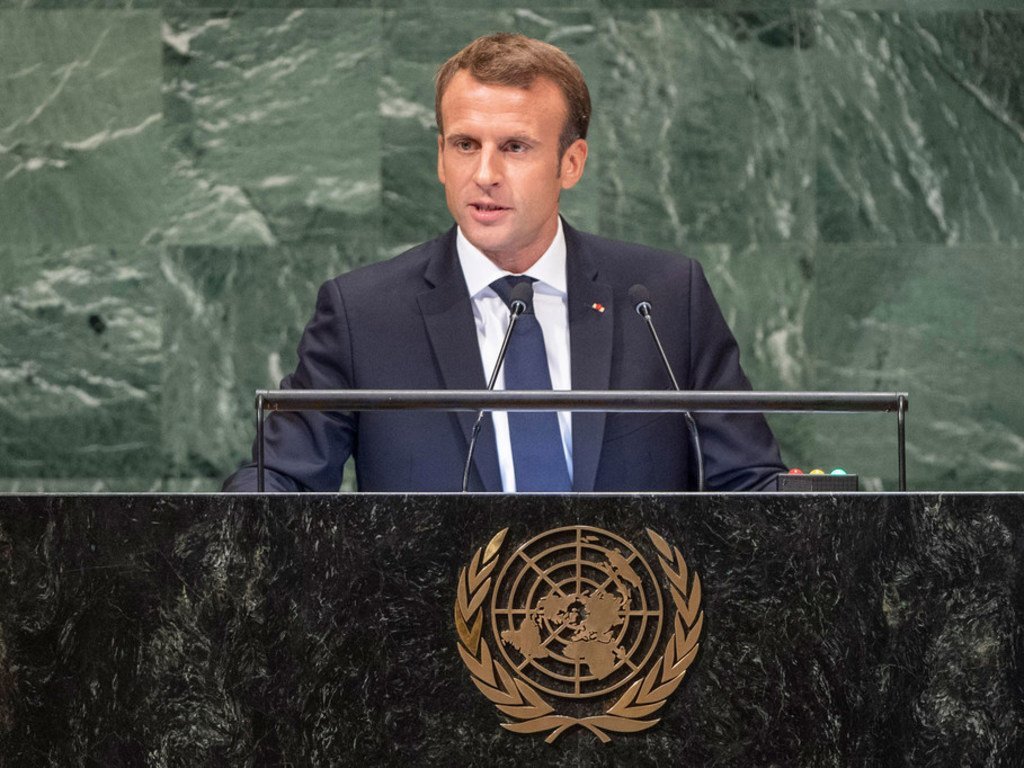
Emmanuel Macron addressing the United Nations General Assembly. For Macron, the global stage remains his strongest refuge from domestic turmoil. (Photo: UN Photo/Cia Pak)
His recent announcement that France will recognize a Palestinian state is not a policy shift but a continuation. Having attempted mediation between Putin and Zelensky, pursued European autonomy despite Washington’s disapproval, and launched a forum to sideline EU institutions, Macron clearly views himself as saving the West from itself. When blocked domestically, he accelerates abroad. In other words, he practices the classic political tactic of ‘exporting the crisis’ – shifting attention from domestic failures to the global stage where he retains control. Mockery in Paris only makes him stand taller at the UN. He clings to the international horizon, the last place he retains interpretative freedom, leadership, and legacy-building opportunities.
Israel is hardly an exception. Macron’s diplomatic hyperactivity isn’t directed solely at Jerusalem. “From launching the European Political Community to hosting global summits like the ‘New Financial Pact’ with African and Asian nations, Macron consistently positions France as an indispensable mediator. Typically, only the headlines remain. But the headline is exactly the point: it reverberates in the Paris evening news, reinforcing Macron’s appearance as a leader still committed to French grandeur, a notion deeply embedded in France’s collective psyche, even if the rest of the world no longer shares that perspective.
Yet while his declarations about distant conflicts often remain purely symbolic, his Palestinian announcement hits a nerve back home. It was directed at French audiences, not Palestinians. Specifically, it aimed at segments whose voices are critical at times when the streets simmer. France hosts a large Muslim community, for whom the Palestinian issue isn’t geopolitical – it’s deeply personal. For them, what happens in Gaza resonates in Lyon. In Macron’s view, this announcement is a sophisticated media message of moral sovereignty and justice – even at the cost of friction with Israel and discomfort in Washington. It isn’t a retreat; it’s calculated political logic. The same strategy that won Macron a pro-Ukrainian reputation across Europe, and distinguished him as a sharp critic of American-Israeli policy in the Gaza conflict, now positions him as a domestic leader in the eyes of key constituencies.
Macron isn’t acting blindly, but from cultural and political superiority. He’s convinced that France is the moral compass of the West, seeing clearly when others hesitate. When Europe remains silent, he speaks. That’s why he pushes Europe in directions he personally maps out, even when Brussels is hesitant. He anticipated sharp Israeli reactions – he might even have counted on them. Israeli Prime Minister Netanyahu swiftly condemned the move as ‘a reward for terrorism,’ hinting at possible annexation of parts of the West Bank in retaliation. Washington, too, expressed serious concerns, privately pressuring Macron to reconsider. In response, Macron quickly clarified that France’s recognition explicitly excludes Hamas and reaffirmed support for Israel’s security within a two-state solution. When Jerusalem condemns and Washington expresses concern, Macron feels vindicated, knowing he sparked precisely the storm he intended.
This explains why some French commentators have resurrected the phrase “Présidence à la godille” – a term describing leadership that zigzags unpredictably, without a clear compass, yet dazzles with theatrical style. Macron has become the global master of godille: he pops up in Kyiv, hops to Beirut, declares policy in New York, and delivers moral speeches in Paris.
Macron is neither puzzling nor disconnected. He recognizes his internal weakness and transforms it into strategy. He lacks a parliamentary majority but commands a podium. He has no stable coalition, but he controls the camera. It often seems that Macron’s strategic vision begins only where France ends.
He relies on France’s historical tradition of diplomatic independence, from De Gaulle to Chirac, on domestic constituencies that demand global justice, and on a French media that understands the domestic political paralysis and thus prefers stories from abroad.
Historically, Macron isn’t alone in turning outward amid internal turmoil. Jacques Chirac’s defiance against the Iraq War in 2003 and François Hollande’s leadership at the 2015 Paris Climate Accord similarly aimed to bolster their stature internationally when weakened at home.
Has he succeeded? In policy terms – no. The chances that his move will enhance peace, regional stability, or Israel’s security are negligible. The likelihood it strengthens Mahmoud Abbas’s position is minimal. But from a strategic communication, crisis management, and perception standpoint, Macron has succeeded spectacularly. He controls the narrative, differentiates himself, and forces everyone to engage. Israelis are outraged, Washington is concerned, and in Paris – they are encouraged. That’s exactly what Macron seeks.
Yet a Palestinian state won’t be established in Paris, nor will it be decided in Washington, Riyadh, or Abu Dhabi – but through direct negotiations between Jerusalem and Ramallah, with security arrangements that ensure Israel’s safety.
History won’t measure his legacy by electoral success, but by whether he set a clear direction. Macron stands on the grand stage even as the curtain descends in Paris. He speaks of two states, but lives in two entirely different ones: the idealistic world of the UN and the cynical, burning streets of Belleville. His real test won’t be persuading Netanyahu – it’ll be convincing the Parisian metro driver.
(An earlier Hebrew version of this article was originally published in Walla News. The present version has been expanded and revised by the author.)
Related Topics