Reflections on Israel and the Jewish world
Make Herzl Proud. Vote Ra’am
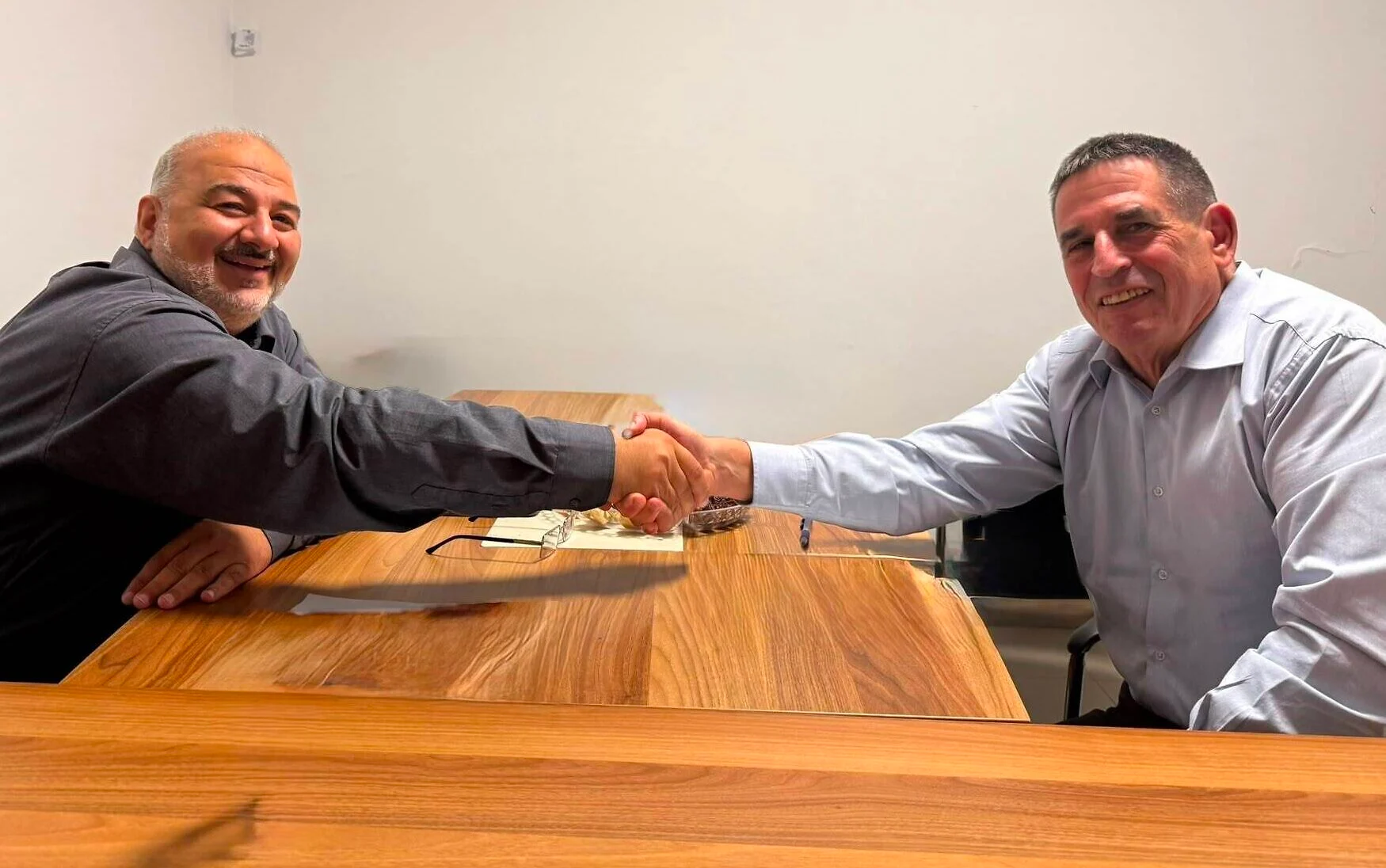
Ra'am chairman Mansour Abbas (left) and former Yesh Atid MK Yoav Segalovitz in a handout photo released by the party on August 26, 2026. (Courtesy)
This may be our last chance to secure a greater Israel.
I’m a firm believer in the Zionist dream. The original one. Herzl’s. His was a vision of a Jewish state in which “my associates and I make no distinction between one man and another” nor “ask to what race or religion a person belongs…as it is enough for us that one is a human being.” His was a country that would naturally welcome an Arab minister, which he was sure to include in his utopian novel, Altneuland.
This ideal espoused by Israel’s founding father in theory was embraced in practice by no less an ardent Zionist than Ze’ev Jabotisnky, passionate advocate of the right of the Jewish people to settle the entire Land of Israel. But this founder of Beitar and Revisionist Zionism was equally committed to the sanctity of democracy, whose aim, he declared, “is to guarantee that the minority, too, has influence on matters of state policy.”
There is no room for conjecture that these sentiments be dismissed as mere rhetoric. Had Jabotinksy had his way, they would have been enshrined in a constitution stating categorically that “the principle of equal rights for all citizens of any race, creed, language or class shall be enacted without limitation throughout all sectors of the country’s public life,” even going so far as to guarantee that “in every Cabinet where the Prime Minister is a Jew, the vice-premiership shall be offered to an Arab, and vice-versa.”
Nor is there any basis for suggesting that Jabotinsky’s call for equal rights might have been mitigated by assigning a status other than “citizen” to non-Jews living in enclaves under Israeli control. “[Even] after the formation of a Jewish majority,” he foretold, “a considerable Arab population will always remain in Palestine. If things fare badly for this group of inhabitants then things will fare badly for the entire country. The political, economic and cultural welfare of the Arabs will thus always remain one of the main conditions for the well-being of the Land of Israel… We want them to prosper both economically and culturally. We envision the regime of Jewish Palestine as follows: most of the population will be Jewish, but equal rights for all Arab citizens will not only be guaranteed, they will also be fulfilled.”
Jabotinsky’s ideological heir, Menachem Begin, was every bit as nationalistic as his mentor, yet he, too, was a passionate proponent of liberal democracy — not only prior to the establishment of the State, but also afterwards when the ideals he championed would be put to the test in real time, particularly during his tenure as Israel’s prime minister.
The examples are numerous. Among them, a speech to the Knesset urging the repeal of Emergency Regulations which enabled military jurisdiction over Arab populations under Israel’s control, and remarks to the Knesset’s Constitution, Law, and Justice Committee, in which he argued that “If we accept the Committee members’ definition of ‘emergency,’ then in all honesty… you are saying that we must reconcile ourselves… to the long-term presence of tyrannical, fascistic laws.”
These ideals of fairness and inclusion, of course, are hallowed in Israel’s Declaration of Independence, with its promise to “ensure complete equality of social and political rights to all its inhabitants irrespective of religion, race or sex” and its direct appeal “to the Arab inhabitants of the State of Israel to… participate in the upbuilding of the State on the basis of full and equal citizenship and due representation in all its provisional and permanent institutions.”
For David Ben-Gurion, upholding these principles was essential to Israel’s existence as a Jewish state. “By these will the State be judged, by the moral character it imparts to its citizens, by the human values determining its inner and outward relations, and by its fidelity, in thought and act, to the supreme behest: ‘and thou shalt love thy neighbor as thyself.’ …The Jewish State will be worthy of its name only if its systems, social and economic, political and legal, are based upon these imperishable words…: not to deprive, not to rob, not to oppress, not to hurt.”
Which brings us to election day — and, more importantly, to the day after. For the resolute majority of Israelis who will be voting for change, there is the sobering reality that the parties they are voting for who are committed to ending the rule of Binyamin Netanyahu will in all likelihood be unable to do so without embracing Ra’am, the Arab party headed by MK Mansour Abbas.
To maintain that it is illegitimate to build a ruling coalition dependent on the support of an Arab party — a mantra of almost all mainstream politicians during this latest election campaign — is the antithesis of the Zionist ideal, and a position that should be eschewed by all who claim allegiance to it. To the contrary, the inclusion of an Arab party in the government is something to be actively sought not as a necessity, but an opportunity.
Chairman Abbas has made it abundantly evident that he believes not only in coexistence but partnership — not merely in word, but in deed. He proved that by joining the 2021-2022 Bennet-Lapid government, marking the first time in Israel’s history that an Arab-led political party officially entered a ruling coalition. He did it again now by installing Jewish MK Yoav Segalovitz as his number two. https://www.timesofisrael.com/liveblog_entry/abbas-and-segalovitz-say-theyre-still-negotiating-joint-knesset-run/
By no means do I agree with every plank of the Ra’am platform, but I can say the same regarding each of the 38 parties appearing on Tuesday’s ballot. One position that does not frighten me, however, is the party’s support for the establishment of a Palestinian state.
Actually, I welcome it, for in the long run I believe that Israel’s future as a Jewish state — both pragmatically and morally — is dependent on the rise of a Palestinian one alongside it. When, how, and under what circumstances is an exceedingly complex matter for future discussion. The carnage of October 7 remains ever present. The unfounded accusations of genocide reverberate endlessly. The escalation of antisemitism everywhere is frightening. Under such circumstances, it is difficult, if not impossible, to contemplate the founding of a country in which some would continue to call for our obliteration. Still, recognizing the eventual inevitability of such an entity coming into existence, rather than taking pride in having prevented it, is vital to maintaining our anthem’s 2000-year-old hope of being a truly free people in our land.
In the meantime, to categorically reject the possibility of Arab-Jewish cooperation is to do ourselves a dangerous disservice. Doing so will only engender bitterness and foster radicalization among those who would otherwise be prepared to work together as the responsible citizens Herzl, Jabotinsky, Begin, and Ben-Gurion would have had us cultivate in the truly shared society they envisioned. That will be the Jewish state I dream of as I place Ra’am in the ballot box, counting on the party’s support in dispelling the nightmare of yet another Netanyahu-led government — and hoping against hope that the leaders of the parties demanding his ouster will be open to accepting it. That is the greater Israel we need to be voting for this week. It may be our last chance to secure it.
The writer previously served as deputy chair of The Jewish Agency executive and World Zionist Organization and was the founding director of the Herzl Museum and Educational Center. The opinions expressed here are not only his own. They are shared by hundreds of thousands of Jews in Israel and abroad who continue to struggle for the fulfillment of the Zionist dream.
Related Topics