Becoming Israel
Today, battles rage about what to call the tiny piece of land between the Jordan River and the Mediterranean Sea. The energy that people put into these debates highlights just how important names are.
This is a point Jewish tradition has been emphasizing for millennia. Names are powerful. In Genesis, the very first thing God has Adam do is name every living being. It is through giving names that humans first partner with the divine. And this work is consequential. According to the Talmud, names have a profound impact on the course of one’s life. If this seems too mystical for you, even social science research suggests that a person’s name can impact their job prospects and other important aspects of their life.
The Jewish tradition’s emphasis on the importance of names is part of why the refounders of the Jewish state put so much thought into its name once Jews reclaimed sovereignty over their ancestral homeland after more than 2,000 years. Israel was not the only choice. Other options included: Judea, Zion, and Ever. So whether you consider it the consequences of a historical choice, or you apply the mystical idea that parents receive a form of prophecy when they name their children, the decision to choose Israel has important ramifications for the Jewish state today, especially as it stands at a critical crossroads to determine its future.
So what does Israel mean?
This week’s Torah portion, Vayishlach, is the source of the name. And its origins hold invaluable lessons for Israel, and all of us who care about it, today.
Most foundationally, Israel is not something you are. It is something you become. The character who gets the name Israel is Jacob. But when he was born, the name his parents gave him was, as you might guess, Jacob.
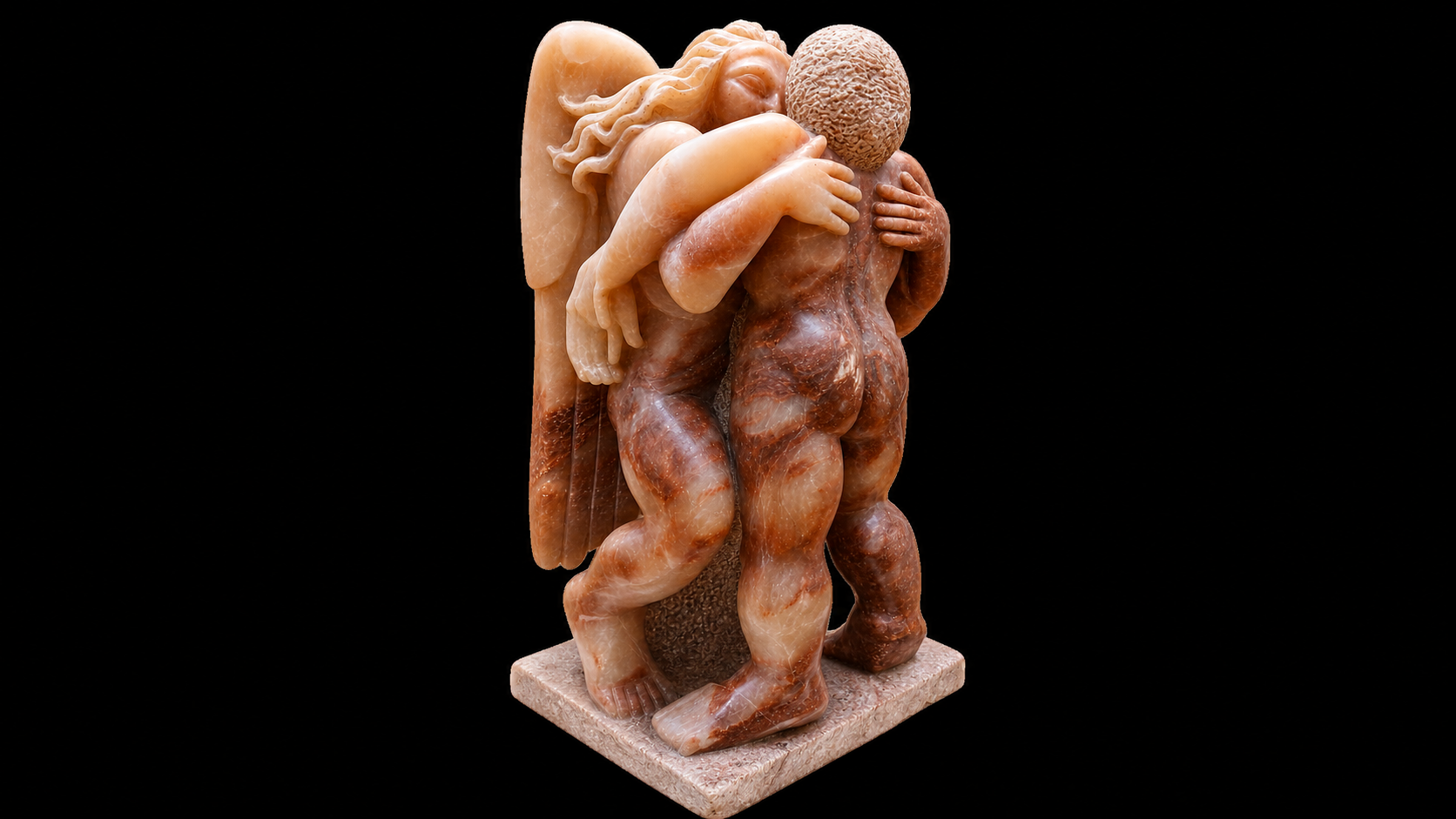
In this week’s parshah, an angel wrestles with Jacob and then gives him a new name: Israel. The angel also gives a reason for this renaming: “For you have struggled with the divine and with humans, vatuchal, and you have prevailed.”
At face value, Jacob gets this new name because of the wrestling match he just had. But it is hard to believe this is the whole story.
As we’ve seen, names are a big deal. Why would it make sense for Jacob to receive an entirely new name simply because he had an intense confrontation? To add to the question, some of the most influential interpreters of this story, like Maimonides (1138-1204) and Gersonides (1288-1344), wrote that it wasn’t a physical wrestling match, but rather a prophetic dream. From this perspective, why would Jacob’s real-life name be changed based on a dream-state encounter? And why does the angel explain the name by referring to Jacob’s struggles with both the divine and humans, when Jacob has just wrestled with only one, single being?
I want to suggest that this encounter with the angel, whether real or in a dream, was actually the culmination of an intense transformation process that Jacob had already gone through. Wrestling with the angel symbolically represented this change, and the renaming to Israel memorialized it.
So what was the transformation?
We need to look at what happens immediately before the wrestling match to understand. Following God’s request to return to his homeland, Jacob has just fled his father-in-law’s home and begun the journey back to his father, Isaac. It has been 20 years since he left on very bad terms with his brother Esau, after he had received the blessings initially intended for his older twin.
This is the context of what happens right before the encounter with the angel, and it is precisely what Jacob does in that context that holds an answer to our question. Jacob is getting ready to see Esau for the first time after he fled. He does not know if Esau wants to kill him, if his anger has subsided, or if he has something entirely else in store.
It is what Jacob does in response to this life-or-death uncertainty that holds the key. As the medieval bible commentator Rashi (1040-1105) summarized the biblical text, Jacob prepared for the encounter in three ways: he offered gifts to try to make peace with Esau; he prayed to God; and he prepared for battle with Esau. What’s more is that Jacob didn’t do any of these three half-heartedly. He was all-in on each of them.
At first glance, these three preparations may seem contradictory. If Jacob was sending peace offerings, he shouldn’t have been preparing for battle. If he was turning to God, taking such strategic, tactical steps could appear like a lack of faith. And if he was readying for war, then he would be naive to send tributes for peace.
But Jacob refused to let any one of these approaches crowd out the others. He could seek peace in earnest while preparing for war. He could place his trust in God while taking responsibility for his own fate. He could recognize the possibility that Esau had changed while taking seriously the possibility that he hadn’t.
This was not the Jacob we met 20 years earlier. Back then, he obtained his father’s blessing through deception and fled when his brother threatened revenge. Now, facing the same brother, he neither runs away nor attempts to deceive him. He takes responsibility for the situation, confronting its complexity rather than trying to escape or oversimplify it. He makes a peace offering. He prays. And he prepares for battle. All three. Fully.
It is precisely in his ability to do all these things at the same time that Jacob earned the name Israel. It was in his ability to grapple with the unknown, with the complex interrelations between his own human motivations, those of others, and the role of the divine energy that pulsates through it all, that he earned a name that meant that he had grappled with the divine and with humans.
There is something important that gets lost in the translation of the Hebrew word vatuchal, which is usually rendered as “and you have prevailed” when the angel renames Jacob. The word comes from a root that means “to be able” or “to be capable.” Jacob’s feat wasn’t in defeating the angel. An ancient midrash emphasizes that we actually don’t know who even won their match. What we do know is that Jacob was able to stay in the muck of uncertainty without giving up.
Jacob hadn’t yet met Esau. He didn’t know whether his gifts would succeed, whether his prayers would be answered, or whether he would need to fight. He had not yet prevailed over anything. But he had demonstrated that he was capable of engaging with all of it, without retreating into the simplicity of any single approach.
So what does this all mean for Israel today?
The contemporary Jewish state is divided into factions that place different emphases on Jacob’s three preparations. There are those who think the country’s future will come primarily through prayer; there are those who emphasize peace offerings; and there are those who place their greatest faith in military strength. Too often, emphasizing one comes at the expense of the others.
Each approach has something important to offer. But none, on its own, is sufficient.
Becoming Israel means recognizing that we must be prepared for all three. To pursue peace without being naive about the possibility of war. To prepare for war while zealously believing in the possibility of peace. And to recognize the role of the divine without relinquishing our own responsibility to act.
That is incredibly hard. I know because I fail to live up to it on a regular basis. It requires us to live with uncertainty, to dance with the unknown, and to stay capable of the struggle even when we do not know how it will end. But it is the only way to live up to the name that we have been striving toward for thousands of years.